
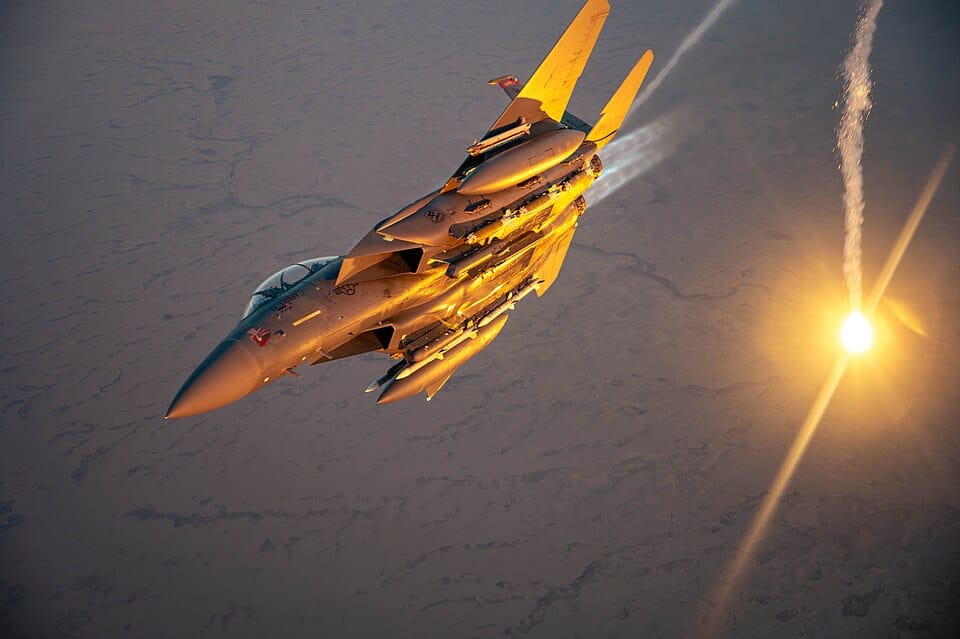
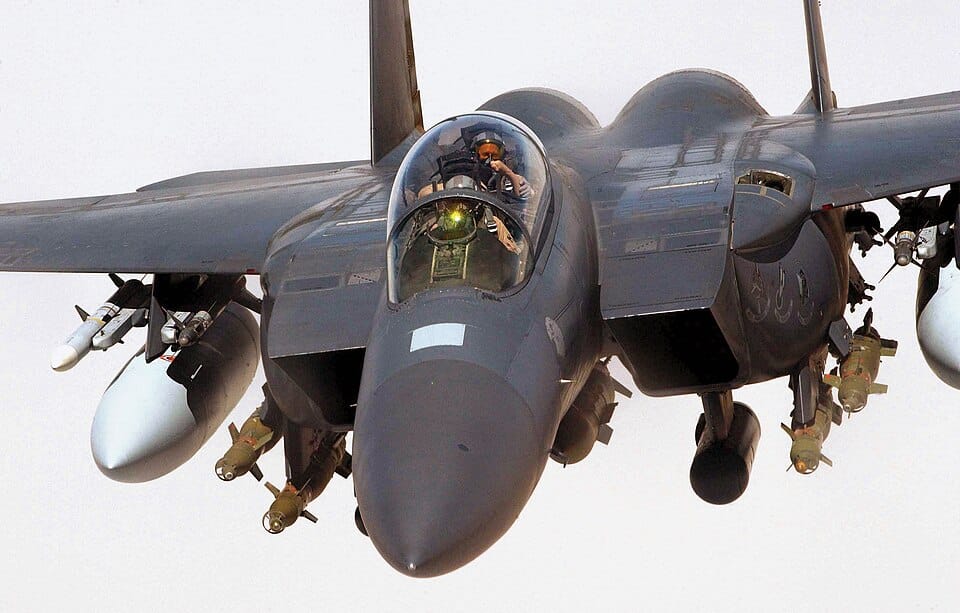
On the afternoon of April 3, somewhere over the scrubby hills of Kohgiluyeh and Boyer-Ahmad province in southwestern Iran, a shoulder-fired missile — roughly seven feet long and weighing about 40 pounds — slammed into an F-15E Strike Eagle from the 494th Fighter Squadron. The crew ejected. The jet, call sign Dude 44, tumbled into the Iranian highlands. It was the first American crewed combat aircraft lost to enemy fire in over three decades.
Now we know what killed it. On May 30, NBC News reported that U.S. intelligence officials believe the missile was Chinese-made — a man-portable air defence system (MANPADS) either recently delivered to Tehran or pulled from older stockpiles shipped during decades of quiet arms cooperation between Beijing and the Islamic Republic. The revelation reframes the entire Iran war. This is no longer just an American-Iranian conflict. A suspected Chinese weapon just downed an American jet.
Three unnamed U.S. officials told NBC the F-15E “was probably struck by a Chinese-made shoulder-launched missile.” They added that China may also have provided Iran with a YLC-8B UHF-band long-range early-warning radar capable of detecting low-observable aircraft — a system explicitly designed to spot stealth fighters.
Quick Facts
- Aircraft: F-15E Strike Eagle, call sign “Dude 44,” 494th Fighter Squadron
- Date: April 3, 2026, during Operation Epic Fury
- Weapon: Likely a Chinese-made MANPADS (shoulder-fired missile)
- Crew: Pilot rescued within hours; WSO recovered after 48-hour CSAR involving 155 aircraft
- Significance: First U.S. fighter lost to enemy fire in over 30 years; second Western jet downed by a Chinese weapon (after Indian Rafale in May 2025)
- Additional allegation: China may have provided Iran a YLC-8B radar to detect stealth aircraft
The Rescue That Became a Legend
When Dude 44 went down, the pilot was recovered within seven hours. The weapons systems officer — a colonel — was not so lucky. He ejected into the foothills of the Zagros Mountains, hiked a 7,000-foot ridgeline, and hid in a mountain crevice, limiting his emergency beacon use to avoid detection by the IRGC. For 48 hours, Iranian ground troops, U.S. special operations forces, and local nomadic tribesmen all converged on the same stretch of highlands.
The Combat Search and Rescue (CSAR) mission that followed has already entered the annals of American special operations. A total of 155 aircraft supported the extraction. A U.S. military official called it “one of the most challenging and complex missions in the history of U.S. special operations.” A Hollywood director has reportedly been tapped to make a film about it.
Beijing’s Fingerprints
Chinese-Iranian defence cooperation stretches back to the 1980s, mostly involving anti-ship cruise missiles and dual-use electronics transferred in an oil-for-weapons barter arrangement. A U.N. arms embargo briefly paused overt sales after 2006, but covert transfers continued. President Trump hinted at the Chinese connection as early as April, and the Chinese Embassy in Washington initially issued a flat denial. By May 30, their tone had shifted to something more lawyerly: “China always acts prudently and responsibly on the export of military products.”
The MANPADS itself is a relatively low-tech weapon — a heat-seeking missile launched from a tube on a soldier’s shoulder. But that is precisely the point. An F-15E flying low enough for a MANPADS engagement is an F-15E that had already been funnelled into a dangerous altitude band by Iran’s layered air defences. The MANPADS was the last link in a kill chain. The radar — the YLC-8B — may have been the first.
Iran’s Air Defence Puzzle
Iran’s air defences are a patchwork of Russian, Chinese, and indigenous systems. The Russian-supplied S-300PMU2 provides medium-range coverage. Domestically built systems — the Bavar-373, the 3rd Khordad, the Ra’ad — fill gaps at various altitudes. Then there are the exotic threats: the Majid AD-08, an optically guided short-range system mounted on civilian trucks, and the Products 378 and 379 — anti-aircraft loitering munitions that use passive optical tracking and launch from everyday vehicles, giving zero warning on a pilot’s radar warning receiver.
The combination is lethal not because any single system is world-class, but because together they create unpredictable engagement zones. An F-15E can jam or evade a radar-guided SAM. It cannot jam a heat-seeking tube on a hillside that nobody knew was there.
A Pattern Emerges
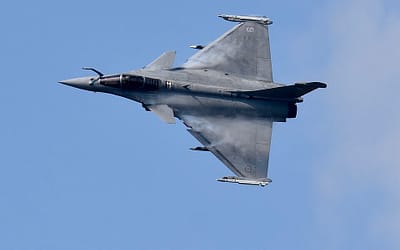
If confirmed, this makes the F-15E the second Western combat aircraft downed by a Chinese weapon in just over a year. In May 2025, a PL-15 beyond-visual-range missile — almost certainly fired from a Pakistani JF-17 — reportedly struck an Indian Rafale during the brief India-Pakistan air skirmish. That incident was dismissed by many Western analysts as an aberration. Two data points make a trend.
The strategic implication is stark. Chinese weapons are reaching America’s adversaries, and they are working. The MANPADS that killed Dude 44 may have been a legacy system from old stockpiles, or it may have been freshly delivered through the same channels that move Iranian oil to Chinese refineries. Either way, Beijing’s fingerprints are now on the wreckage of an American fighter jet.
The Trump administration has not filed a formal diplomatic protest with Beijing — a conspicuous silence that suggests the equation is more complicated than public outrage would demand. Washington needs Chinese cooperation on trade, Taiwan, and a dozen other fronts. A dead F-15E, it seems, is not yet enough to force the issue.
Sources: NBC News, The Aviationist, CBS News, Air & Space Forces Magazine, Military Times
 English
0 Comments