

French Rafale pilots operating from Šiauliai Air Base in Lithuania have been having a busy spring. Since France took command of the NATO Baltic Air Policing mission on March 31, their four Rafale B fighters have scrambled repeatedly to intercept Russian combat aircraft flying without transponders, radio contact, or filed flight plans. In a single week in April, French crews intercepted six Russian aircraft across four separate scrambles.
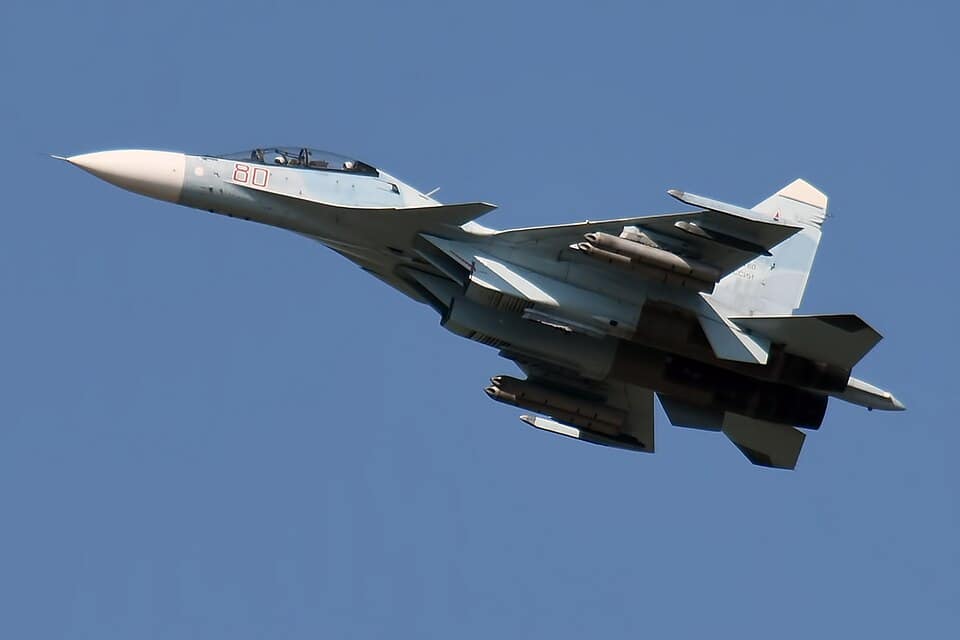
What made these intercepts different from routine posturing was what the French pilots found under the wings. Using the Thales TALIOS targeting pod — which can identify aircraft at long range without closing to visual distance — the Rafale crews photographed Kh-31 anti-radiation missiles on the Russian Su-30SMs. The Kh-31 has one purpose: destroying radar systems. Analysts say the loadout suggests the Russians were rehearsing Suppression of Enemy Air Defences (SEAD) — the opening move of a strike against NATO’s radar network.
France’s Armed Forces General Staff published footage of one of the intercepts and confirmed the alert was launched “on very short notice.” More than 100 French military personnel are deployed at Šiauliai for the rotation.
Quick Facts
- Mission: NATO Baltic Air Policing, commanded by France since March 31, 2026
- Base: Šiauliai Air Base, Lithuania
- Aircraft: 4 Rafale B fighters, 100+ personnel
- Intercepts: 4 scrambles, 6 Russian aircraft in a single April week
- Russian aircraft: Su-30SM fighters
- Key finding: Kh-31 anti-radiation missiles — weapons designed to destroy NATO radar
- Sensor: Thales TALIOS targeting pod used for long-range identification
The Kh-31 Problem
An air superiority fighter carrying air-to-air missiles is standard. An Su-30SM carrying Kh-31 anti-radiation missiles is a different proposition entirely. The Kh-31P (NATO designation AS-17 Krypton) homes in on radar emissions. It is designed to fly down the beam of a ground-based radar and destroy the antenna. NATO’s entire air defence architecture — from ground-based early-warning radars to Patriot fire-control systems — depends on these emitters.
When Russian jets fly near NATO airspace carrying these weapons, they are not simply testing reaction times. They are mapping radar positions, measuring response patterns, and rehearsing the attack profile they would use on Day One of a real conflict. Every scramble becomes an intelligence-gathering opportunity for both sides.
TALIOS: Seeing Without Being Seen
France’s secret advantage in these encounters is the Thales TALIOS targeting pod. Originally designed for precision strike missions, the pod’s high-resolution optical and infrared sensors allow Rafale crews to identify an approaching aircraft — including what it carries under its wings — at distances far beyond visual range. This means French pilots can photograph the Kh-31s without closing to a distance that would be provocative or dangerous.
The ability to identify a weapons loadout from long range changes the intelligence equation. Previous generations of interceptors had to fly alongside the target to see what it was carrying. TALIOS turns every intercept into a surveillance mission, building a database of Russian loadout patterns, weapons configurations, and operational habits.
The Baltic Chessboard
The Baltic states — Lithuania, Latvia, and Estonia — have no significant air forces of their own. NATO’s Baltic Air Policing mission, rotating between alliance members since 2004, provides their air defence. France, Germany, Spain, Italy, the UK, and others take turns operating from Šiauliai and Ämari Air Base in Estonia.
Russia tests every rotation. New crews, new aircraft, new procedures — Moscow probes each one to identify weaknesses and measure capabilities. The French deployment has been particularly active, suggesting either that Russian provocations have intensified this spring or that France is more willing than some allies to publicise what it finds.
Either way, the photographs of Kh-31s under Su-30SM wings are not reassuring reading at NATO headquarters. Routine patrols carry air-to-air missiles. SEAD rehearsals carry radar-killers. The difference matters.
Sources: Defence Blog, Army Recognition, UNITED24 Media, Military Watch Magazine, France Armed Forces General Staff
 English
0 Comments