
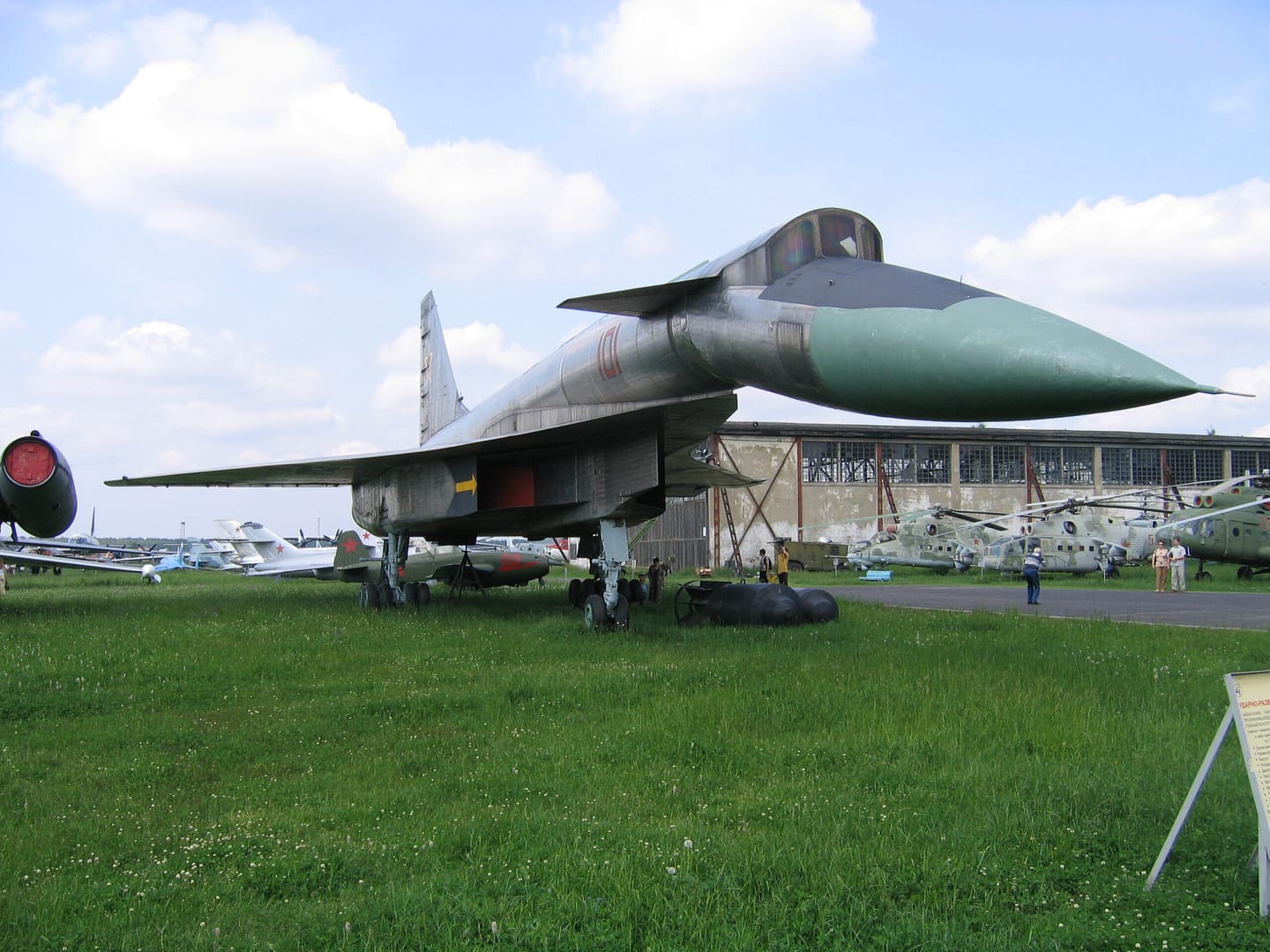
On August 22, 1972, at the Zhukovsky flight test center outside Moscow, a colossal aircraft unlike anything the Western world had ever seen rolled onto the runway. Its drooping nose — eerily similar to the Concorde’s — was raised for takeoff position. Four Kolesov RD36-41 afterburning turbojets screamed to full power. Test pilot Vladimir Ilyushin, son of the legendary aircraft designer Sergei Ilyushin, released the brakes. The Sukhoi T-4 — all 122 tonnes of titanium, high-temperature steel, and Soviet ambition — thundered down the runway and lifted into the sky. It was the first flight of what was supposed to be Russia’s answer to the XB-70 Valkyrie, a Mach 3 strategic bomber that could outrun any interceptor on Earth.
Quick Facts: Sukhoi T-4 “Sotka”
| First Flight | August 22, 1972 |
| Design Speed | Mach 3.0 (3,200 km/h / 2,000 mph) |
| Role | Strategic bomber / reconnaissance / anti-ship |
| Also Known As | Aircraft 100, Project 100, Su-100 |
| Material | Titanium and high-temperature steel |
| Max Takeoff Weight | 122 tonnes (268,960 lbs) |
| Total Flights | 10 flights, 10 hours 20 minutes total |
| Patents | Nearly 600 inventions and patents |
| Cancelled | 1974 (in favor of the Tu-160) |
The Soviet Valkyrie
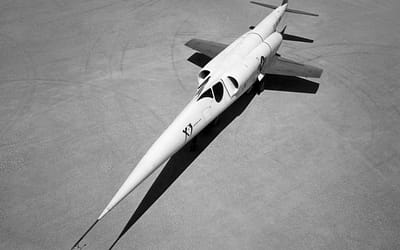
The story of the T-4 begins in 1961, when Soviet military planners grew alarmed by American development of the North American XB-70 Valkyrie — a Mach 3 strategic bomber that could fly at 70,000 feet, beyond the reach of Soviet air defenses. The response was a 1963 competition among Soviet design bureaus for a similar aircraft. Sukhoi, Tupolev, and Yakovlev all submitted proposals. Sukhoi’s design, with its projected cruise speed of 3,200 km/h (2,000 mph), won the competition after a June 1964 design review, and construction of a prototype was authorized.
But the Americans had already lost their own Valkyrie in a catastrophic mid-air collision with an F-104 Starfighter during a photo shoot in June 1966. The XB-70 program was effectively dead. The Soviets, however, pressed on. Their intelligence suggested that the United States might revive the concept, and in any case, the T-4 had evolved beyond a simple bomber into something more ambitious: a multi-role strategic platform capable of reconnaissance, anti-carrier strike, and nuclear delivery at speeds no adversary could match.
Engineering the Impossible
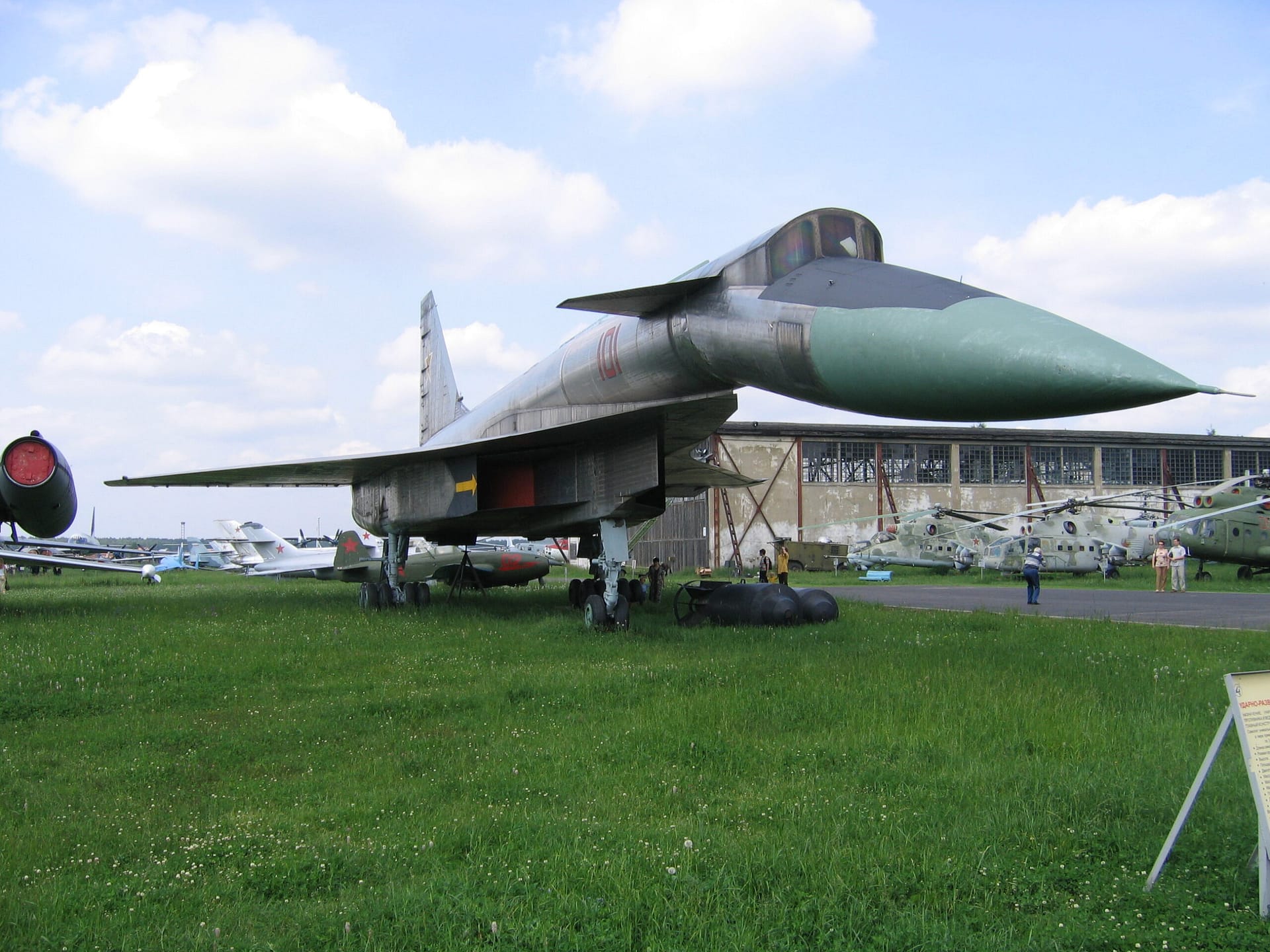
Building an aircraft that could sustain Mach 3 flight required solving problems that had never been tackled before. At those speeds, aerodynamic heating would push airframe temperatures beyond 300 degrees Celsius — far beyond the capabilities of conventional aluminum construction. Sukhoi’s engineers turned to titanium and high-temperature steel, developing entirely new manufacturing processes for welding and machining these exotic materials. The program generated nearly 600 patents and inventions.
The T-4’s design was striking. Like the Concorde, it featured a drooping nose that tilted downward during takeoff and landing to give the pilot forward visibility, then raised to a streamlined position for high-speed flight. The canard-delta configuration, with small forward control surfaces and a large delta wing, was optimized for stability at extreme speeds. Four massive Kolesov RD36-41 turbojets, each producing 16,000 kgf of thrust with afterburner, were clustered beneath the fuselage in a shared nacelle.
Ten Flights to Nowhere
The first flying prototype, designated “101,” was completed in autumn 1971 after years of delays caused by the extraordinary manufacturing challenges. Vladimir Ilyushin was chosen as test pilot — a fitting choice, given his unmatched experience with high-performance Soviet aircraft. The maiden flight on August 22, 1972, lasted 40 minutes and was conducted with the landing gear down as a precaution. The only problem encountered was heating of the aft airframe section due to engine exhaust.
Over the next year and a half, Ilyushin would fly the T-4 a total of ten times, accumulating 10 hours and 20 minutes in the air. He reached a maximum speed of Mach 1.36 at 12,000 meters — impressive, but a long way from the design speed of Mach 3. The aircraft handled well and showed genuine promise, but it never had the chance to demonstrate its full capabilities. The last flight took place on January 22, 1974.
The Tupolev Conspiracy
What killed the T-4 was not engineering failure but political maneuvering. Andrei Tupolev, the most powerful figure in Soviet aviation, had lost the original 1963 competition to Sukhoi — a humiliation he never forgave. Throughout the T-4’s development, Tupolev lobbied relentlessly against the program, arguing that his own Tu-160 design (a variable-geometry swing-wing bomber that would eventually enter service as the “Blackjack”) was a superior and less risky investment.
In 1974, the Soviet Ministry of Aviation Industry ordered the T-4 program suspended. By 1975, all work had been terminated. A second prototype, “102,” had been partially completed, while additional airframes “103” through “106” existed at various stages of planning. All were scrapped. Pavel Sukhoi, who had invested a decade of his bureau’s resources into the aircraft, was reportedly devastated. He died in 1975, just months after the final cancellation.
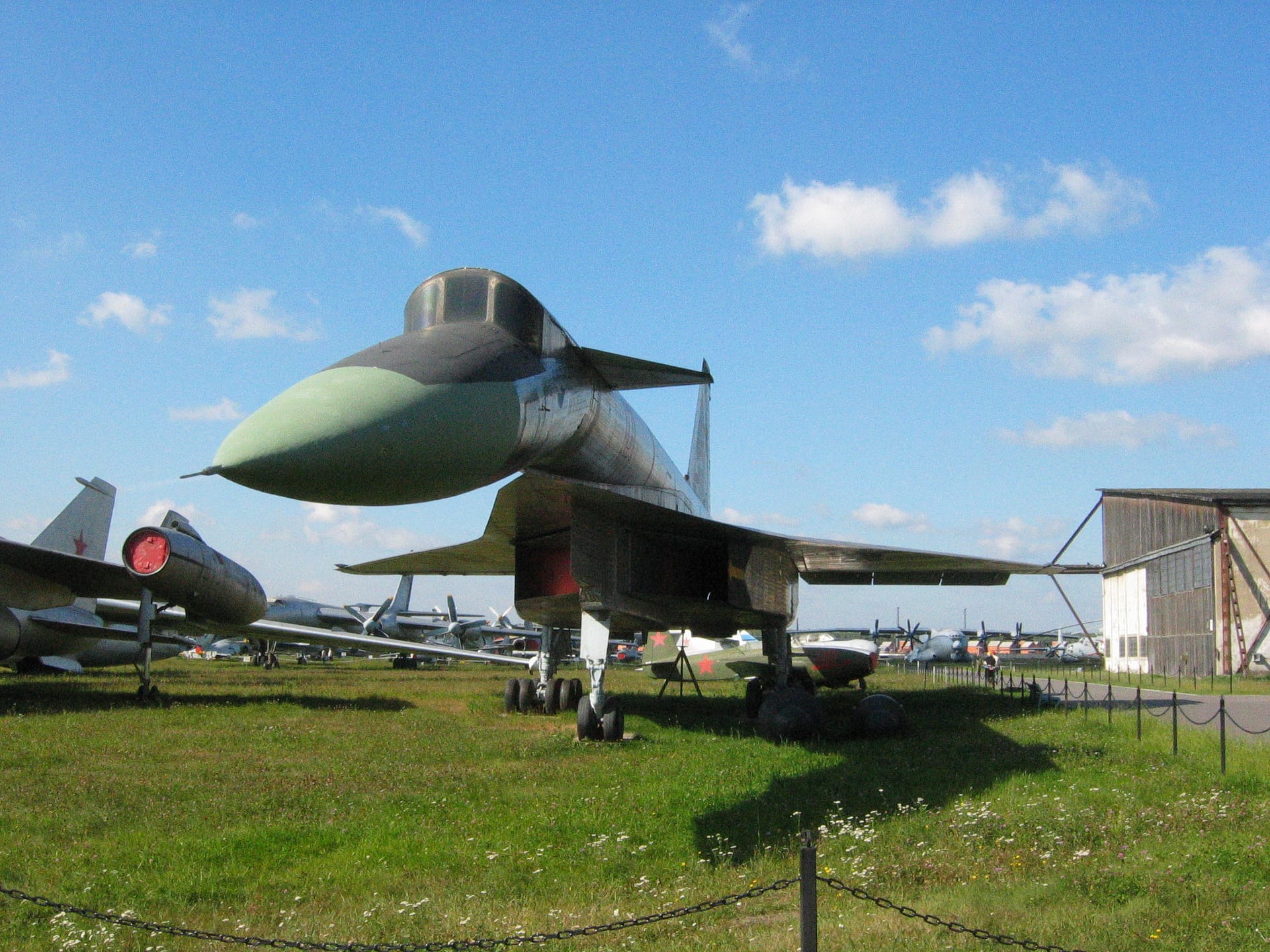
Today, the sole surviving T-4 — aircraft 101 — sits in the open air at the Central Air Force Museum in Monino, near Moscow. Its titanium skin has weathered decades of Russian winters, but the aircraft remains remarkably intact, a monument to what might have been the Soviet Union’s most ambitious aerospace achievement. Whether the T-4 could have matched the XB-70’s performance remains one of Cold War aviation’s most tantalizing questions.


 English
0 Comments