
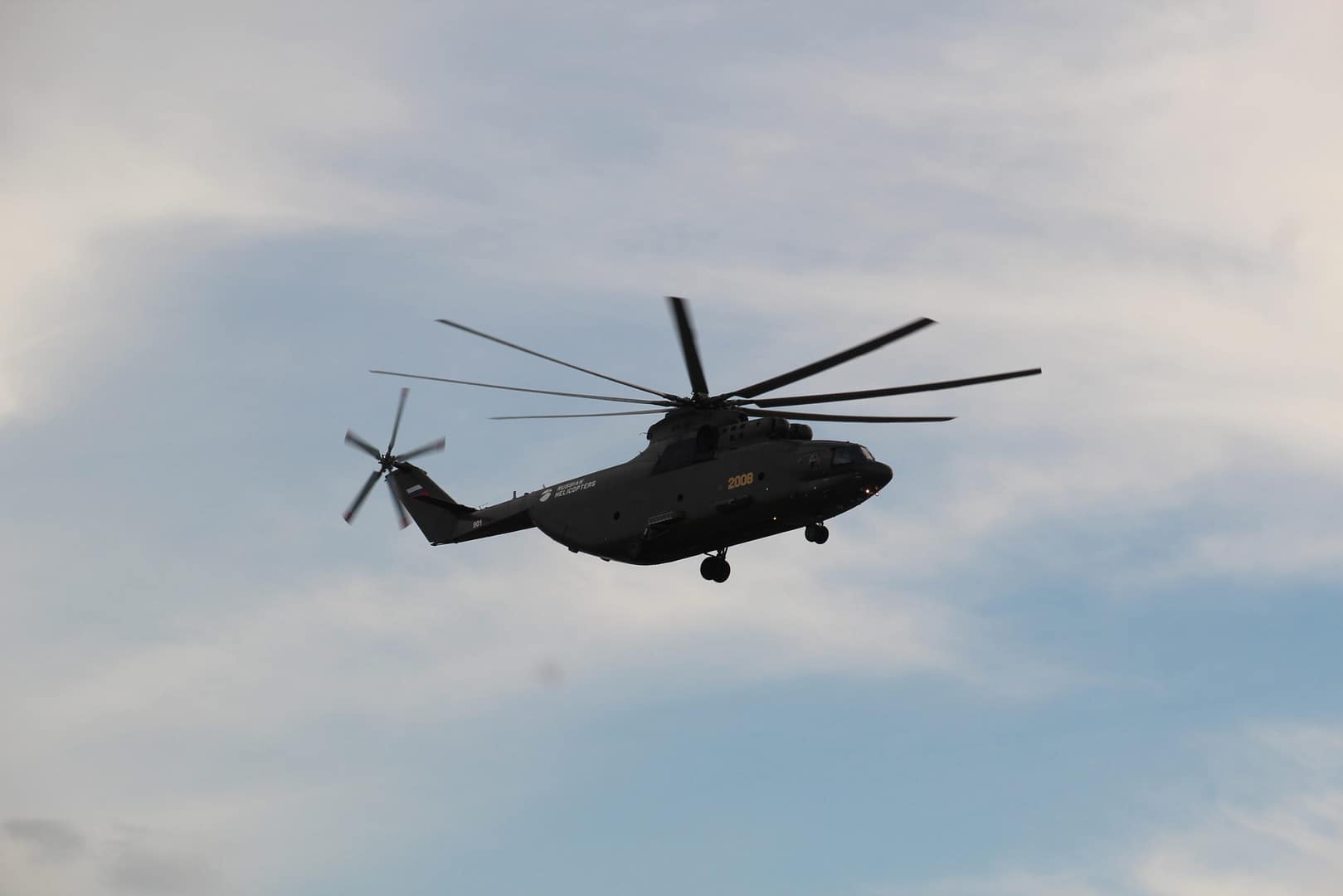
When you hear the name Samsung, you think of smartphones, televisions, memory chips, and maybe washing machines. You probably do not think of the world's largest production helicopter — a 56-tonne Soviet-designed behemoth with an eight-blade rotor spanning 32 meters, capable of carrying 20 tonnes of cargo slung beneath its belly. And yet, in 1997, Samsung took delivery of a Mil Mi-26 heavy-lift helicopter and put it to work in South Korea.
This is the story of one of the most unexpected intersections in aviation history: a South Korean electronics conglomerate, a Cold War-era Russian helicopter, and the massive construction projects that brought them together.
Quick Facts: Mil Mi-26 "Halo"
- Role: Heavy-lift transport helicopter
- Manufacturer: Mil Moscow Helicopter Plant (now Russian Helicopters)
- First flight: December 14, 1977
- Main rotor diameter: 32.0 m (105 ft)
- Length (rotors turning): 40.0 m (131 ft)
- Empty weight: 28,200 kg (62,170 lb)
- Max takeoff weight: 56,000 kg (123,459 lb)
- Internal payload: 20,000 kg (44,000 lb)
- Sling load capacity: 20,000 kg (44,000 lb)
- Engines: 2 x Lotarev D-136 turboshafts, 11,400 shp each
- Max speed: 295 km/h (183 mph)
- Range: 1,952 km (1,213 mi)
Samsung: Not Just Smartphones
Samsung is one of the world's largest conglomerates — a chaebol that touches virtually every sector of the Korean economy. Most Westerners know Samsung Electronics, but the Samsung Group has built ships, managed hotels, sold life insurance, and — crucially for this story — manufactured aircraft. Samsung Aerospace was established in 1977 (originally as Samsung Precision), changed its name to Samsung Aerospace Co., Ltd. in February 1987, and quickly became a significant player in South Korea's growing defense and aviation industry.
By the 1990s, Samsung Aerospace was building helicopter components, had co-developed the Bell 427 light helicopter with Bell Helicopter Textron, and was license-building the T700 turboshaft engines that powered the UH-60P Black Hawks assembled in Korea for the military. But Samsung had ambitions beyond assembly and co-production. They wanted heavy-lift capability — the kind that could transform construction, firefighting, and industrial logistics in mountainous South Korea.
Enter the Mi-26: The Biggest Helicopter on Earth
The Mil Mi-26 is not just large — it is in a category of its own. With a maximum takeoff weight of 56,000 kg and a cargo capacity of 20 tonnes (either internally or as a slung load), it dwarfs every other helicopter in production. Its main rotor has eight blades spanning 32 meters — wider than the wingspan of a Boeing 737. Its cargo hold is roughly the same dimensions as the fuselage of a C-130 Hercules transport aircraft. Two Lotarev D-136 turboshaft engines produce a combined 22,800 shaft horsepower.
During its test program the Mi-26 set a string of world records, including climbing to an altitude of 2,000 meters at a total takeoff mass of 56,768 kilograms — a mark for helicopters that still stands.
The Mi-26 has been used to airlift other helicopters as slung loads — including CH-47 Chinooks, UH-60 Black Hawks, and damaged Mi-24 Hinds. It has carried armoured vehicles, construction equipment, and even commercial airliners. It is, in every measurable way, the undisputed champion of vertical heavy lift.
Samsung's Giant Arrives
On September 13, 1997, an Mi-26TS — the export variant designed for civilian operations — was delivered to Samsung Aerospace Industries in South Korea. The helicopter came equipped with a Twin Bambi Bucket fire-suppressant system, giving it a dual role: heavy-lift transport for the construction industry and aerial firefighting platform for Korea's mountainous, fire-prone terrain.
Samsung put the Mi-26 to work immediately. In mountainous South Korea, where road access to remote construction sites was often impossible, the helicopter's ability to sling-load 20-tonne payloads was transformative. It transported high-tension electrical pylons to mountaintop positions, carried massive antenna arrays to communication towers, and moved heavy construction materials to sites that would have otherwise required months of road building. A remarkable photograph from 1999 shows Samsung's Mi-26 transporting 15 tonnes of pine trees during the construction of the National Debt Redemption Memorial Park.
Samsung also obtained sales rights for the Mi-26 in Korea and Southeast Asia, hoping to find other operators for the massive helicopter. But the timing was catastrophic: the 1997 Asian financial crisis devastated South Korea's economy, and demand for expensive heavy-lift helicopter services collapsed.
The End of Samsung Aerospace
The financial crisis reshaped South Korea's entire industrial landscape. In 1999, at the government's urging, Samsung Aerospace's aircraft division was merged with the aerospace operations of Daewoo Heavy Industries and Hyundai Space and Aircraft to form Korea Aerospace Industries (KAI) — the unified national champion for aerospace and defense. Samsung Aerospace itself was renamed Samsung Techwin in March 2000 (and would later be sold to Hanwha Corporation in 2014, becoming today's Hanwha Aerospace).
The Mi-26, meanwhile, never found additional Korean buyers. Samsung failed to sell a single additional airframe in the Korean or Southeast Asian markets. On May 24, 2004, the helicopter was sold back to Russia, ending Samsung's brief chapter as an operator of the world's largest helicopter.
A Footnote That Tells a Bigger Story
Samsung's Mi-26 adventure lasted barely seven years — a footnote in the conglomerate's vast history. But it tells a fascinating story about the ambition of South Korean industry in the 1990s, the versatility of Cold War-era Soviet engineering, and the way financial crises can reshape entire sectors overnight. It's also a reminder that Samsung — the company that puts a phone in your pocket — once put the world's largest helicopter in the sky.
Today, the Mi-26 remains in production and in service around the world, continuing to do what no other helicopter can. And Samsung's aerospace DNA lives on through Hanwha Aerospace and KAI, which together form the backbone of South Korea's growing defense and space industry. The giant helicopter is gone, but the ambition that brought it to Korea never left.
Related Questions
What is the Mil Mi-26?
The Mil Mi-26 'Halo' is a Soviet-designed heavy-lift helicopter and the largest helicopter ever to enter series production. First flown on 14 December 1977, it can carry 20 tonnes internally or as a sling load — a class of vertical lift no other production helicopter can match.
How much can the Mi-26 lift?
The Mi-26 can lift 20,000 kg — about 20 tonnes — either inside its cargo hold or slung beneath it, with a maximum takeoff weight of 56,000 kg. Its hold is roughly the size of a C-130 Hercules fuselage, letting it carry vehicles, machinery and even other aircraft as slung loads.
When did the Mi-26 first fly?
The Mi-26 made its first flight on 14 December 1977. During testing it set several world records, including climbing to 2,000 metres at a takeoff mass of 56,768 kg — a helicopter mark that still stands today.
Did Samsung once own the world's largest helicopter?
Yes. On 13 September 1997 an Mi-26TS, the civilian export version, was delivered to Samsung Aerospace Industries in South Korea. Fitted with a twin Bambi Bucket system, it served both as a heavy-lift transport for construction and as an aerial firefighter for Korea's mountainous, fire-prone terrain.
What was Samsung Aerospace?
Samsung Aerospace was the aviation arm of the Samsung Group, established in 1977 as Samsung Precision and renamed Samsung Aerospace Co., Ltd. in February 1987. By the 1990s it built helicopter components, co-developed the Bell 427 and license-built engines, becoming a major player in South Korea's defence industry.
What engines power the Mi-26?
The Mi-26 is driven by two Lotarev D-136 turboshaft engines producing 11,400 shaft horsepower each, for a combined 22,800 shp. That immense power turns an eight-blade main rotor 32 metres across — wider than the wingspan of a Boeing 737.
Can a helicopter lift an airliner?
Remarkably, yes. The Mi-26 has airlifted other helicopters such as Chinooks and Black Hawks and even small airliners as slung loads. For more on extreme rotorcraft, see the helicopter with the biggest rotor ever built and the origins of the AH-1 Cobra gunship.
0 Comments