
Quick Facts
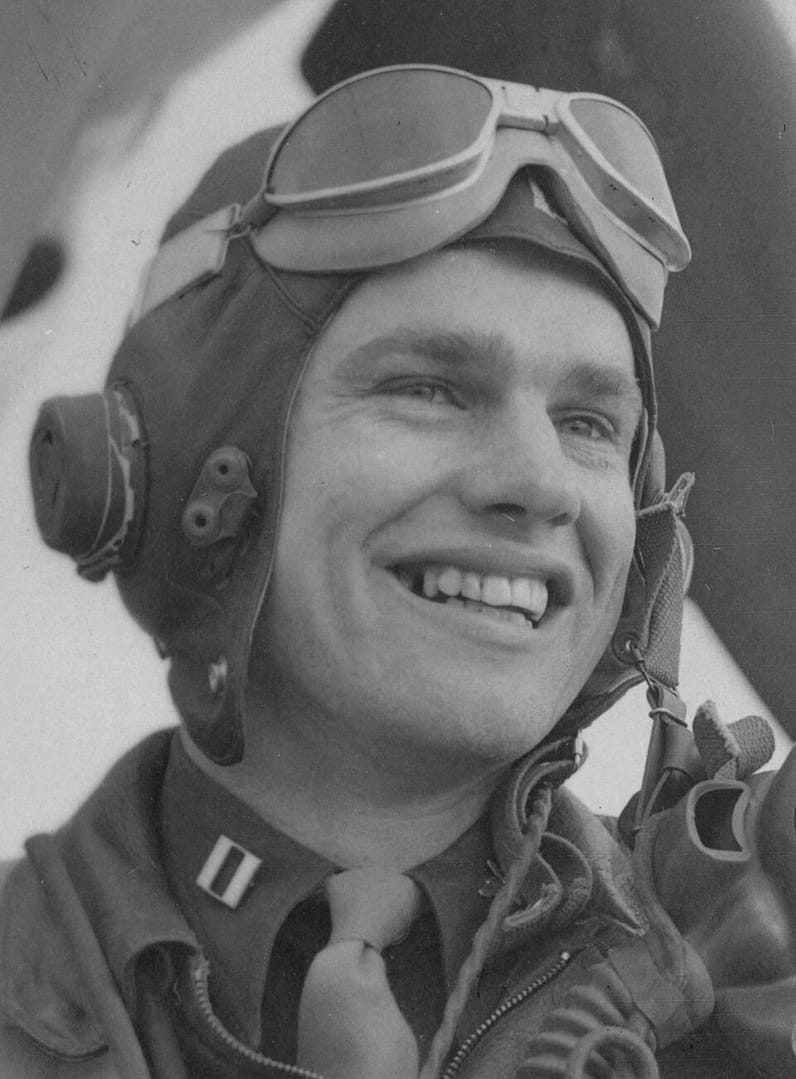
- Who: Col. Clarence E. "Bud" Anderson (1922–2024)
- Record: 16¼ aerial victories — triple ace, 357th Fighter Group
- Aircraft: P-51 Mustang "Old Crow"
- Missions: 116 combat missions, never hit by enemy fire
- Ceremony: March 30, 2026, Arlington National Cemetery, Section 38

Four F-35 Lightning IIs thundered over Arlington National Cemetery in tight formation. Seconds later, four P-51 Mustangs followed — two of them painted in the olive drab and red trim of "Old Crow." The sound of Merlin engines rolled across the headstones like a message from 1944. Below, a horse-drawn caisson carried the urn of Colonel Clarence E. "Bud" Anderson to his final resting place in Section 38.
America's last surviving World War II triple ace came home on March 30, 2026. More than 100 people gathered to say goodbye — generals, fellow veterans, aviation historians, and ordinary citizens who understood what they were witnessing: the closing of a chapter in aerial combat that will never be written again.
Anderson died on May 17, 2024, at the age of 102. He was laid to rest beside his wife of nearly 70 years, Eleanor "Ellie" Cosby, who preceded him in 2015. The ceremony featured full military honours: a firing team from the Air Force fired three volleys, a bugler sounded Taps, and a lone bagpiper closed with "Amazing Grace."
The Kid from Newcastle, California
Born on January 13, 1922, in the small town of Newcastle, California, Anderson grew up watching barnstormers land in nearby fields. He enlisted after Pearl Harbor and earned his wings in 1943, shipping out to England with the 363rd Fighter Squadron of the 357th Fighter Group — a unit that would become one of the most decorated in the Eighth Air Force.
His assigned aircraft was a P-51B Mustang he named "Old Crow," after his favourite bourbon. It was in that cockpit that a small-town kid from the Sierra Nevada foothills became one of the deadliest fighter pilots of the war.

116 Missions, Never Hit
Anderson's combat record borders on the unbelievable. Over two tours escorting heavy bombers deep into occupied Europe, he flew 116 missions and logged roughly 480 combat hours. He shot down 16¼ enemy aircraft — the quarter-kill shared with another pilot — earning the rare distinction of triple ace. Only a handful of American pilots in the entire war achieved that status.
But the statistic that defines Anderson isn't the kill count. It's this: across all 116 missions, neither his first P-51B nor his second P-51D — both named Old Crow — was ever struck by enemy fire. He never had to turn back for mechanical failure. He never aborted a mission. In a theatre where the average fighter pilot's life expectancy could be measured in weeks, Anderson flew through it all untouched.
His opponents included some of the Luftwaffe's best. He tangled with Me 262 jet fighters, duelled with seasoned German aces, and flew long-range escort missions that pushed the Mustang to its fuel limits. Through it all, Old Crow brought him home.
After the War
Anderson didn't stop flying after VE Day. He became a test pilot, wringing out jets at Edwards Air Force Base during the golden age of experimental aviation. He flew over 100 different types of aircraft in his career and logged more than 7,000 flight hours. He was decorated 25 times before retiring as a colonel in March 1972.
In retirement, he became aviation's most beloved ambassador. His memoir, To Fly and Fight, is considered one of the finest first-person accounts of air combat ever written. He appeared at airshows around the world, signed autographs for hours, and never tired of telling young people what it felt like to fly a Mustang at 400 miles an hour with a Messerschmitt on your tail.
A Final Escort
The flyover at Arlington was a fitting farewell. The F-35s represented the future of American air power — stealth, sensors, and digital warfare. The P-51s represented its soul. Anderson bridged both worlds. He started in a propeller-driven fighter with a gunsight and ended his career testing jets that broke the sound barrier.
When the last Mustang passed overhead and the Merlins faded into silence, something irreplaceable went with it. There are no more WWII triple aces. Bud Anderson was the last — and Arlington is exactly where he belongs.
Sources: U.S. Air Force, Arlington National Cemetery, DVIDS, Stars and Stripes, National Air and Space Museum
Related Questions
Who was Bud Anderson?
Colonel Clarence E. "Bud" Anderson (1922–2024) was a celebrated American World War II fighter ace credited with 16¼ aerial victories, making him a triple ace. Flying the P-51 Mustang "Old Crow" with the 357th Fighter Group, he completed 116 combat missions and was never hit by enemy fire.
What aircraft did Bud Anderson fly?
Anderson flew a P-51 Mustang he named "Old Crow," after his favourite bourbon. He served with the 363rd Fighter Squadron of the 357th Fighter Group, one of the most decorated units in the Eighth Air Force, escorting bombers deep into Europe.
How many aerial victories did Bud Anderson have?
Anderson was credited with 16¼ aerial victories, qualifying him as a triple ace. He achieved this across 116 combat missions in 1944 without ever being hit by enemy fire, a record of skill and luck that few pilots matched.
When did Bud Anderson die?
Bud Anderson died on May 17, 2024, at age 102, reportedly America's last surviving triple ace of World War II. He was interred with full military honours at Arlington National Cemetery on March 30, 2026, with a flyover of F-35 Lightning IIs and P-51 Mustangs.
What is a triple ace?
A triple ace is a fighter pilot credited with at least 15 aerial victories, three times the five kills needed to become an ace. Anderson's 16¼ victories placed him among an elite group profiled in our series on history's greatest flying aces.
0 Comments