
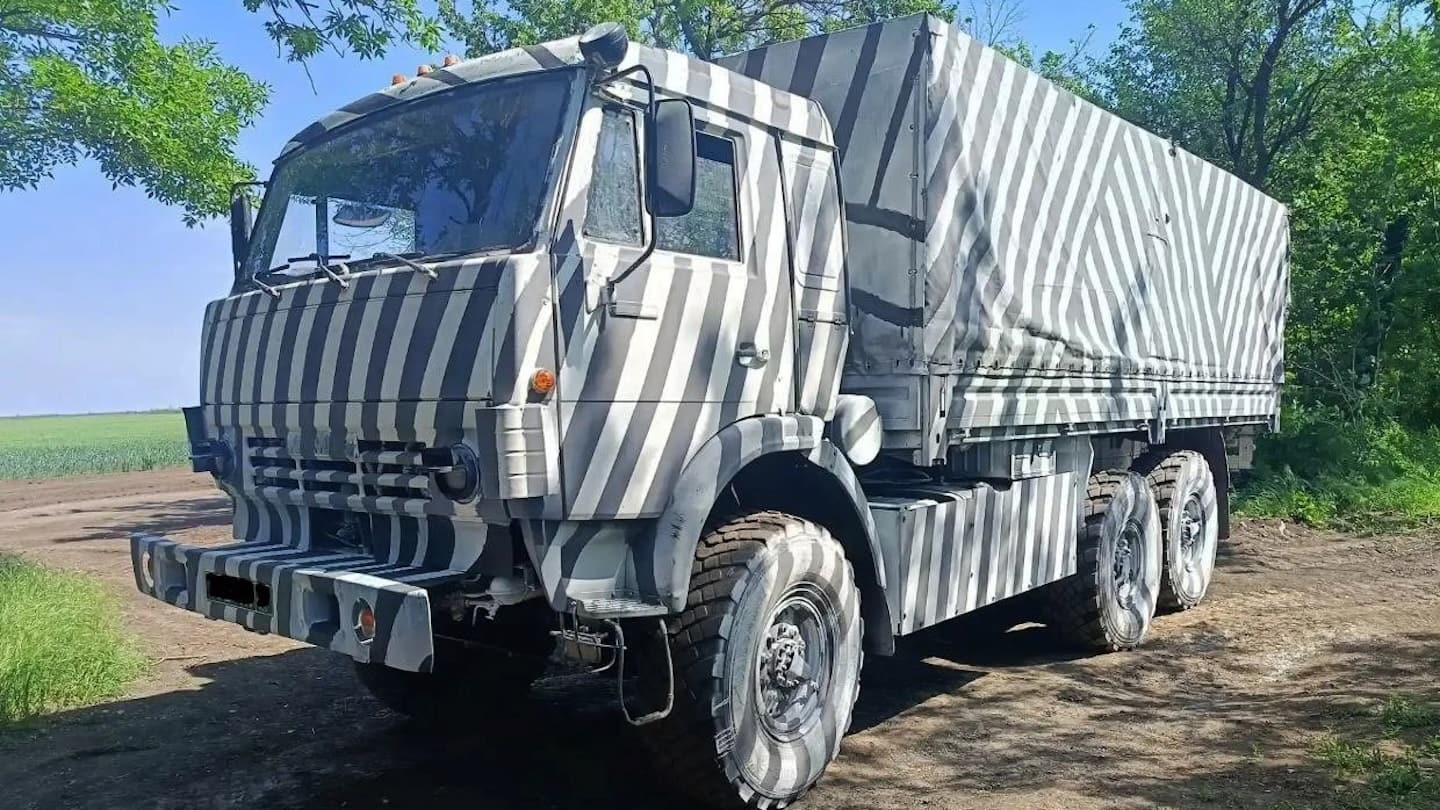
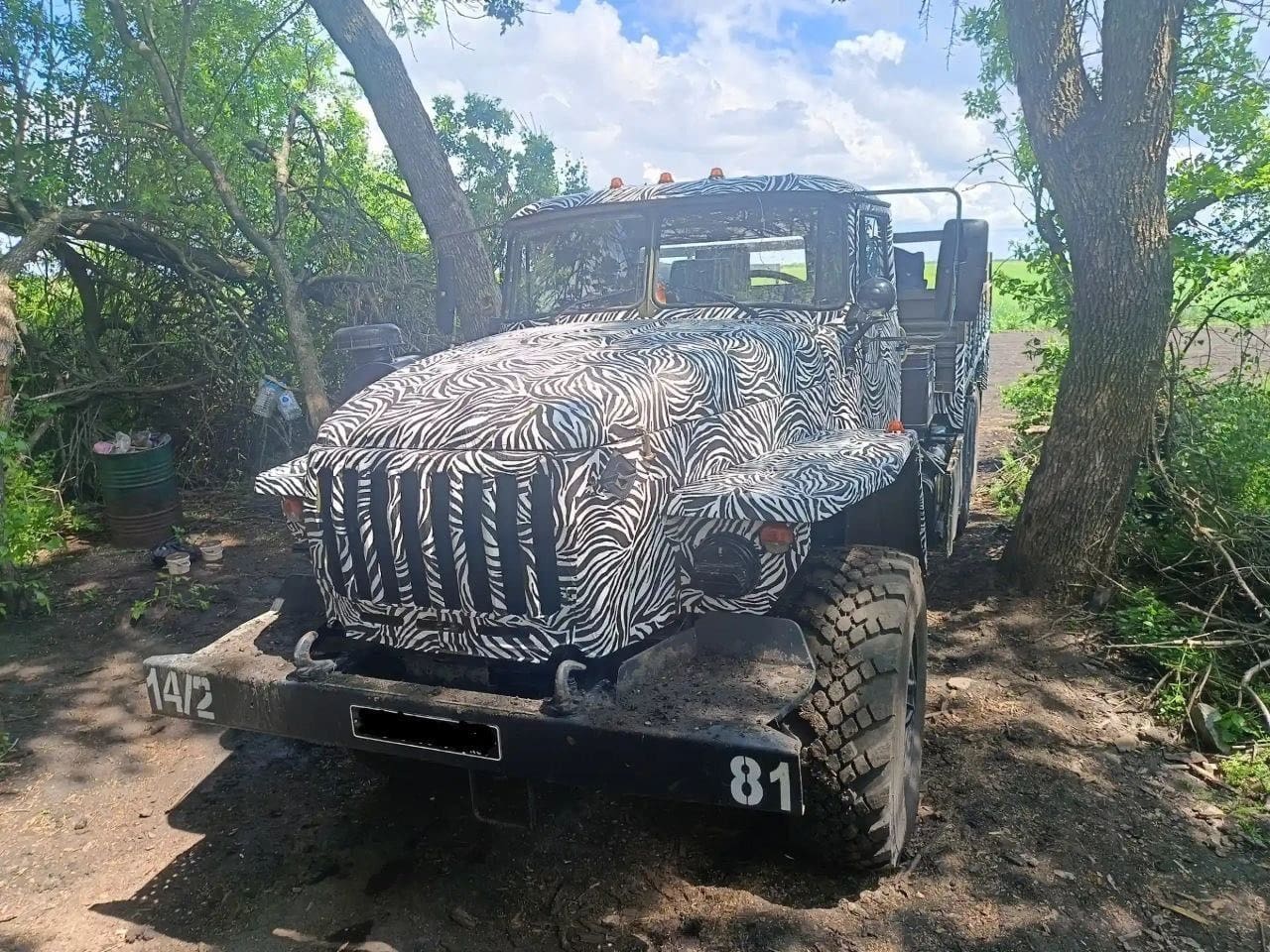
Somewhere behind the front lines in occupied Ukraine, Russian supply trucks have started looking like escaped zoo animals. Photos that surfaced on social media in early June show Ural and KamAZ heavy trucks painted nose to tail — wheels and tires included — in bold black-and-white stripes, while others wear a swirling, leaf-like pattern that looks more like a Rorschach test than military camouflage.
The paint jobs make the trucks dramatically more visible to the human eye. That's the point. The intended audience isn't human at all. Ukraine has ramped up a “middle strike” campaign using AI-assisted kamikaze drones to hunt Russian logistics up to 200 kilometres behind the front, and these vivid patterns are an attempt to confuse the machine-vision algorithms doing the hunting.
If the idea looks familiar, it should. The world's navies tried exactly this trick more than a century ago — and the story of why it worked then explains why it might (briefly) work now.
Quick Facts
- What: Russian Ural and KamAZ trucks repainted in high-contrast ‘dazzle’ patterns
- Two schemes: zebra-style straight stripes and an organic, leaf-like swirl
- Target: machine-vision targeting on AI-enabled Ukrainian strike drones
- The original: dazzle camouflage, devised in 1917 by British war artist Norman Wilkinson
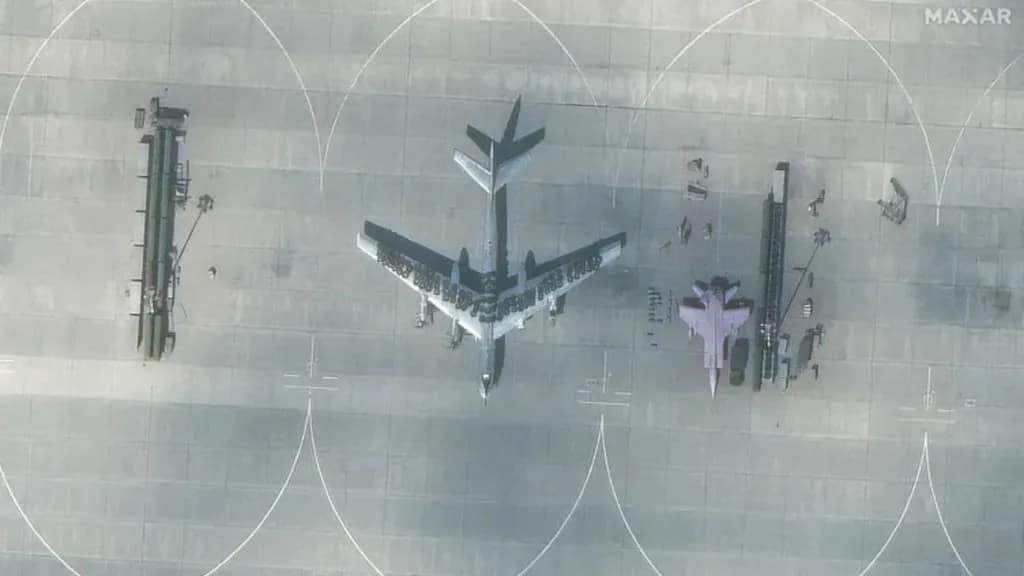
- Precedent: Russia put car tires on its Tu-95 bombers in 2023 to defeat image-matching seekers
- Weakness: thermal sensors don't care about paint — and AI can be retrained
The Razzle-Dazzle of 1917
In the spring of 1917, German U-boats were sinking British merchant ships faster than shipyards could replace them. Hiding a ship on the open ocean is impossible — smoke, wake and silhouette give it away at any distance. A British marine painter and naval officer named Norman Wilkinson proposed something heretical: stop trying to hide the ship, and instead make it impossible to aim at.
His “dazzle” schemes covered hulls in violently contrasting geometric blocks — black, white, blues and greens slashing across the superstructure at conflicting angles. A U-boat commander peering through a periscope had only seconds to estimate a target's range, heading and speed before firing a torpedo at where the ship would be. Dazzle broke up the visual cues that made that mental geometry possible. The bow looked like the stern; one ship read as two; a vessel steaming left appeared to head right. By the end of the war, thousands of Allied ships wore dazzle, and the concept returned for a second tour in World War II.
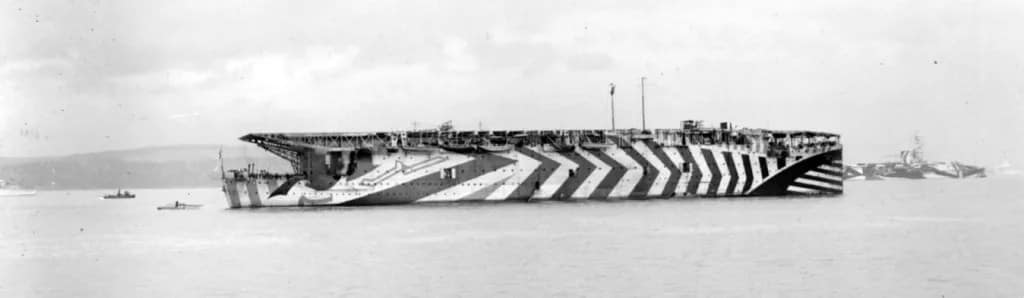
The genius of dazzle was that it attacked the observer, not the line of sight. It exploited the assumptions a human brain makes when interpreting a shape. Which is exactly why it's back — because today's battlefield observers also make assumptions. They've just been trained on datasets instead of in gunnery school.
Fooling a Brain Made of Math
Modern Ukrainian strike drones increasingly carry machine-vision systems: onboard algorithms trained on enormous libraries of labelled images to recognise, classify and track targets — even when jamming severs the radio link to a human operator. Show the algorithm enough photos of dark-green 6x6 military trucks, and it learns what a Russian truck looks like with brutal efficiency.
Paint the truck like a zebra, and it no longer matches anything in the training data. In machine-learning jargon, the target has been pushed “out of distribution” — the classifier's confidence collapses, and the drone may never flag the vehicle as a target during its autonomous search phase at all.
There's a catch, and it's a big one. The same adversarial logic cuts both ways.
Russia Has Played This Game Before
This isn't Moscow's first experiment in confusing machine eyes. In 2023, satellite images revealed Tu-95 strategic bombers at Engels-2 Air Base with car tires laid across their wings and fuselage — a move that baffled observers until U.S. officials confirmed it was aimed at image-matching seekers on Ukrainian cruise missiles and drones. As Schuyler Moore, then U.S. Central Command's chief technology officer, explained in 2024: put tires on top of the wings, and “all of a sudden, a lot of computer vision models have difficulty identifying that that's a plane.”
Russian warships in Crimea got silhouette-breaking paint. Decoy aircraft outlines were painted on empty ramps. And both sides have escalated through cope cages, turtle tanks, anti-drone nets and log armour. The dazzle trucks are simply the newest move in a four-year improvisation arms race — and one of the cheapest.
Does It Actually Work?
Three sober caveats. First, thermal sensors don't care about paint: an infrared camera sees a warm engine, stripes or no stripes. Second, a dazzle truck is wildly conspicuous to any human who reviews the drone's video feed — and most Ukrainian systems still keep a person in the loop for the kill decision. Third, and most deliciously ironic: once these patterns become known, a drone could be trained to hunt them specifically. Nothing else on the battlefield looks like a zebra. A truck that screams “I am hiding from your AI” has, in a sense, already confessed.
Norman Wilkinson's ships bought safety measured in seconds of a U-boat captain's confusion. Russia's zebra trucks are buying time measured in software update cycles. The century-old idea still works — it just expires much, much faster now.
For the full story of how the original dazzle ships came to be, the short documentary below is the best primer on the strangest camouflage in naval history.
Sources: The War Zone, RFE/RL, Defense Express, Euromaidan Press, Militarnyi
Related Questions
Why is Russia painting its trucks in zebra stripes?
Russia is painting supply trucks in bold black-and-white stripes and swirling patterns to confuse the machine-vision algorithms on AI-assisted Ukrainian attack drones. The high-contrast schemes make the trucks more visible to humans but aim to disrupt how targeting software recognises a vehicle’s shape, countering Ukraine’s deep-strike drone campaign.
What is dazzle camouflage?
Dazzle camouflage is a high-contrast patterning that, instead of hiding an object, makes it hard to judge its shape, speed, and direction. It was devised in 1917 by British war artist Norman Wilkinson to protect merchant ships from German U-boats, whose crews struggled to aim torpedoes at the confusingly painted hulls.
Does dazzle camouflage work against AI drones?
Dazzle paint can briefly confuse the image-recognition software guiding AI-enabled drones, but it has clear limits. Thermal sensors ignore paint entirely, and machine-vision models can be retrained on the new patterns. It is best seen as a cheap, temporary countermeasure rather than a lasting solution.
Has Russia tried tricks like this before?
Yes. In 2023 Russia placed car tyres on the wings and fuselages of its Tu-95 bombers, apparently to defeat the image-matching seekers on Ukrainian drones and missiles by altering the aircraft’s recognisable outline. The painted trucks continue the same low-cost approach to confusing automated targeting.
Who invented dazzle camouflage?
Dazzle camouflage was invented by Norman Wilkinson, a British marine painter and naval officer, in 1917. Rather than trying to hide ships, his schemes used bold geometric patterns to make a vessel’s course and speed hard to estimate, throwing off the aim of U-boat torpedo crews during the First World War.
What are AI drones used for in modern war?
AI-assisted kamikaze drones are increasingly used to hunt military logistics — trucks, fuel, and supplies — far behind the front line, identifying and striking vehicles with limited human input. The same technology is driving systems like containerised drone swarms that put autonomous firepower almost anywhere.
0 Comments