
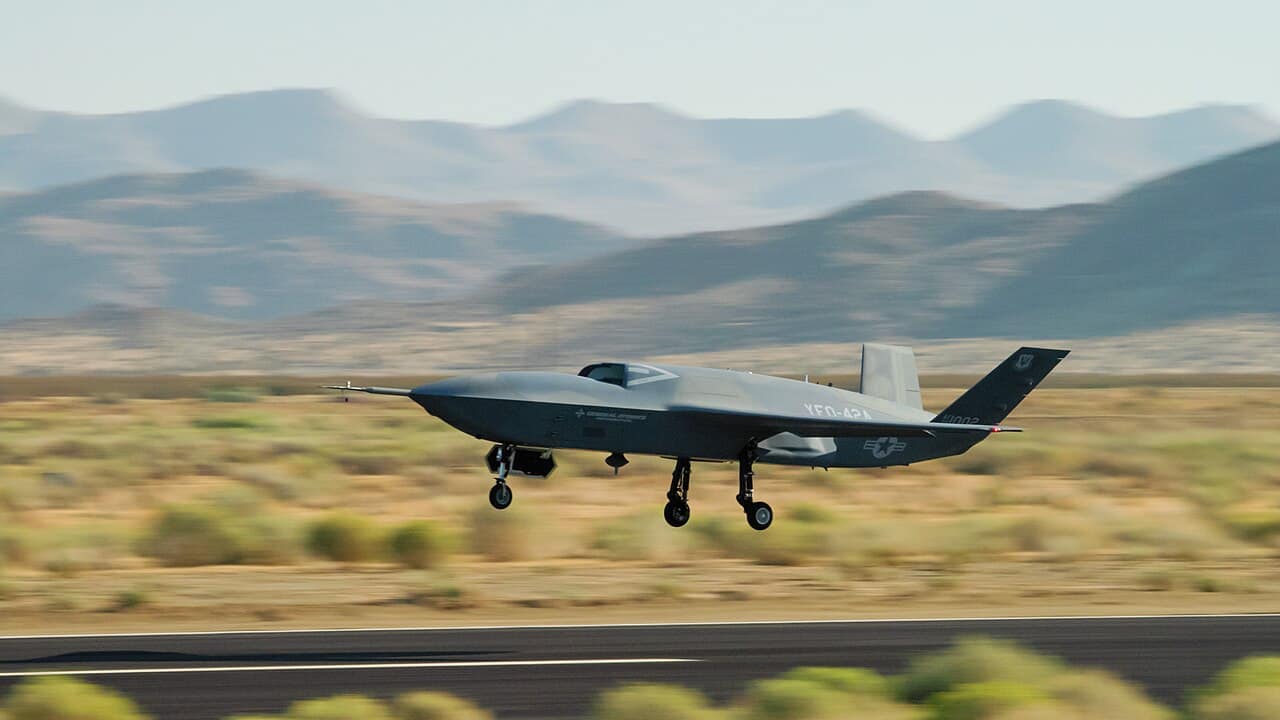
The first generation of America’s robot fighters is already being built. The second generation is still an argument about engines.
Speaking at the Air Force’s Life Cycle Industry Days conference in Dayton, Ohio, senior acquisition officials laid out where Collaborative Combat Aircraft Increment 2 actually stands: nine vendors, a concept refinement phase running to roughly mid-2027, and two brand-new engine classes being developed because nothing suitable exists on the shelf.
Quick Facts
| Programme | Collaborative Combat Aircraft (CCA) Increment 2 |
| Increment 1 status | In production (General Atomics YFQ-42A, Anduril YFQ-44A) |
| Increment 2 vendors | Nine, currently unnamed |
| Concept refinement runs to | Approximately mid-2027 |
| Designs to be carried forward | Up to six |
| Small engine effort | 1,400–1,600 lb thrust, in preliminary design |
| Medium engine effort | 5,000–6,000 lb thrust, clean-sheet or modified commercial |
| Additional market research | Sources-sought notice issued 24 July 2026 |
| Competition | Will reopen beyond the nine refinement vendors |
Nine Vendors, Six Designs, One Funnel
The process mirrors what the Air Force did for Increment 1: start with a broad set of desired attributes, work with industry on conceptual designs, then winnow.
The goal is to select up to six conceptual designs to move forward. Crucially, the nine companies currently in concept refinement do not have the field to themselves.
Running in parallel, the service issued a notice on 24 July seeking sources able to develop next-generation semi-autonomous collaborative platforms. Helfrich described that as continual market research, and was candid about why it is happening in the open: much of this work has until now been done in classified channels, and the Air Force wants to learn what the wider market can actually offer.
The Engine Problem Is the Real Story
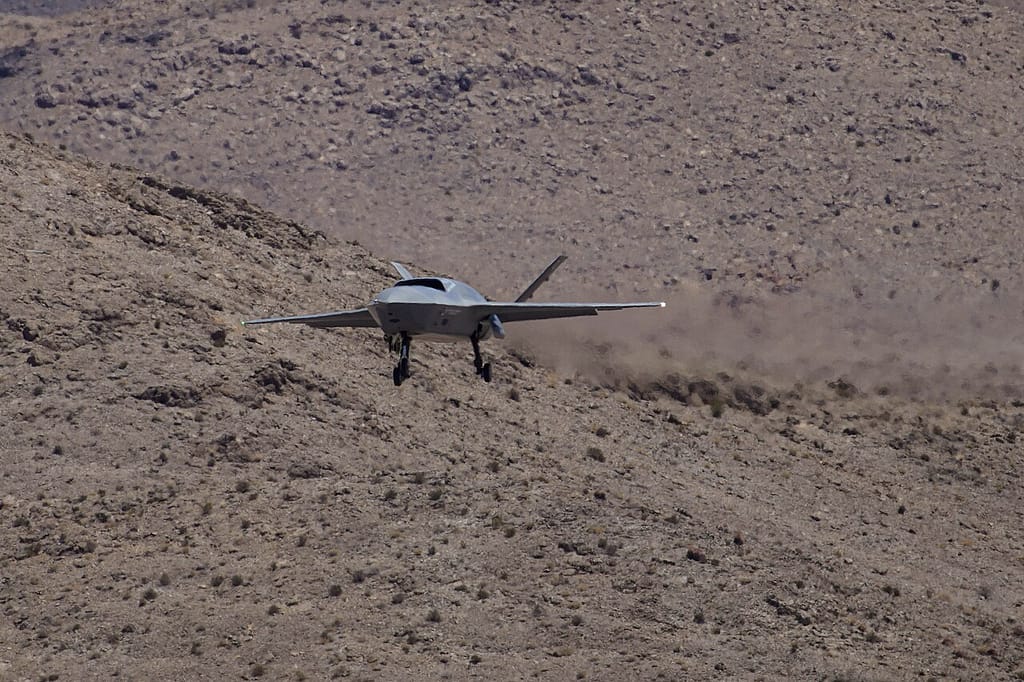
For Increment 1, the Air Force did the pragmatic thing: it iterated quickly on an existing engine to get aircraft flying sooner. That option has now run out.
The gap is simple. If Increment 2 needs a powerplant meaningfully smaller or larger than what Increment 1 uses, there is nothing available that meets the requirement. So the service is developing two engine classes at once: a small one in the 1,400 to 1,600 pound thrust bracket, currently in preliminary design, and a medium one in the 5,000 to 6,000 pound bracket that will be either a clean-sheet design or a heavily modified commercial engine.
That bracketing is worth dwelling on. A 1,500 lb-thrust engine suggests something small, cheap and probably attritable, closer to a large cruise missile than a fighter. A 5,000 to 6,000 lb-thrust engine suggests something substantially more capable, with the range and payload to matter in the Pacific. The Air Force is deliberately keeping both doors open.
Not Committing to Either
Helfrich was careful to say Increment 2 is not constrained by the two engine concepts. If a selected design needs one of those thrust classes, the airframe and the powerplant will be developed in concert.
This is the unglamorous part of building an air force of robot wingmen, and it is where programmes usually go wrong. Autonomy software gets the headlines. Propulsion sets the range, the payload, the unit cost and ultimately whether you can afford to lose the thing, which was the entire point of the concept.
Increment 1 is being built. Increment 2 will be defined by whichever of those two engines the Air Force ends up needing.
Sources: National Defense Magazine, 24 August 2026, reporting by Josh Luckenbaugh from the U.S. Air Force Life Cycle Industry Days conference, Dayton, Ohio.
0 Comments