Airports around the world are quietly repainting their runways. Not because the paint is fading — because the numbers are wrong. Magnetic north is drifting, and the compass heading that defined a runway when it was built twenty or thirty years ago no longer matches the compass heading pilots see on approach. When the discrepancy gets large enough, the numbers have to change.
It sounds obscure. It is not. Runway designations are the most fundamental piece of information in aviation navigation. They tell a pilot which direction the runway faces. They determine approach procedures, departure routes, noise abatement patterns, and instrument landing system frequencies. When a runway number changes, everything downstream changes with it.
Quick Facts
- How it works: Runway numbers = magnetic heading rounded to nearest 10, divided by 10
- Example: A runway pointing 273 degrees magnetic = Runway 27
- Opposite end: Always 18 higher/lower (Runway 27 → Runway 09 from the other end)
- Why they change: Earth’s magnetic north pole is drifting ~55 km/year toward Siberia
- Current drift rate: ~0.1-0.2 degrees per year (varies by location)
- Redesignation trigger: When actual heading deviates by 5+ degrees from displayed number
How the Numbers Work
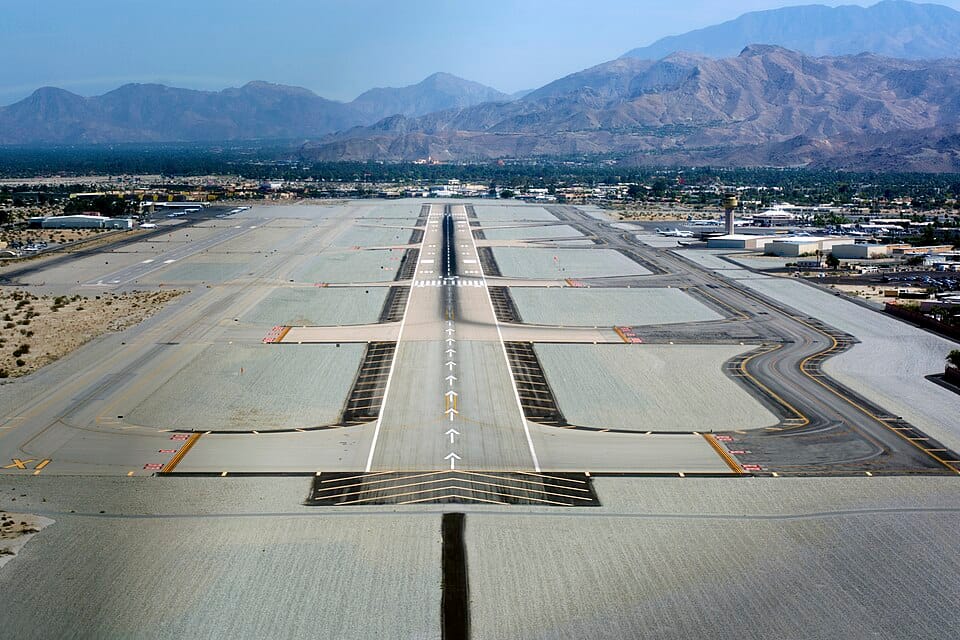
Every runway in the world is identified by a number between 01 and 36. That number is the magnetic heading of the runway, rounded to the nearest ten degrees, with the final zero dropped. A runway pointing 273 degrees magnetic becomes Runway 27. The opposite end of the same strip of concrete points 093 degrees, so it is Runway 09. Simple. Elegant. And entirely dependent on magnetic north staying where it is.
Parallel runways add a letter: L (left), C (centre), R (right). London Heathrow has 27L and 27R. But the fundamental logic is always the same: the number tells you where the runway points on a magnetic compass.
The Problem: Magnetic North Won’t Stay Put
Earth’s magnetic north pole is not a fixed point. It is generated by convection currents in the planet’s liquid iron outer core, and it moves. In the twentieth century, it drifted relatively slowly across the Canadian Arctic. Since the 1990s, it has accelerated dramatically — currently moving toward Siberia at roughly 55 kilometres per year.
“Runway designators shall be changed when the actual magnetic heading deviates from the runway designation by more than five degrees.”FAA Advisory Circular AC 150/5340-1M — Federal Aviation Administration
As the pole moves, magnetic headings at airports shift. A runway built in 1990 with a heading of 265 degrees (Runway 27) might now read 260 degrees on a compass — making it Runway 26 by the FAA’s rounding rules. When the discrepancy hits five degrees, the airport must redesignate.
What a Redesignation Involves
Changing a runway number is not just a paint job. Every approach plate, departure procedure, ATIS frequency assignment, noise abatement route, and published chart that references the old number must be updated simultaneously. Air traffic controllers retrain. GPS databases update. Airlines reprogramme their flight management systems. The coordination between the airport, the national aviation authority, ICAO, and every airline that uses the airport can take months.
The paint itself is significant. Runway markings are applied with thermoplastic or epoxy paint that must meet strict reflectivity, friction, and durability standards. Sandblasting the old numbers, repainting the new ones, and remarking the entire threshold area can close a runway for days — an operational headache at any busy airport.
Where It’s Happening
Wichita Dwight D. Eisenhower National Airport in Kansas changed its runway designations in 2023. Fairbanks International in Alaska — closer to the magnetic pole and therefore more affected by its drift — has redesignated multiple times. London Stansted, Tampa International, and dozens of airports across North America and Europe have either recently changed or are planning to change their runway numbers in the next decade.
The irony is that GPS navigation has made magnetic headings increasingly irrelevant for en-route flight. Modern airliners navigate by true heading and satellite positioning. But on the ground, at the airport, the magnetic compass still rules. Runway numbers are magnetic. Approach headings are magnetic. And until the entire global aviation system transitions to true-north references — a change that ICAO has discussed but not implemented — airports will keep repainting their runways every few decades, chasing a pole that will not stand still.
Sources: FAA, ICAO, National Oceanic and Atmospheric Administration (NOAA), Simple Flying, Aerotime


 English
0 Comments