A Shahed drone slams into an AH-64 Apache over the Strait of Hormuz. Both crew members plunge into the Gulf. Two hours later, a robotic boat drags them from the water — the first-ever unmanned sea rescue of downed aviators. Hours after that, American jets are hammering Iranian radar sites from Qeshm Island to Bandar Abbas.
Monday night’s shootdown marks the single most dangerous escalation since Operation Epic Fury began, and the first time Iran has downed a manned U.S. aircraft in the current conflict. The response was swift, kinetic, and anything but proportional in Tehran’s eyes.
The Pentagon says this is self-defence. Iran says it is war. The Strait — through which 21% of the world’s oil still flows — just became the most dangerous corridor on Earth.
Quick Facts
What: U.S. Army AH-64 Apache shot down over the Strait of Hormuz
When: Monday night, 8 June 2026 (local time)
Cause: Iranian Shahed drone struck the helicopter — intent still under investigation
Crew: Both pilots rescued within ~2 hours by an unmanned Navy Corsair surface vessel (USV)
U.S. response: CENTCOM launched precision strikes on Iranian air defences, radar sites, and ground control stations near Hormuz
Targets hit: Qeshm Island, Sirik, Jask, Bandar Abbas
Iran response: IRGC Navy launched drone attacks on U.S. Fifth Fleet in Bahrain and Ali Al-Salem base in Kuwait
A Drone Meets a Gunship
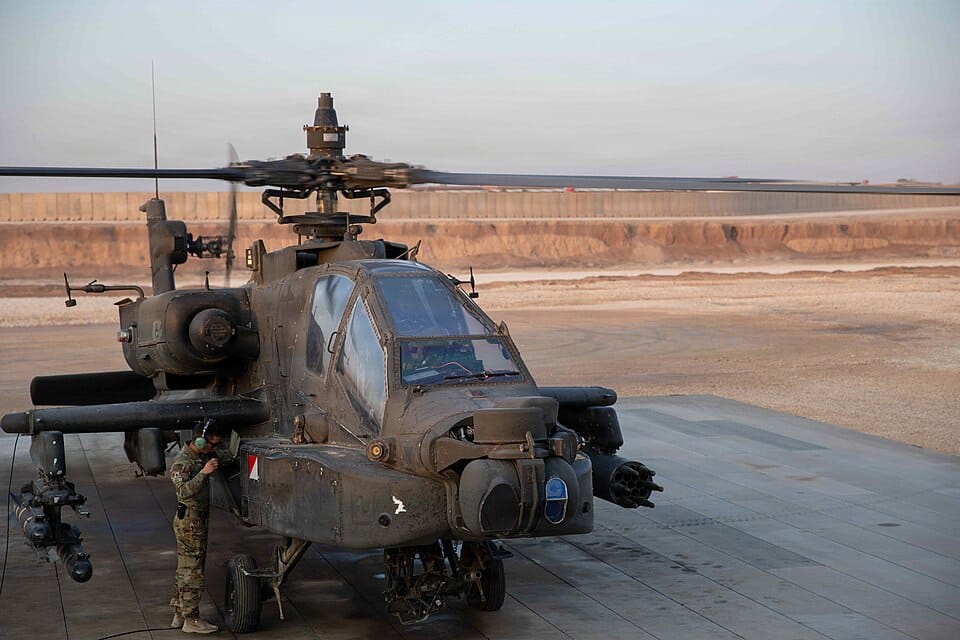
The AH-64 was on a routine patrol of regional waters near the Omani coast when it was struck by what investigators have identified as an armed Iranian Shahed drone. The helicopter went down into the sea. Both crew members survived the impact and entered the water.
Within approximately two hours, a U.S. Navy Corsair unmanned surface vessel — operated by Task Force 59, the Fifth Fleet’s experimental drone warfare unit based in Bahrain — located the pilots and pulled them from the Gulf. It was the first time in history that an unmanned vessel had conducted a combat search-and-rescue extraction.
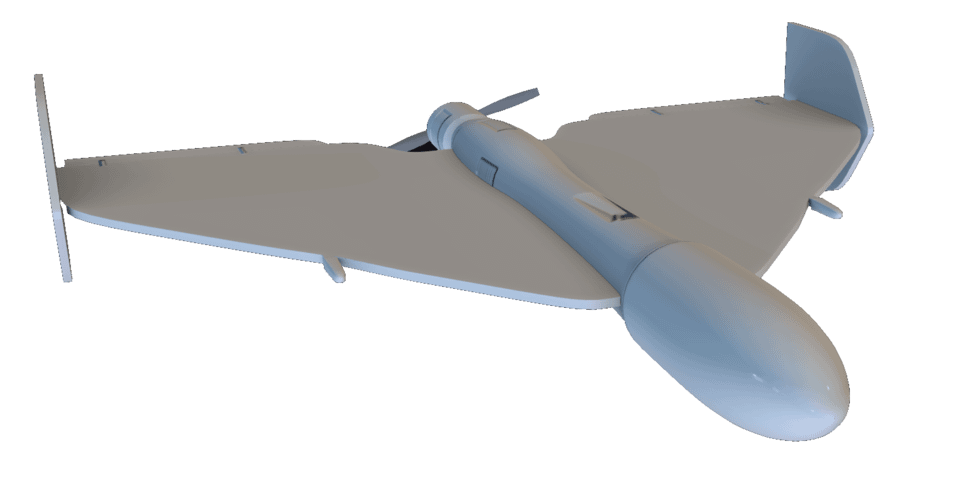
A rendering of the Iranian Shahed-136 one-way attack drone — the type suspected of striking the Apache. Whether the collision was deliberate or accidental remains under investigation.
President Trump confirmed the shootdown on the morning of June 9, declaring that Iran “shot down our helicopter” and vowing the United States “must respond.” Two senior U.S. officials told multiple outlets that an armed Shahed drone hit the Apache, though one noted it was not yet clear whether the strike was intentional or the result of a mid-air collision.
“Iran shot down our helicopter while it was patrolling over the Strait of Hormuz. The pilots are fine. We must respond.”
President Donald Trump — President of the United States, 9 June 2026
America Strikes Back
At 5:00 p.m. ET on June 9, U.S. Central Command launched what it described as “self-defence strikes” against Iran. CENTCOM stated that its forces struck “Iranian air defence, ground control stations, and surveillance radar sites near the Strait of Hormuz with precision munitions from U.S. Air Force and Navy fighter jets.”
Iranian state broadcaster IRIB reported explosions on Qeshm Island in the Strait of Hormuz, and in the ports of Sirik and Jask during the first wave. Further explosions were reported in Jask and Bandar Abbas hours later. Iran’s Revolutionary Guard said the strikes damaged a telecommunications tower in Sirik and destroyed two water tanks in the Bemani district.
CENTCOM described the operation as “a proportional response to unjustified Iranian aggression” and “recent attacks on U.S. forces and international commercial ships.”
Tehran Fires Back
Iran’s response came within hours. The IRGC Navy launched drone attacks targeting the U.S. Fifth Fleet headquarters in Bahrain and the Ali Al-Salem Air Base in Kuwait. Initial reports indicated that Kuwait’s air defences intercepted at least some of the incoming munitions.
The widening of targets to Bahrain and Kuwait — both sovereign Gulf states hosting U.S. forces — represents a significant escalation beyond the Strait itself. Previous Iranian retaliatory strikes in the current conflict had been confined to targets within or immediately adjacent to the Hormuz chokepoint.
The Robot Boat That Changed Rescue Forever
The Corsair USV rescue may prove to be one of the most consequential footnotes of the night. Task Force 59 has been deploying unmanned surface vessels in the Gulf since late March 2026, primarily for maritime surveillance and patrol. The Apache shootdown forced an unplanned real-world test of the platform’s rescue capability — and it worked.
The concept of using expendable robotic boats to retrieve downed crews in contested waters has obvious implications. A manned rescue helicopter entering the same airspace where an Apache was just shot down faces the same threat. A drone boat does not carry a crew to lose.
What Comes Next
The shootdown is the first loss of a manned U.S. aircraft to Iranian action in the current conflict. Previous losses — including more than 30 MQ-9 Reapers and at least one MQ-1 Predator — were all unmanned platforms. The psychological and political calculus changes when American pilots are pulled from burning wreckage.
The Strait of Hormuz remains the world’s most critical oil chokepoint. The ongoing U.S. naval blockade of Iranian ports has already redirected 134 commercial vessels and disabled seven ships attempting to run the blockade. With dual-carrier coverage from USS Abraham Lincoln and USS George H.W. Bush, the U.S. military presence in the region is at its highest level since the opening weeks of Epic Fury.
Whether Monday night’s shootdown was a deliberate act of war or a tragic accident involving an autonomous drone may ultimately be irrelevant. The response cycle is already in motion.
Sources: NBC News, CBS News, CNN, Al Jazeera, NPR, CENTCOM statement, The War Zone, Air & Space Forces Magazine
On October 24, 2003, three British Airways Concordes landed at London Heathrow within minutes of each other. One arrived from Edinburgh. One from the Bay of Biscay, where it had made a farewell supersonic run. One from New York — the last-ever scheduled supersonic...
A pilot pulls the handle. Two and a half seconds later, they are floating under a parachute. In between, they have been subjected to forces that would kill an unrestrained human being — and the engineering that makes it survivable is among the most violent and precise...
Every fighter jet ever designed starts with the same question: one engine or two? The answer shapes everything — the aircraft's size, weight, cost, survivability, performance envelope, and the missions it can fly. It is the single most consequential decision in combat...

 English
0 Comments