
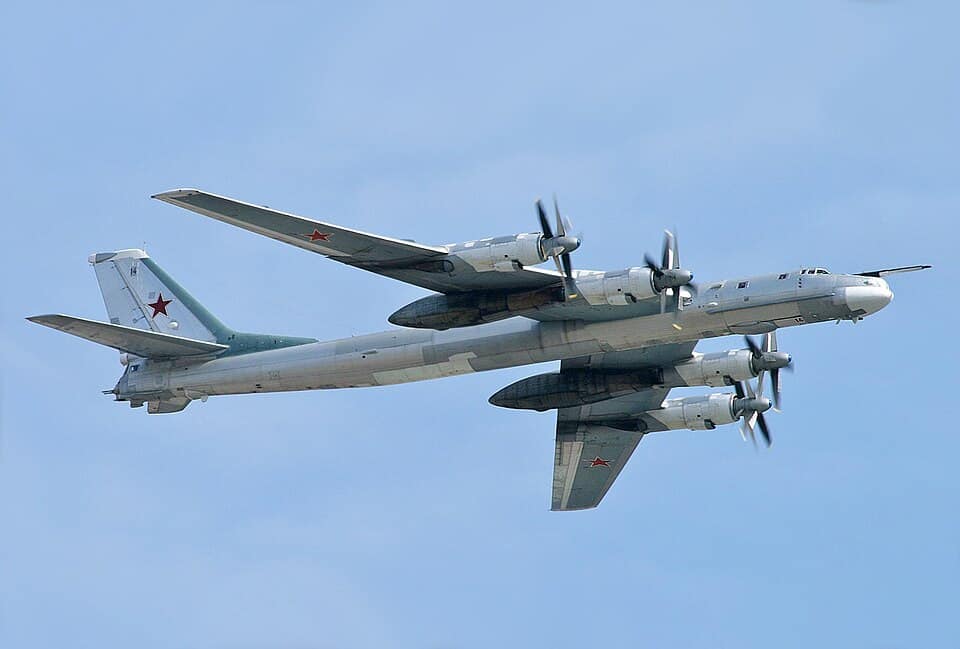
Somewhere over the Norwegian Sea, at this precise moment, there is a reasonable chance that a Tupolev Tu-95 is airborne. It has been flying for twelve hours. It will fly for twelve more. Its four Kuznetsov NK-12 turboprop engines are turning eight contra-rotating propeller blades at tip speeds approaching Mach 1, generating a noise so distinctive that submarine sonar operators can identify it through the hull of a submerged boat. A pair of NATO fighters — Norwegian F-35s, perhaps, or RAF Typhoons scrambled from Lossiemouth — are flying alongside, photographing it, just as their predecessors have done for seventy years.
The Tu-95, NATO reporting name “Bear,” first flew on 12 November 1952. Josef Stalin was still alive. The Korean War was still being fought. The aircraft was designed to deliver a free-fall nuclear bomb to the continental United States and return — a mission profile that became obsolete within a decade. Yet the Bear is still in service, still probing NATO air defences, still carrying weapons that can reshape the map of Europe. No other combat aircraft in history has remained operationally relevant for this long.
This is not a story about nostalgia. This is a story about an engineering decision made in 1951 that turned out to be so fundamentally correct that no replacement has ever been necessary.
Quick Facts
- NATO reporting name: Bear
- First flight: 12 November 1952
- Still in service: Russian Aerospace Forces (VKS), 2026
- Engines: 4 x Kuznetsov NK-12MA turboprops, 15,000 shp each
- Top speed: 920 km/h (Mach 0.82) — fastest propeller-driven aircraft ever
- Range: 15,000 km unrefuelled
- Crew: 7
- Primary weapon: Kh-101/102 cruise missiles (conventional/nuclear)
- Total built: approximately 500
The Propeller That Broke the Rules
In the early 1950s, Andrei Tupolev faced a problem that Western engineers considered unsolvable. The Soviet Union needed a strategic bomber with intercontinental range — 15,000 kilometres minimum — but Soviet jet engine technology lagged behind the West. Turbojet engines of the era were powerful but thirsty. A pure jet bomber with the required range would have been impractically large.
Tupolev’s solution was the NK-12 turboprop, designed by the German-born engineer Nikolai Kuznetsov using a team that included captured German specialists. The NK-12 remains the most powerful turboprop engine ever produced: 15,000 shaft horsepower per unit, driving two four-bladed contra-rotating propellers that are 5.6 metres in diameter. The contra-rotation was essential — it eliminated the torque effect that would have made a single propeller of that size uncontrollable and recovered energy from the swirling slipstream of the front stage.
The result was an aircraft that could cruise at 920 km/h — Mach 0.82 — making the Tu-95 the fastest propeller-driven aircraft ever built, a record it still holds. At that speed, the tips of the propeller blades are moving supersonically, which is the source of the Bear’s legendary noise signature. The sound has been described as a continuous, high-pitched scream audible at ranges that would be impossible for any other propeller aircraft.
Cold War Sentinel
The Tu-95 entered service with the Soviet Long-Range Aviation force in 1956, initially configured as a free-fall nuclear bomber. Within a decade, intercontinental ballistic missiles had rendered that mission largely redundant. A lesser aircraft would have been retired. Instead, the Bear was transformed into a cruise-missile carrier, a maritime patrol platform, and a strategic reconnaissance aircraft — roles it continues to perform today.
The Tu-95MS variant, which forms the backbone of the current Russian strategic bomber fleet, carries up to sixteen Kh-55 or Kh-101 cruise missiles on internal rotary launchers and external pylons. The Kh-101 has a range of approximately 4,500 kilometres, meaning a Tu-95MS does not need to approach within thousands of kilometres of its target. The aircraft has become a launch platform rather than a penetrating bomber — a flying missile magazine that can hold station over the Arctic or the Pacific for twenty hours at a time.
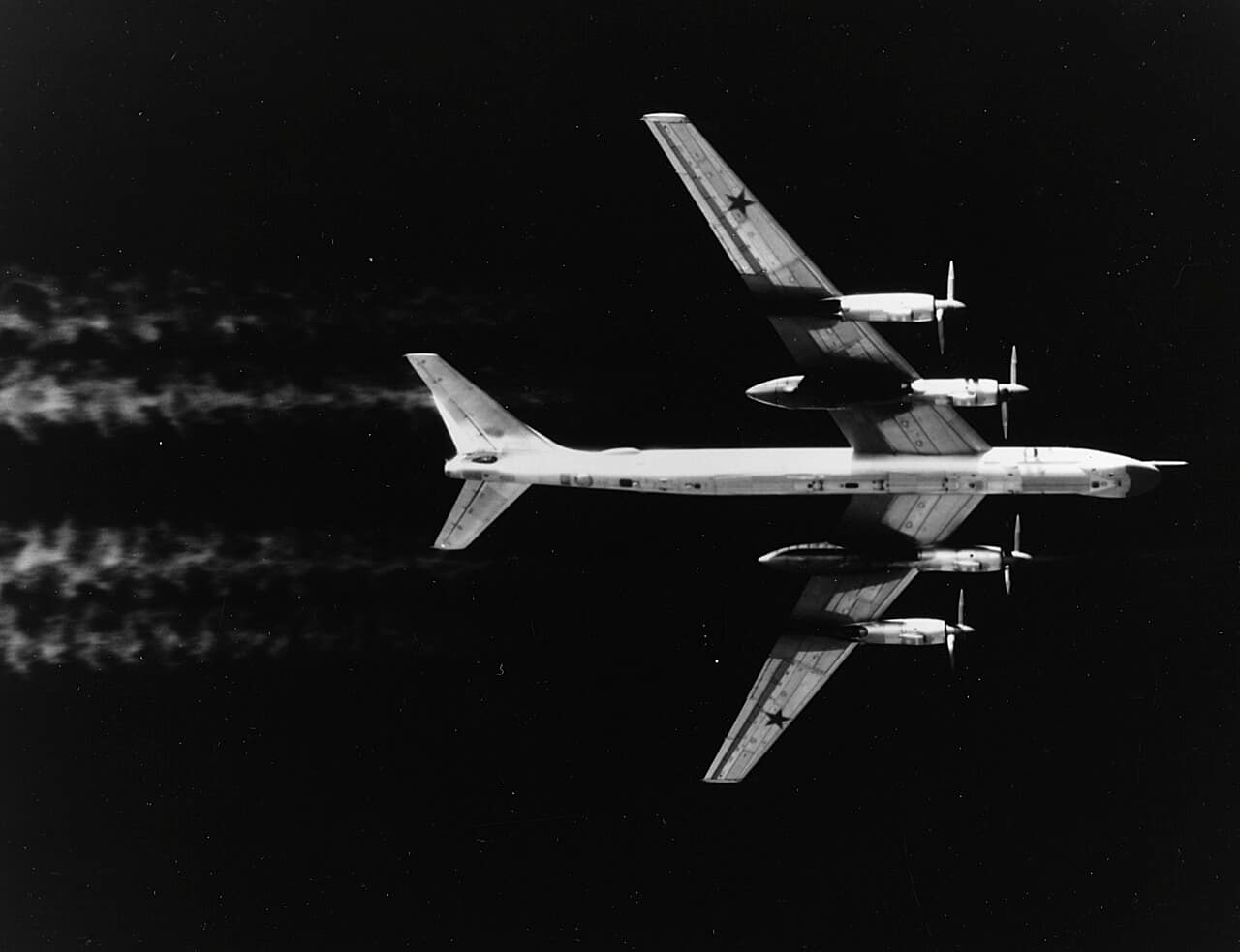
This transformation explains why the Bear has survived while its contemporaries — the B-47, the Vulcan, the Myasishchev M-4 — are museum pieces. The airframe’s extraordinary range and endurance, products of its efficient turboprop powerplant, make it ideal for the standoff missile role. A Tu-95 burning turboprop fuel at cruise altitude consumes roughly half the fuel of a comparably sized turbojet bomber, giving it a loiter time that no jet-powered replacement can match without aerial refuelling.
Still Buzzing NATO
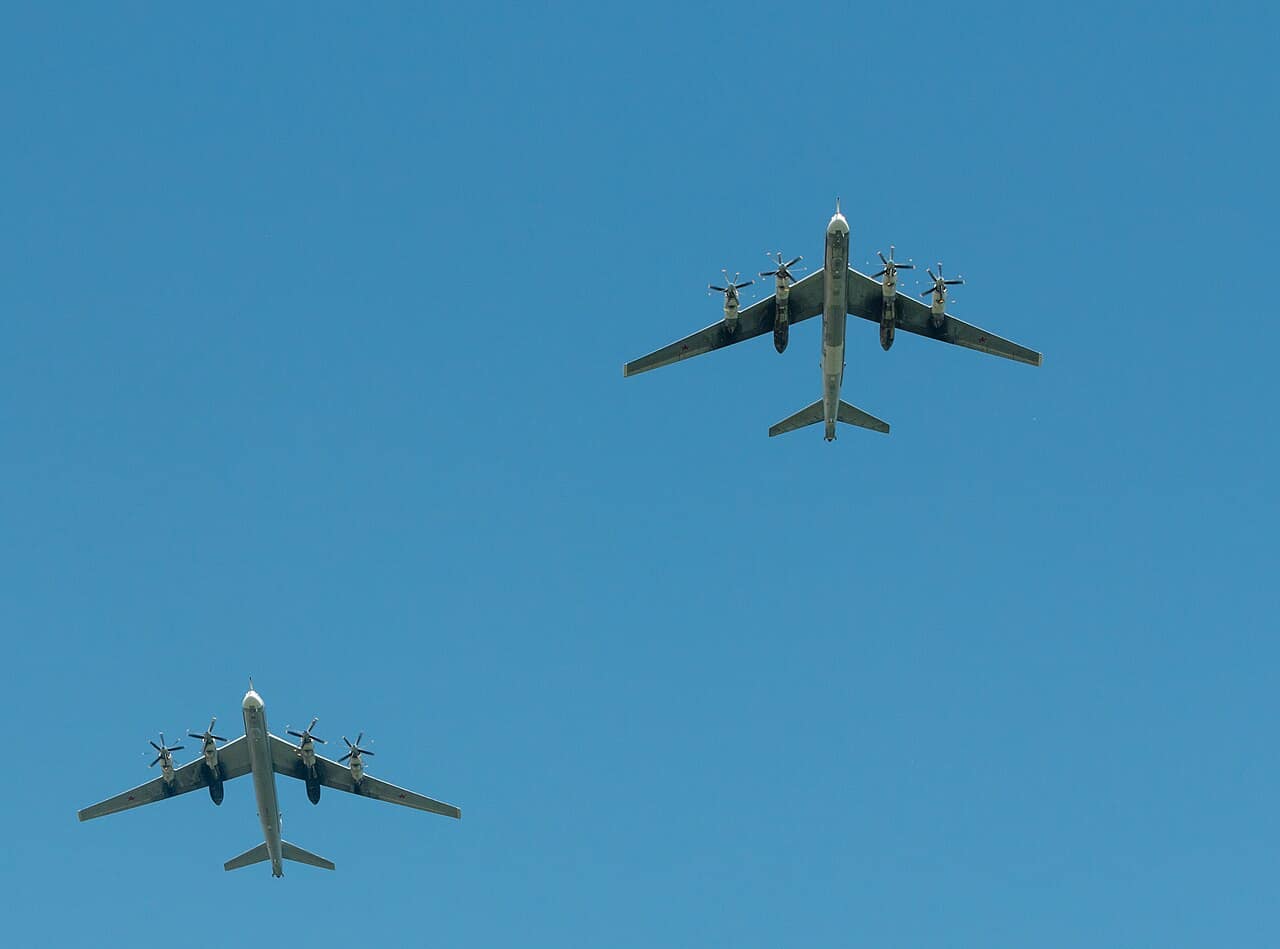
The Tu-95’s most visible role today is not strategic deterrence but strategic signalling. Russian Bears regularly fly along the edges of NATO airspace — through the Greenland-Iceland-United Kingdom gap, down the coast of Norway, around the coast of Japan, and into the Alaska Air Defense Identification Zone. These flights, which have intensified markedly since 2014, trigger Quick Reaction Alert scrambles from NATO fighter bases across northern Europe and the Pacific.
The flights serve multiple purposes. They test NATO response times, exercise Russian aircrew on long-range navigation, demonstrate that Russia’s nuclear deterrent remains airborne-capable, and generate media coverage that reinforces Moscow’s strategic messaging. The photograph of a modern stealth fighter flying alongside a 1950s propeller bomber has become one of the defining images of the new Cold War — a visual absurdity that obscures the very real threat posed by the cruise missiles slung beneath the Bear’s wings.
In 2022 and 2023, Tu-95MS aircraft launched Kh-101 cruise missiles against targets in Ukraine from launch positions over the Caspian Sea, more than 1,500 kilometres from the front line. The missions demonstrated that the Bear is not merely a symbolic provocation. It is an operational weapons platform capable of delivering precision-guided munitions in a real war — exactly as it was designed to do, seven decades ago, for a very different conflict.
No Replacement in Sight
Russia has been developing the PAK-DA stealth bomber since the early 2010s, but the programme has been delayed repeatedly, and sanctions imposed after 2022 have further complicated the supply of advanced materials and electronics. The Tu-160M2 remanufacture programme is producing updated supersonic bombers, but in single-digit numbers per year. For the foreseeable future, the Tu-95MS will remain the numerical backbone of Russia’s airborne nuclear deterrent.
The Bear’s longevity is not a Russian peculiarity — the USAF’s B-52H, which first flew in 1961, is expected to serve until the 2050s. What makes the Tu-95 unique is its powerplant. No other military aircraft has ever demonstrated that turboprop propulsion can sustain strategic-level performance for this duration. Kuznetsov’s NK-12, conceived in the wreckage of post-war Soviet industry, powered by the knowledge of captured German engineers, turning propellers at supersonic tip speeds — it is one of the most consequential engineering achievements in aviation history, and it is still flying.
Sources: Yefim Gordon “Tupolev Tu-95/Tu-142: Famous Russian Aircraft” (Midland Publishing), International Institute for Strategic Studies “The Military Balance 2025,” NORAD public records, Bill Sweetman in Jane’s International Defence Review


 English
0 Comments