

On the morning of 17 March 1947, two test pilots lifted a four-engined jet off the hard-packed lakebed at Muroc, in the California high desert, and into a clear blue sky. The aircraft was ungainly, slab-sided, and unmistakably a product of the piston age with turbojets bolted on. It was also the most important American bomber almost nobody remembers.
The North American B-45 Tornado was America’s first operational jet bomber — the machine that carried the United States into the jet-bomber era while the more famous Boeing B-47 Stratojet was still two years from flying. For a few tense years in the early 1950s it stood as one of the West’s front-line nuclear deterrents in Europe, and in stripped-down reconnaissance form it flew some of the most audacious spy missions of the entire Cold War — deep over the Soviet Union, at night, wearing the wrong air force’s markings.
Then the Stratojet arrived, swept-winged and sleek, and the Tornado was quietly swept into the footnotes. This is the story of an aircraft that did almost everything first, and is remembered for almost none of it.
Quick Facts: North American B-45 Tornado
- Role: Light/strategic jet bomber & reconnaissance aircraft
- First flight (XB-45): 17 March 1947, Muroc Army Air Field
- Entered service: 22 April 1948 (USAF)
- Engines: Four turbojets in two underwing nacelles — Allison-built J35s on the prototypes and earliest aircraft, General Electric J47s on production B-45s
- Crew: 4 (pilot, co-pilot, bombardier-navigator, tail gunner)
- Built: roughly 142–143 of all variants, including 33 dedicated RB-45C reconnaissance aircraft
- Retired: last withdrawn from operational use by the late 1950s
- Superseded by: Boeing B-47 Stratojet
Born From a German Shock
The B-45 owes its existence to a thin, elegant German aircraft. When Allied intelligence got its first proper look at the Arado Ar 234 Blitz — the world’s first operational jet bomber, streaking over the Western Front in 1944 faster than any piston fighter could climb to meet it — the U.S. War Department took fright. America had nothing remotely comparable.
In the autumn of 1944 the U.S. Army Air Forces issued a formal requirement for a family of jet bombers; aviation historians have described it as the first such requirement issued anywhere outside Germany. North American Aviation answered with its NA-130 design, and on 8 September 1944 work began on three prototypes. Post-war budget cuts nearly killed the programme, but rising tension with the Soviet Union gave it new urgency, and on 2 January 1947 a production contract for the B-45A followed.
The design philosophy was conservative to a fault. As aviation authors Bill Gunston and Peter Gilchrist later put it, the NA-130 was essentially a traditional bomber onto which jet engines had been fitted — and that very conservatism is exactly why it worked when bolder rivals were still on the drawing board.
The layout showed its lineage plainly: a fat, straight wing, a glazed bombardier’s nose straight out of the B-25 school, and four turbojets slung beneath the wing in two nacelles — two engines crammed into each pod. It looked like what it was: a bridge between two eras.
A Fistful of Firsts
For an aircraft so thoroughly forgotten, the Tornado’s record of milestones is remarkable. The National Museum of the United States Air Force credits it with four genuine firsts: it was the first American four-engine jet bomber to fly; the first American production jet bomber; the first jet bomber capable of carrying an atomic bomb; and the first multi-jet aircraft to be refuelled in mid-air.
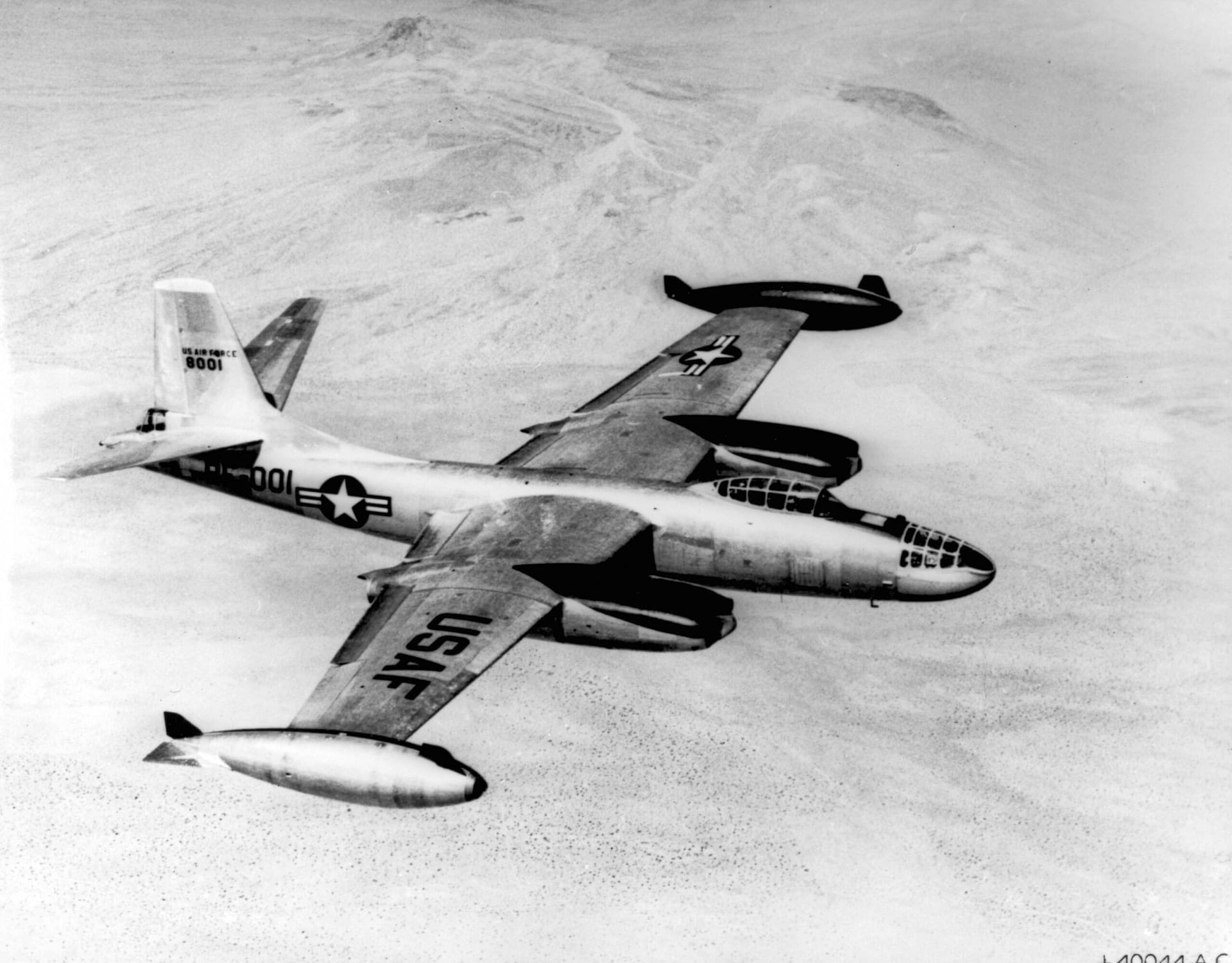
Those firsts were not trivia. A jet that could haul a nuclear weapon and top up its tanks from a flying tanker was, in 1950, a strategic instrument of the first order. The progressive shrinking of American atomic weapons meant that a medium aircraft like the B-45 could suddenly do a job once reserved for giants like the B-36. Overnight, a modest fleet of Tornados became a credible nuclear deterrent.
Power came from four turbojets. The three XB-45 prototypes and the first 22 production B-45As used Allison-built J35s; later production aircraft switched to the more powerful General Electric J47, the engine that would also power the F-86 Sabre and the B-47. Even so, early service was plagued by engine trouble, gyrocompass failures at high speed, and a fragile bombing radar — the growing pains of a brand-new technology being rushed into squadrons.
Korea, and the Deterrent in Europe
The Korean War gave the Tornado its combat baptism. B-45s flew conventional bombing and reconnaissance sorties, and on 4 December 1950 an RB-45C earned a grim distinction: it became the first jet bomber ever shot down by a jet fighter, downed by a Soviet-flown MiG-15 near the Chinese border. Only one of the four crew is believed to have survived to bail out, and the secrecy around such missions means much of the story stayed classified for decades.
In Europe, nuclear-capable B-45s of the 47th Bomb Wing deployed to RAF Sculthorpe in Norfolk from 1952, where they served as Tactical Air Command’s first-line nuclear deterrent against a Soviet ground offensive. For a few years, before bigger and better aircraft arrived, the unglamorous Tornado was holding part of the line in the most dangerous standoff of the century.
The Spy Flights: Operation Ju-Jitsu
The Tornado’s most extraordinary chapter was also its most secret. American law barred the U.S. military from overflying the Soviet Union, but Britain — with Winston Churchill back in Downing Street and willing — could do what Washington could not. Under Operation Ju-Jitsu, four RB-45Cs were loaned to an ad-hoc RAF unit, the “Special Duty Flight” at RAF Sculthorpe.
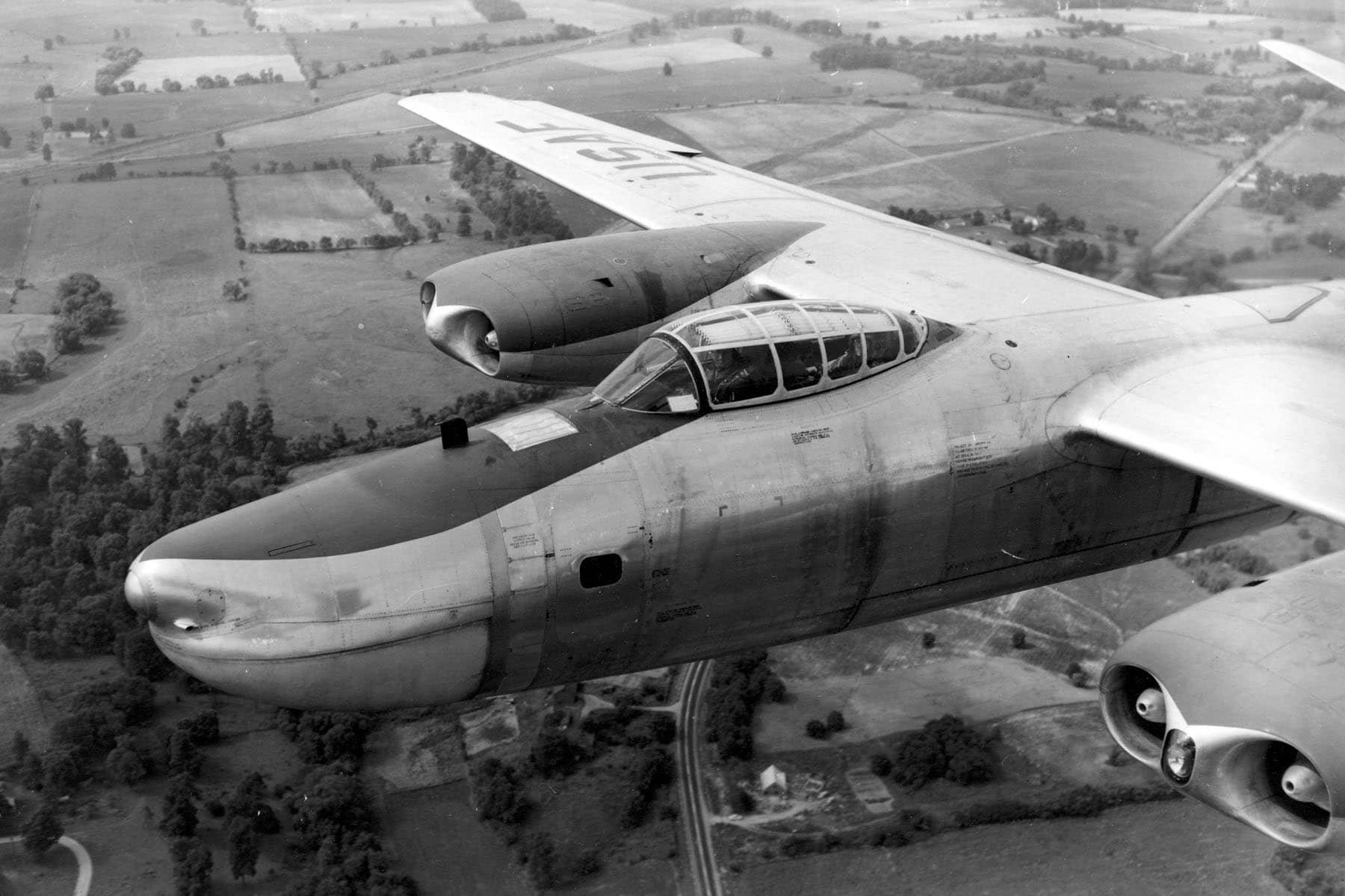
The jets had their USAF stars painted out and RAF roundels applied. They never belonged to the RAF; the British simply flew them on America’s behalf. The aircraft and crews were so deeply buried in secrecy that, by one navigator’s account, even the wives of the men flying them did not know what they had done.
On the night of 17 April 1952, three aircraft slipped east. Two probed north and south of Moscow; the third, commanded by Squadron Leader John Crampton with navigator Rex Sanders, pushed up to 1,000 miles inside Soviet territory, zig-zagging between targets at around 35,000 feet to photograph airfields and capture radar signals. They came home untouched.
When the operation was re-run in April 1954, the Soviets were ready. Over Kyiv, Crampton and Sanders were detected and the anti-aircraft guns opened up. Unknown to the crew, the local commander had scrambled MiG-15s with orders to ram the intruder — but the fighters could not claw their way up to the Tornado’s altitude. Crampton firewalled the throttles, turned for the West, and made it home. The existence of the flights stayed buried until 1994.
Eclipsed, and Forgotten
What killed the Tornado was not failure but progress. The Boeing B-47 Stratojet — swept-winged, podded, genuinely modern — was everything the B-45 was not, and once it matured the older jet had no future. RB-45Cs were replaced in their reconnaissance role by RB-47s by the mid-1950s, and the last Tornados were withdrawn from operational service before the decade was out, a handful soldiering on as test aircraft into the early 1970s.
The B-45 had the bad luck to be first in an era when “first” meant “obsolete almost immediately.” It bridged the gap between the piston bombers of the Second World War and the jet fleets of the Cold War, held a nuclear deterrent together for a few crucial years, and flew spy missions audacious enough to risk a third world war — all before most people had even heard its name.
Three survive today, in museums in California, Ohio and Nebraska. Walk past one and it looks almost quaint. Look closer, and you are looking at the aircraft that did it all first.
Sources: National Museum of the United States Air Force; Wikipedia; The Aviationist; AeroCorner; The National Interest; Vintage Aviation News; Bill Gunston & Peter Gilchrist, Jet Bombers (Osprey, 1993); Rogers Jones & Co (Wing Commander Rex Sanders obituary).
Frequently Asked Questions
What was the North American B-45 Tornado?
The B-45 Tornado was America's first operational jet bomber, first flown on 17 March 1947 and entering US Air Force service in 1948. A four-engine, straight-winged aircraft, it carried the United States into the jet-bomber era before the more famous Boeing B-47 flew, and served as a nuclear deterrent in Europe in the early 1950s.
What was America's first jet bomber?
The North American B-45 Tornado was America's first operational jet bomber. It first flew on 17 March 1947 at Muroc and entered service in 1948, years before the swept-wing Boeing B-47 Stratojet. About 142 to 143 were built, and it bridged the gap between Second World War piston bombers and the Cold War jet fleets.
What aviation firsts did the B-45 Tornado achieve?
The National Museum of the US Air Force credits the B-45 with four firsts: the first American four-engine jet bomber to fly, the first American production jet bomber, the first jet bomber able to carry an atomic bomb, and the first multi-jet aircraft to be refuelled in mid-air. These made it a serious strategic instrument by 1950.
What was Operation Ju-Jitsu?
Operation Ju-Jitsu was a secret Cold War spy mission using RB-45C Tornado reconnaissance aircraft. Because US law barred American military overflights of the Soviet Union, Britain flew the jets on America's behalf. Four RB-45Cs had their US markings painted out and RAF roundels applied, then flew deep over the USSR at night to photograph targets.
What was the first jet bomber shot down by a jet fighter?
On 4 December 1950 during the Korean War, an RB-45C Tornado became the first jet bomber ever shot down by a jet fighter, downed by a Soviet-flown MiG-15 near the Chinese border. Only one of the four crew is believed to have survived to bail out, and the mission stayed classified for decades.
Why is the B-45 Tornado largely forgotten?
The B-45 was eclipsed by progress. The swept-wing Boeing B-47 Stratojet was faster and genuinely modern, and once it matured the conservative, slab-sided Tornado had no future. RB-45Cs were replaced by RB-47s by the mid-1950s, and the last Tornados left operational service before the decade ended, leaving the pioneering jet a footnote.
What inspired the B-45 Tornado?
The B-45 owes its existence to the German Arado Ar 234 Blitz, the world's first operational jet bomber, which alarmed Allied intelligence in 1944. With nothing comparable, the US Army Air Forces issued a requirement for jet bombers that autumn, and North American answered with the NA-130 design that became the B-45.
0 Comments