
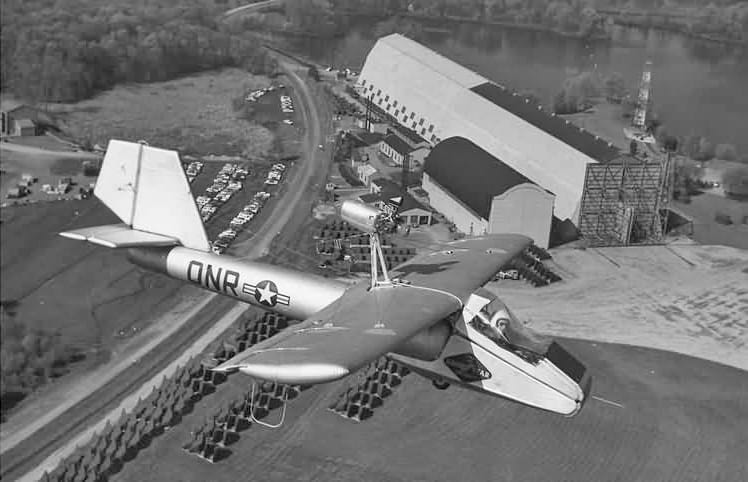
Picture a small wooden crate, about the size of a car’s trunk, dropped by parachute into a field. A man runs to it, opens it, and pulls out what looks like a deflated grey rubber raft. He works a pump for about five minutes. The shapeless bundle swells, stiffens, and takes the shape of an aeroplane — wings, fuselage, tail. He climbs in, starts a tiny engine, and flies away.
This is not science fiction. In 1956, the Goodyear Aircraft Company — the people who made the blimps and the tyres — built exactly this: an aeroplane you inflated with a pump. They called it the Inflatoplane, and incredibly, it worked.
QUICK FACTS
Aircraft: Goodyear Inflatoplane — an inflatable rubber aeroplane
Built: From 1956, designed in just 12 weeks
The idea: Air-drop it to a downed pilot, who inflates it and flies to safety
How it worked: Rubberised fabric inflated to about 25 psi; a 40-hp engine kept it rigid
Numbers: 12 prototypes built; tested until 1972, then cancelled
Verdict: Brilliant, bizarre, and far too fragile for war
A plane made of rubber
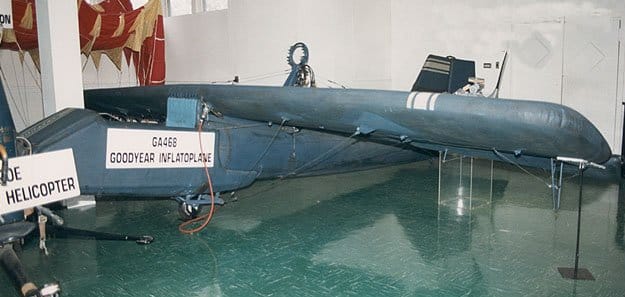
The genius was in the material. The wings and fuselage were not metal but a sandwich of rubberised fabrics, held together by thousands of tiny nylon threads. Deflated, the whole aircraft could be packed into a small container. Pumped up to around 25 pounds per square inch, those soft fabric panels stiffened into a rigid wing strong enough to fly. The engine even kept feeding air into the structure to hold its shape in the air.
Goodyear designed and built the first one in just twelve weeks. It was tiny — about twenty feet long, with a forty-horsepower engine — and it could carry a single person plus a little cargo.
The point: getting downed pilots home
The Inflatoplane was not a toy. The military problem it tried to solve was deadly serious: how do you rescue a pilot shot down deep behind enemy lines, before the enemy reaches him? Goodyear’s answer was to parachute him an aircraft. He would inflate it where he stood, take off from a road or a clearing, and fly himself out.
The Inflatoplane could carry enough fuel to fly several hundred miles and stay aloft for hours. For a rubber aeroplane that started the day folded inside a box, that was a remarkable performance — and for a moment in the late 1950s the U.S. Army took it seriously enough to test it intensively.
The video below tells the strange, true story of how an aircraft built from rubber actually got off the ground.
The short, strange history of the Goodyear Inflatoplane — the aircraft you pumped up before you flew it.
Why the rubber dream deflated
The problem, of course, was obvious the moment you said it out loud: it was made of rubber. An aircraft you could puncture was a terrifying thing to fly into a war zone, where even a single rifle bullet could let the air out. The programme also suffered a fatal accident when a control cable slipped its pulley and jammed, and a wing folded.
Goodyear built a dozen of them and kept testing until 1972, but no production order ever came. The Inflatoplane joined the long, wonderful list of aircraft that were too clever for their own good — a flying machine you could fold up and carry, undone by the one weakness no amount of engineering could fix. It remains one of the most charming what-ifs in aviation: the day a tyre company built a plane you blew up like a beach toy, and flew it.
Sources: National Air and Space Museum; War History Online; Cleveland Magazine; Wikipedia.
Related Questions
What was the Goodyear Inflatoplane?
The Goodyear Inflatoplane was an inflatable aircraft built by the Goodyear Aircraft Company starting in 1956. Made of rubberised fabric, it could be packed into a small container, pumped up in minutes, and flown. It was designed as a way to rescue pilots shot down behind enemy lines.
Could an inflatable airplane really fly?
Yes. The Goodyear Inflatoplane genuinely flew. Once inflated to about 25 psi, its rubberised wings and fuselage became rigid enough to support flight, and a small 40-horsepower engine drove it through the air. The engine also kept circulating air to maintain the aircraft’s shape while flying.
Why did Goodyear build an inflatable plane?
It was meant to be a rescue aircraft. The idea was to air-drop the deflated plane in a hardened container to a pilot stranded behind enemy lines, who would inflate it with a pump and fly himself to safety. Goodyear, famous for its blimps and tyres, was a natural fit for the rubber technology.
How did the Inflatoplane stay rigid in the air?
The wings and fuselage were made from a sandwich of rubberised fabrics linked by thousands of nylon threads. Inflated to around 25 psi, this structure stiffened into a rigid airfoil, and the engine continuously fed air into it to keep it firm throughout the flight.
How many Inflatoplanes were built?
Goodyear built 12 Inflatoplane prototypes between 1956 and 1959. Testing continued until 1972, when the project was finally cancelled. It never received a production military order.
Why did the Inflatoplane fail?
The Inflatoplane never won a military contract. A rubber aircraft was alarmingly vulnerable — even small-arms fire could deflate it — and the programme suffered a fatal crash when a control cable jammed. The concept was clever but too fragile to be practical, and it was cancelled in 1972.
0 Comments