
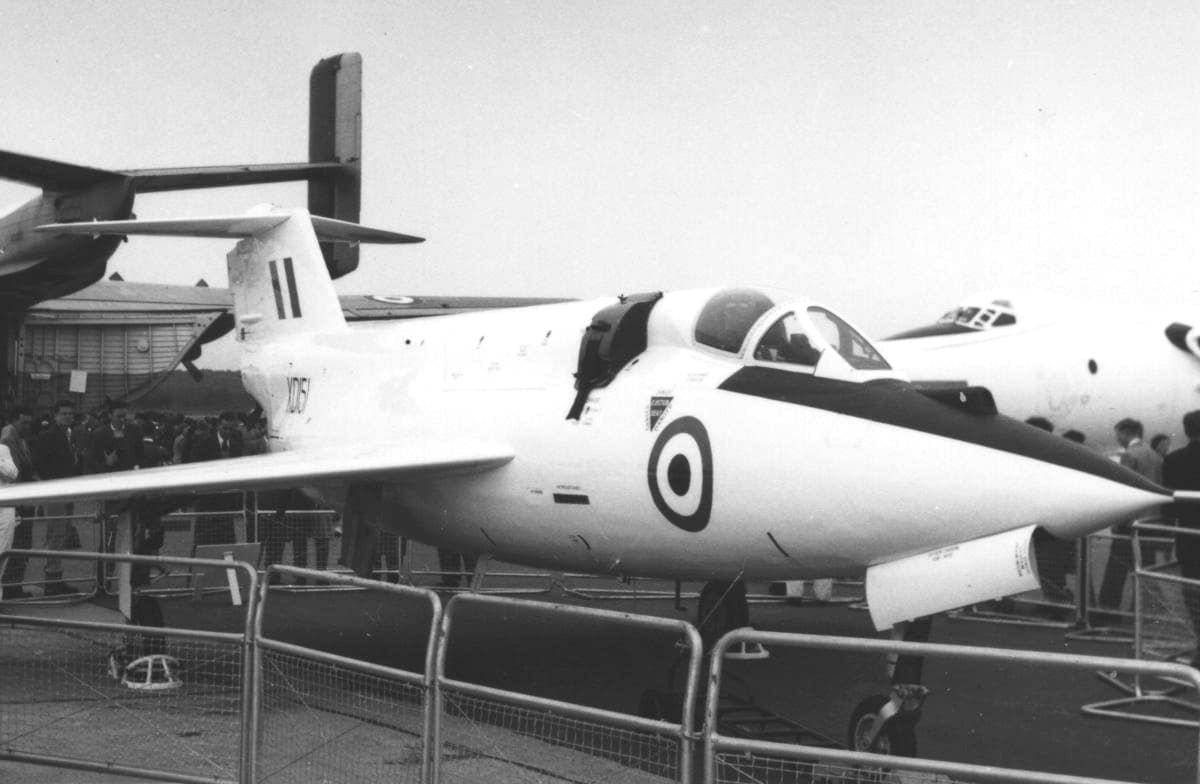
In the mid-1950s, Britain faced a nightmare: waves of Soviet bombers climbing ever higher and flying ever faster, each one potentially carrying an atomic bomb. Conventional fighters simply could not climb quickly enough to catch them in time. So British engineers reached for a radical answer — a fighter that would rocket almost vertically into the stratosphere on a column of flame, kill its target, and then glide home on a modest jet engine.
It was called the Saunders-Roe SR.53, and by every account it flew beautifully. It was cancelled anyway, killed not by any failure of its own but by a single stroke of government policy.
Quick Facts
- Aircraft: Saunders-Roe SR.53, a British prototype mixed-power interceptor
- Concept: a rocket for a near-vertical dash after high-flying bombers, and a small jet to cruise home and land
- Engines: a de Havilland Spectre rocket (8,000 lbf) plus an Armstrong Siddeley Viper turbojet
- Performance: designed for Mach 2.2; climbed at over 50,000 ft per minute; endurance only about seven minutes at full power
- Armament (planned): two de Havilland Firestreak heat-seeking missiles
- First flight: 16 May 1957, Squadron Leader John Booth
- Built: two prototypes; one (XD151) crashed in 1958, killing Booth
- Fate: overtaken by missiles and better jets; cancelled July 1960. XD145 survives at the RAF Museum Cosford
The bomber panic
The requirement grew out of genuine fear. By 1951, the Air Ministry wanted an interceptor that could reach 60,000 feet in just two and a half minutes — a “point-defence” fighter to scramble at the last moment and destroy incoming bombers before they could release their weapons. Only a rocket could deliver that kind of climb. The idea was not new: in the final year of the war, Germany had flown the rocket-powered Messerschmitt Me 163 for exactly this purpose, and the Allies had studied its terrifying performance closely.
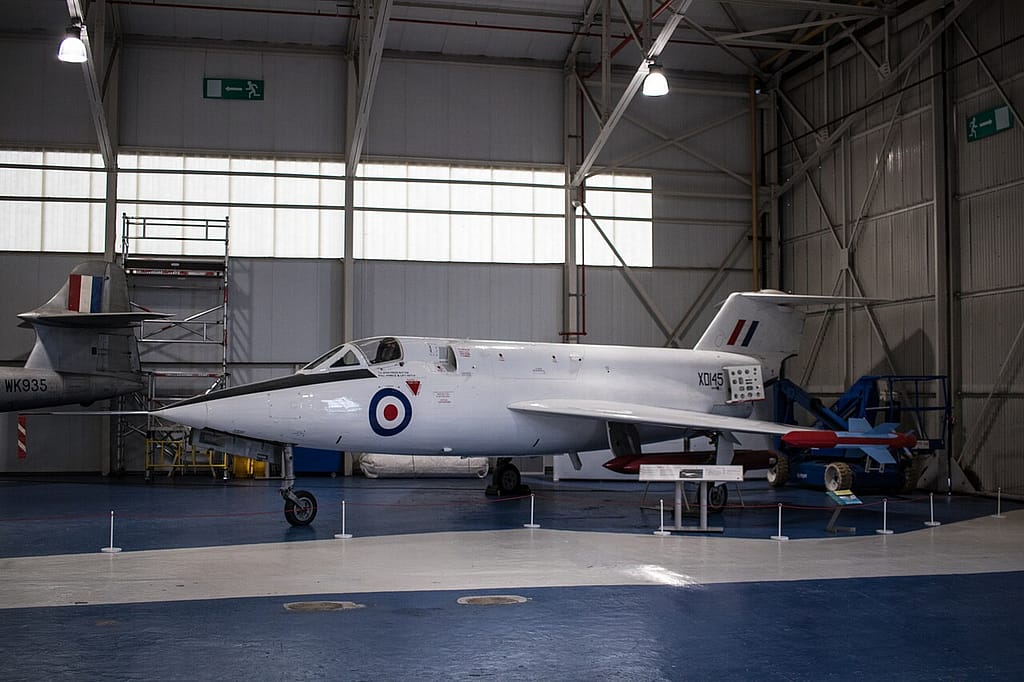
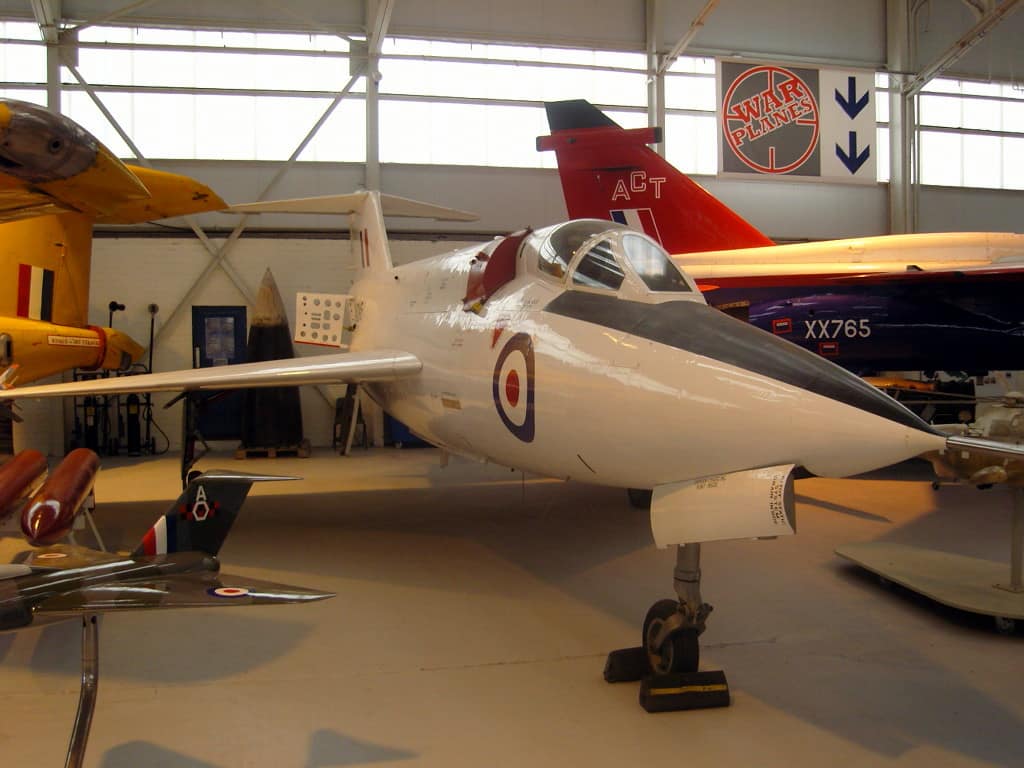
The surviving Saunders-Roe SR.53, XD145, preserved at the RAF Museum Cosford.
Rocket up, jet home
The design came from Saunders-Roe — curiously, a firm best known for building flying boats on the Isle of Wight. Its chief designer, Maurice Brennan, had quietly been studying rocket fighters, and the company talked its way into the competition. The key insight was that a pure rocket interceptor would have to glide home unpowered, which was dangerous; far better to add a small jet engine for the cruise back and the landing.
The result was a sleek, sharp-nosed aircraft with a delta-like wing and a T-tail, its two exhausts stacked one above the other. A de Havilland Spectre rocket, burning high-test peroxide, provided a colossal 8,000 pounds of thrust for the climb; a small Armstrong Siddeley Viper turbojet handled the gentle work. It was to be armed with a pair of de Havilland Firestreak heat-seeking missiles. At full power it could climb at more than 50,000 feet a minute — but it could sustain that fury for only about seven minutes.
The story of the SR.53 and its larger, radar-equipped successor, the SR.177.
First flight, and a fatal one
On 16 May 1957, Squadron Leader John Booth lifted the first prototype, XD145, off the runway at Boscombe Down. The aircraft handled superbly.
But rocket flight was unforgiving. On 5 June 1958, the second prototype, XD151, suffered an aborted takeoff, ran off the runway, struck a concrete approach light and exploded, killing John Booth. Test flying continued with the surviving aircraft under Lieutenant Commander Peter Lamb; between them, the two SR.53s made 56 flights.
Killed by a white paper
The real enemy, though, was not the danger of the machine but the calendar. The SR.53 flew for the first time barely a month after the British government published its 1957 Defence White Paper — a document that declared the future of air defence belonged to guided missiles, not manned fighters, and swept away programme after programme.
By then, too, the world had moved on. Jet engines had grown so much more powerful in six years that a conventional fighter with an afterburner could nearly match the SR.53’s climb without any temperamental rocket at all, and improved radar meant bombers could be detected far earlier. The rationale for a short-legged rocket interceptor had simply evaporated. The programme was formally cancelled on 29 July 1960.
The rocket fighter’s last stand
The SR.53 was the end of a bloodline that ran back to the Me 163. Britain was not alone in chasing the dream — France built its own mixed rocket-and-jet interceptor, the SNCASO Trident, at almost the same moment — but the whole concept was already obsolete. As jet engines and surface-to-air missiles improved, the fragile, short-endurance rocket fighter had nowhere left to go.
A larger, radar-equipped development, the SR.177, was drawn up for the RAF, the Royal Navy and even West Germany, only to be cancelled as well. Saunders-Roe never built another fighter. Today the sole surviving SR.53, XD145, sits quietly at the RAF Museum Cosford — a sleek, beautiful might-have-been from the brief, strange age when Britain planned to defend its skies with rockets.
A wartime instructional film on the Messerschmitt Me 163 — the rocket interceptor whose idea the SR.53 inherited.
Sources: Derek Wood, “Project Cancelled”; Pete London, “Saunders-Roe’s Rocket Fighters” (Aircraft); RAF Museum Cosford; Flight (1957); Wikipedia.

0 Comments