
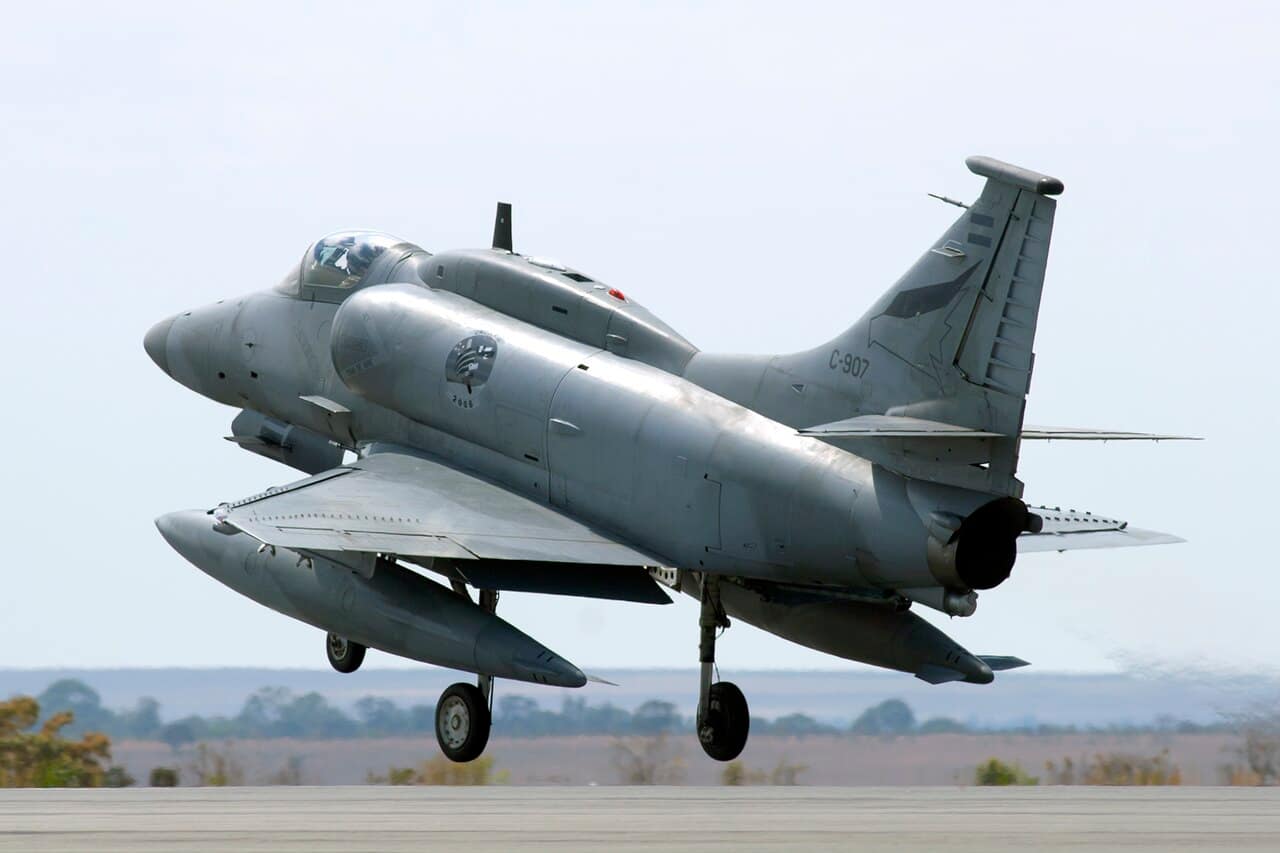
For 60 years, the Argentine Air Force flew the A-4 Skyhawk. The compact little Douglas attack jet — designed in California in 1952 for the United States Navy — became a Latin American workhorse, a Falklands warrior, and the last vintage combat aircraft in operational service in the southern hemisphere. On 14 May 2026, Argentina officially withdrew the final A-4AR Fightinghawks from front-line service. The aircraft that sank HMS Coventry and HMS Antelope in 1982 is now a museum piece.
In its place, the new generation has arrived: F-16AM/BM Fighting Falcons, transferred from Denmark, repainted in Argentine grey, and now standing alert at Mendoza. After 35 years of slow capability decline that turned Argentina into a permanent regional under-performer in air power, the country has crossed the line back to credible.
| Retiring aircraft | Douglas/Lockheed Martin A-4AR Fightinghawk and OA-4AR |
| Operator | Fuerza Aérea Argentina (Argentine Air Force) |
| Years in service | 1966 – 2026 (60 years) |
| Total in service at retirement | ≈ 18 airframes (of 36 original) |
| Replacement | Lockheed Martin F-16AM/BM Fighting Falcon (ex-Royal Danish Air Force) |
| Falklands War record | Argentine A-4s sank HMS Coventry, HMS Antelope and RFA Sir Galahad in 1982 |
From California to Patagonia
The A-4 Skyhawk was Ed Heinemann’s reaction to a decade of fighter bloat: a single-engined, lightweight strike aircraft that came in 45 per cent under the Navy’s 1952 weight target and was nicknamed the “Scooter” by its first pilots. Argentina took delivery of the A-4B variant in 1966, and bought further batches of A-4P and A-4Q jets — the Q being the naval variant intended for the carrier ARA Veinticinco de Mayo. By 1982, the Argentine Air Force and Navy together fielded around 70 Skyhawks of various marks.
The Falklands War turned those aircraft into legends. Operating at the absolute edge of their range, flying low under British radar, and dropping unguided iron bombs that frequently failed to detonate because they had been released below their arming altitude, Argentine A-4 pilots ran a gauntlet of Sea Harriers, Sea Wolf missiles, and Type 42 destroyers. They paid for it heavily — at least 21 Skyhawks were lost in combat — but they sank three Royal Navy ships and damaged many more.

The Fightinghawk era
In the 1990s, Argentina bought 36 surplus US Marine Corps A-4M Skyhawks, stripped them, and had Lockheed Martin install the APG-66 radar from the F-16 along with a new mission computer, modern HUD, and HOTAS controls. The result — the A-4AR Fightinghawk — was essentially an F-16 cockpit grafted onto a 1950s airframe. For a budget-strapped air force, it was the cheapest way to stay relevant.
Two decades later, however, the A-4 was running out of spares. The British arms embargo imposed after the Falklands War made it almost impossible to integrate any Western weapons that contained UK-origin components, which is roughly all of them. By 2020 only a handful were flyable. The Argentine Air Force was a token force.


The F-16 brings Argentina back
The deal was signed in April 2024: 24 F-16AM/BM aircraft from the Royal Danish Air Force, refurbished, transferred, and supported through a Foreign Military Sales agreement with the United States. The first jet arrived at the 6th Air Brigade at Tandil in December 2024. By the time the A-4 was officially retired, six F-16s were operational and another two were in transit.
The British government raised no objection to the sale — F-16s are not subject to UK component restrictions in the way the Skyhawk was, although Argentina has been told that the AIM-120 AMRAAM is off the table for now. In practical terms, that means short-range AIM-9X Sidewinders, AGM-65 Maverick air-to-ground missiles, and laser-guided bombs. It is enough.
For the Falklands garrison — the RAF detachment of four Eurofighter Typhoons at Mount Pleasant — the calculus has shifted modestly. The A-4AR was no threat. The F-16AM is. Whether the British government will quietly thicken the Falklands air defence package in response is a question now being asked in Westminster for the first time in a decade.
Sources: The Aviationist, The War Zone, Scramble, Aerospace Global News.
 English
0 Comments