

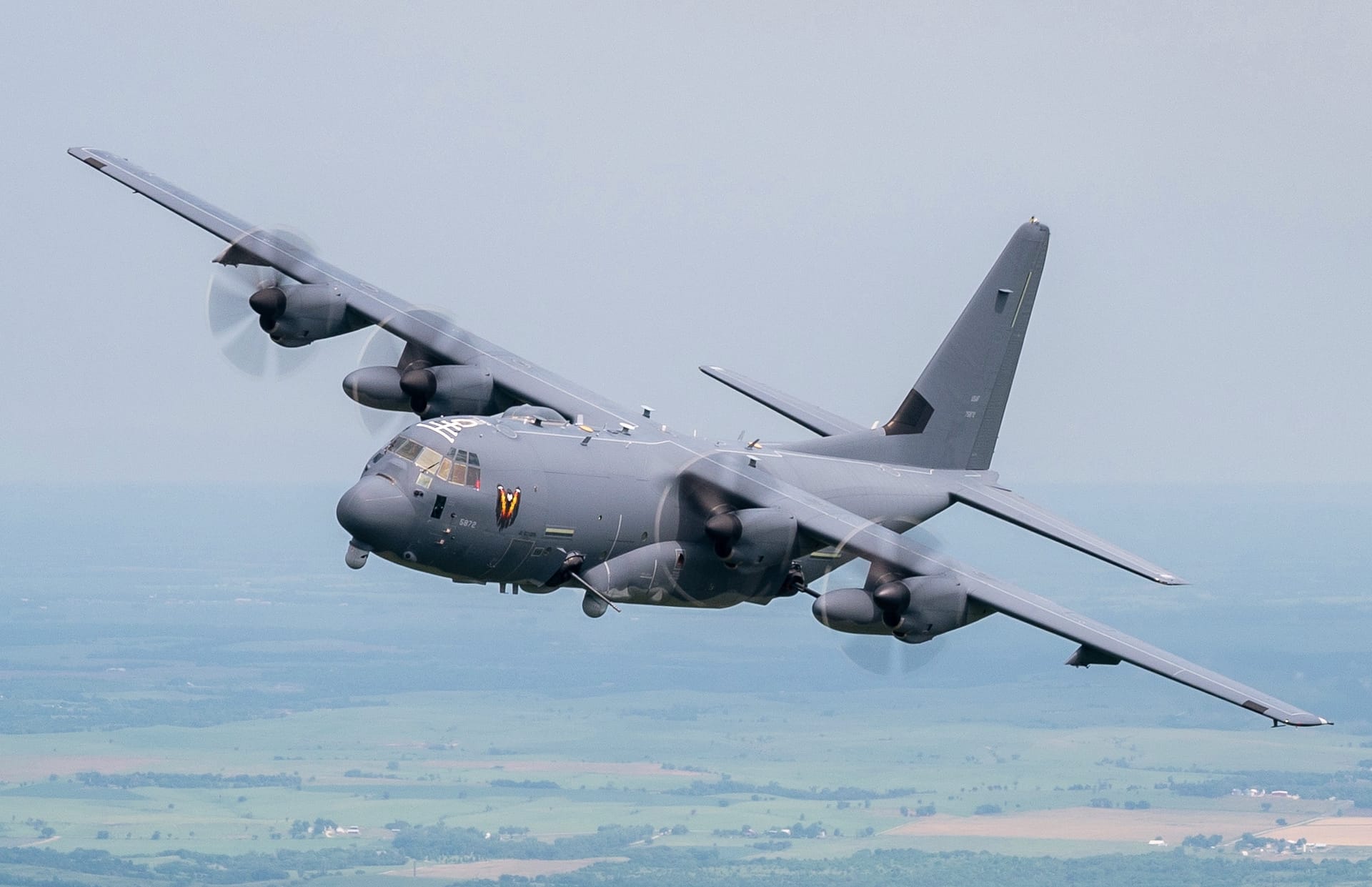
The AC-130 Ghostrider was built for a war America may never fight again. Slow, fat, vulnerable, and devastating against unarmed insurgent convoys in permissive airspace — the gunship belongs to the Global War on Terror, not to the Pacific. So Special Operations Command is rebuilding it. New AESA radar. New mini cruise missiles. New ability to hit moving targets from beyond the reach of Chinese air defences.
If it works, the AC-130J gets to keep its job description into the 2040s. If it does not, the most distinctive aircraft in American service since the Vietnam War may not survive the decade.
Quick Facts
Aircraft: AC-130J Ghostrider — the latest gunship variant of the C-130J Super Hercules
Operator: U.S. Air Force Special Operations Command (AFSOC) / SOCOM
Existing armament: 105mm M102 howitzer, 30mm GAU-23/A Bushmaster II cannon, AGM-114 Hellfire missiles, GBU-39 Small Diameter Bombs, AGM-176 Griffin missiles
New planned weapon: AGM-190A Havoc Spear — the Leidos Black Arrow Small Cruise Missile, with a demonstrated range of around 400 miles
New sensor: AESA radar capable of tracking moving surface and air targets
Why it matters: Allows the AC-130 to engage targets from well outside the threat envelope of modern integrated air defences
Demo timeline: Integrated AESA-plus-missile demonstration planned within the next year or so; $5.9 million requested in SOCOM’s FY2027 budget for radar integration
Operational concern: Without standoff weapons, the AC-130 cannot survive against any near-peer adversary
A 25-ton truck with a side-firing howitzer
To understand what SOCOM is trying to do, you have to understand what the AC-130 currently is. The Ghostrider is a four-engined turboprop transport with a 105mm howitzer and a 30mm cannon bolted into its left side. It flies in a continuous left-banked orbit over a target and fires sideways, walking shells onto whatever needs to disappear. It has done this — devastatingly well — across two decades in Iraq, Afghanistan, Syria, and Yemen.
It also has no business flying anywhere near a country that owns S-400 surface-to-air missiles. A modern AC-130J cruises at maybe 320 knots at 25,000 feet. Against a single ZSU-23-4 it is a survivable platform. Against the integrated air defences of China, Russia, or Iran, it is a target.
The mini cruise missile fix
What changes the equation is a small, cheap, smart standoff weapon — the AGM-190A Havoc Spear, developed by Leidos under the name Black Arrow. The Pentagon has been pouring money into this category — what it calls “low-cost cruise missiles” — for the past three years. The goal: a million-dollar-or-less weapon with 300+ kilometres of range, network-enabled targeting, and the ability to be palletised and dropped from cargo aircraft in volleys of dozens.
An AC-130J carrying a volley of these can do something the current gunship cannot: stand off well outside the threat envelope, identify a moving target with its new AESA radar, designate it for a wingman or for itself, and put a precision warhead on the target from beyond visual range. The aircraft never has to enter contested airspace. The mission survives.
AESA radar — finally, in the gunship
The other half of the upgrade is the radar. AESA — active electronically scanned array — is the standard sensor on every modern American fighter from the F-15EX to the F-35. The AC-130 has never had one. It has had optical sensors, infrared turrets, and laser designators — fine in clear weather over flat terrain against a stationary truck convoy. Useless against a moving target hidden under camouflage in monsoon weather.
An AESA radar changes that. The gunship can now see ships, vehicles, and even small aerial targets at long range, in any weather, day or night. Paired with the mini cruise missile, it gives the AC-130 something close to a Pacific maritime-strike capability — the same role the U.S. Navy has been quietly assigning to its P-8A Poseidons.
Why this matters for the Ghostrider’s survival
The U.S. Air Force has been quietly asking hard questions about whether the AC-130 fleet should be cut, replaced by drones, or repurposed. The Skyraider II — the OA-1K — has stolen a chunk of the gunship’s close air support mission for low-end contingencies. The MQ-9 Reaper handles much of the persistent ISR work. The AC-130 sits awkwardly in the middle: too expensive for permissive environments, too vulnerable for contested ones.
The mini cruise missile and AESA upgrade reframes the platform. The AC-130 stops being a close air support aircraft and becomes a long-range maritime and ground strike platform — one that happens to carry a 105mm howitzer for when the threat picture allows. That is a different aircraft, philosophically. It is also one the U.S. military still needs.
Watch: AC-130J Ghostrider gunship firing its 105mm howitzer in flight — the capability SOCOM wants to keep relevant against modern adversaries.
Sources: The War Zone; SOCOM public affairs releases; Air Force Special Operations Command briefings.


 English
0 Comments