
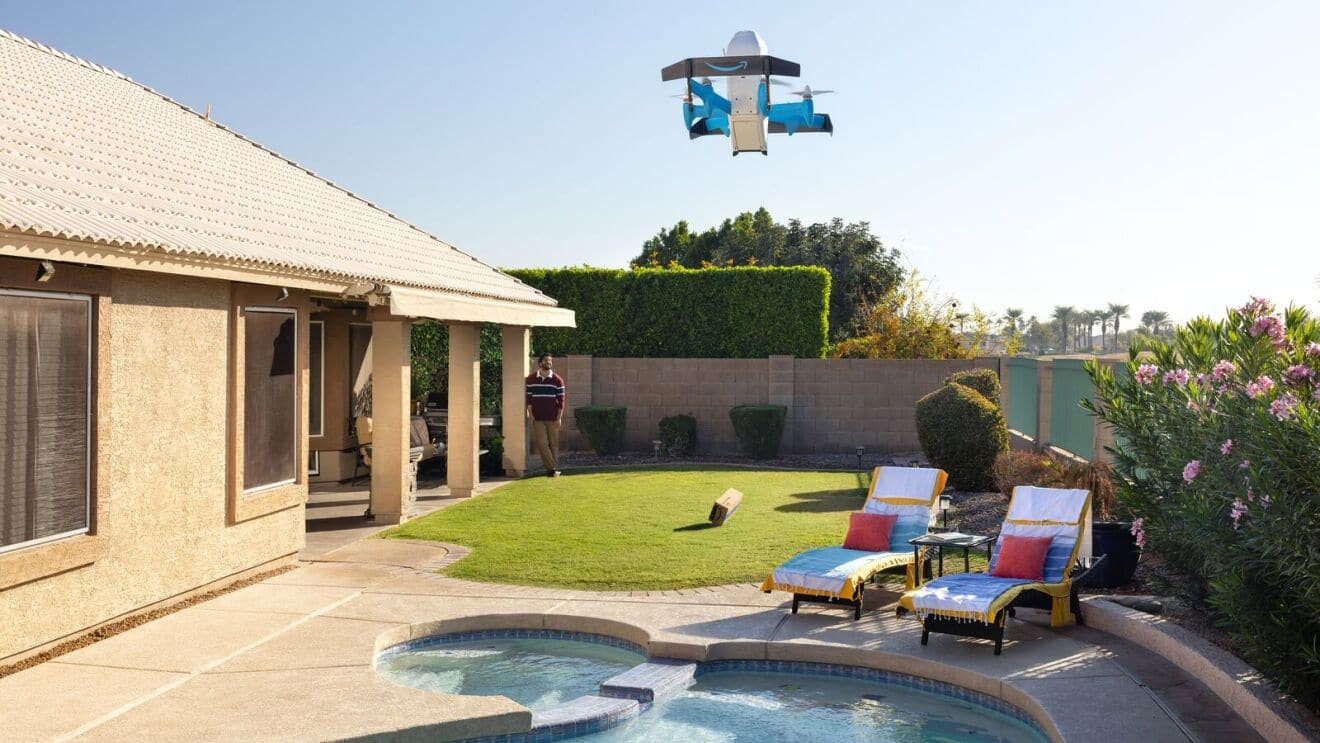
In a back garden in Darlington, a 40-kilo aircraft drops out of the County Durham sky, hovers about four metres up, releases a shoebox-sized parcel onto the lawn, and climbs away again. No van. No driver. No knock on the door. Just a tube of mascara, or a phone cable, delivered from the air in under two hours.
This is Amazon Prime Air, and after more than a decade of promises, slick concept videos and quietly slipped deadlines, the drones have finally done something genuinely new: they have left the United States. Darlington is now the first place anywhere outside America where Amazon delivers shopping by drone — and the first retail drone deliveries in British history flown beyond the operator's line of sight.
For aviation watchers, the parcels are almost beside the point. The real story is what it took to get a fully autonomous aircraft cleared to fly over British houses at all.
Quick Facts
- What: Amazon Prime Air retail drone deliveries — the UK's first beyond-visual-line-of-sight (BVLOS) retail drone service
- Where: Darlington, County Durham — Amazon's first drone-delivery territory outside the United States
- Aircraft: Amazon's MK30 delivery drone (hybrid vertical-takeoff design)
- Payload: Up to 5 lb / 2.2 kg; within a 7.5 mile / 12 km radius; under two hours from order, per Amazon
- Regulator: Civil Aviation Authority (CAA) approved the service in January; authorised as a trial through the end of 2026
- Throughput: Up to ~10 flights an hour, capped at 100 deliveries a day on weekdays
A regulatory first, not just a retail one
The phrase that matters here is beyond visual line of sight. For most of drone history, the rule has been simple and strict: a human has to be able to see the aircraft with their own eyes. That keeps small drones from wandering into the path of helicopters, light aircraft or each other. It also makes parcel delivery economically pointless, because you would need a spotter standing in every garden.
BVLOS flips that. In Darlington, remote operators monitor the MK30s from screens at Amazon's site, coordinating with air traffic controllers at nearby Teesside International Airport when needed. To make it legal, Amazon had to secure a slice of temporary protected airspace — ring-fenced sky reserved for the drones. The CAA signed off on the arrangement in January, then authorised flights to continue on a trial basis through the end of 2026.
That trial framing is important, and it is where some of the breathless coverage gets ahead of itself. This is not a permanent, nationwide green light. It is a tightly bounded experiment: one town, a daily cap, daylight and fair-weather only, and an airspace permission that has to be renewed. Amazon expects it to be extended as it demonstrates safety — but the CAA has not handed over the keys to British skies.
Meet the MK30
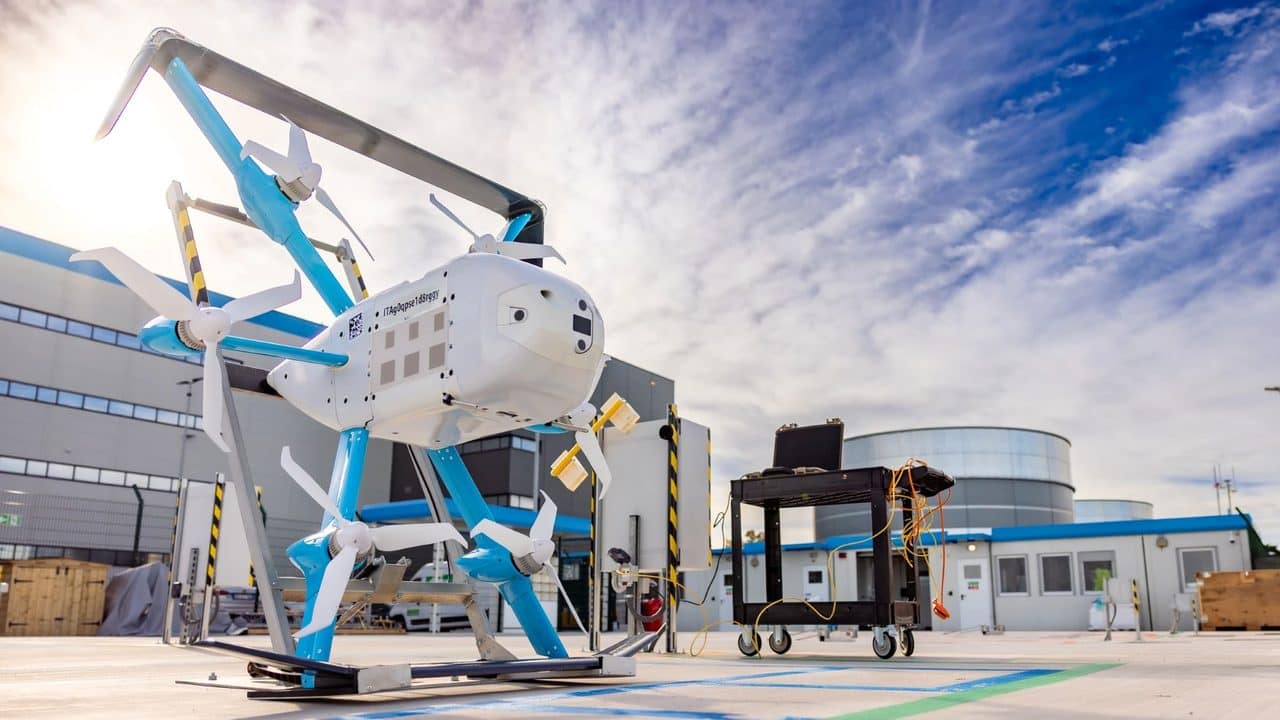
The aircraft doing the work is Amazon's MK30, the latest in a long line of Prime Air prototypes. It is a hybrid: it lifts off and lands vertically like a multirotor, then transitions to wing-borne flight to cruise efficiently. Amazon says it is built for double the range and half the noise of its previous drone, with onboard detect-and-avoid systems trained to spot people, animals, other aircraft — and, on the way down, garden-variety hazards like clotheslines and trampolines that never show up on a satellite map.
It is not small. Amazon's drone stands roughly five feet tall with a wingspan of about five and a half feet, and at maximum takeoff weight it tips the scales around 83 pounds — the overwhelming majority of which is aircraft, not cargo. The payload limit is just five pounds. That ratio tells you everything about how hard delivery drones are: it takes a substantial flying machine to carry a hairbrush.
On a delivery, the MK30 descends to around four metres above the target, confirms the area is clear, and lowers the parcel the rest of the way. Then it climbs back to its cruise altitude — Amazon says the Darlington drones operate between roughly 180 and 280 feet — and flies home to base, where an operator can take over and coordinate with local air traffic control if anything looks off.
What you can actually order
The menu is deliberately mundane. Eligible Prime customers within 7.5 miles of Amazon's Darlington fulfilment centre can opt in and choose from everyday small items — beauty products, cables, batteries, small household and office goods — as long as the order fits the weight limit and they have a suitable open space to receive it. Amazon says packages arrive within two hours, and in many cases far quicker.
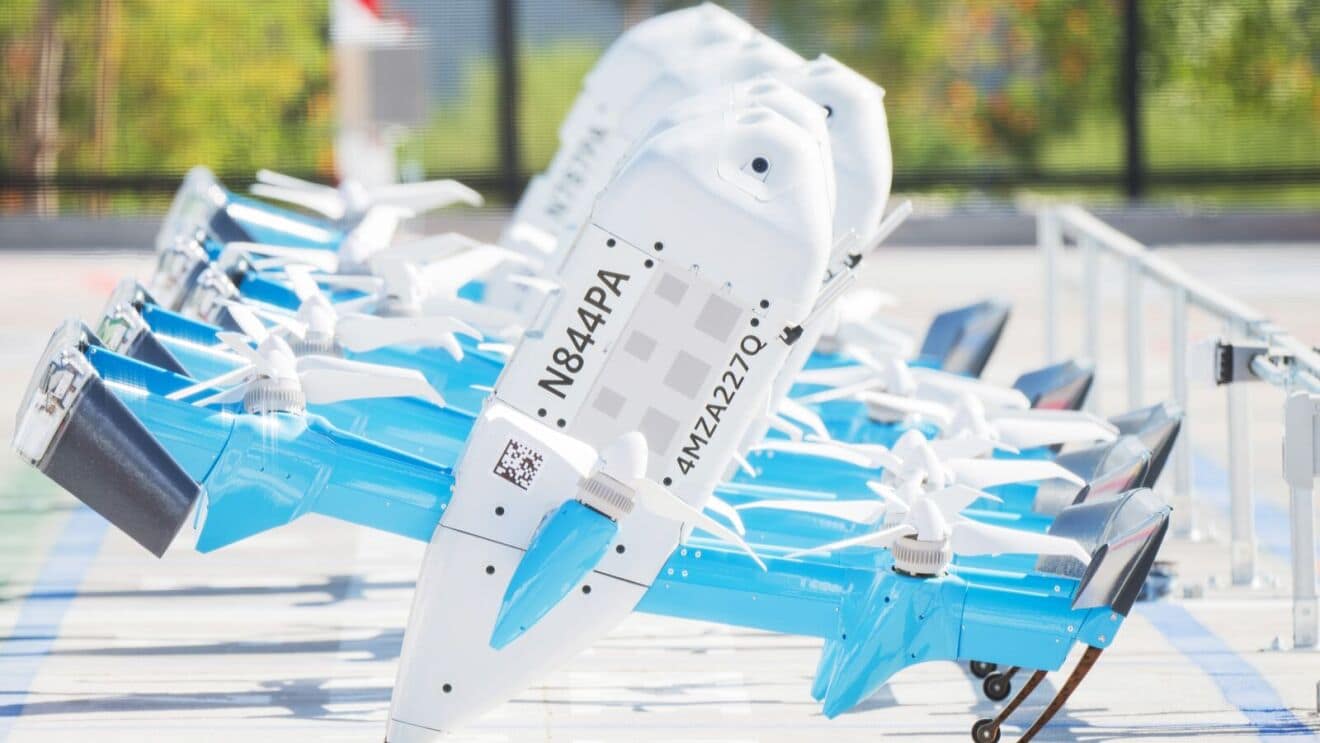
The economics are modest by design. The Darlington operation is capped at around ten flights an hour and 100 deliveries a day, weekdays only — a volume that could never threaten the humble Amazon van. This is a proving ground, not a revolution in your high street. Amazon's longer-term ambition is to expand the hours toward 12 hours a day, seven days a week, and to roll the model out to other UK locations.
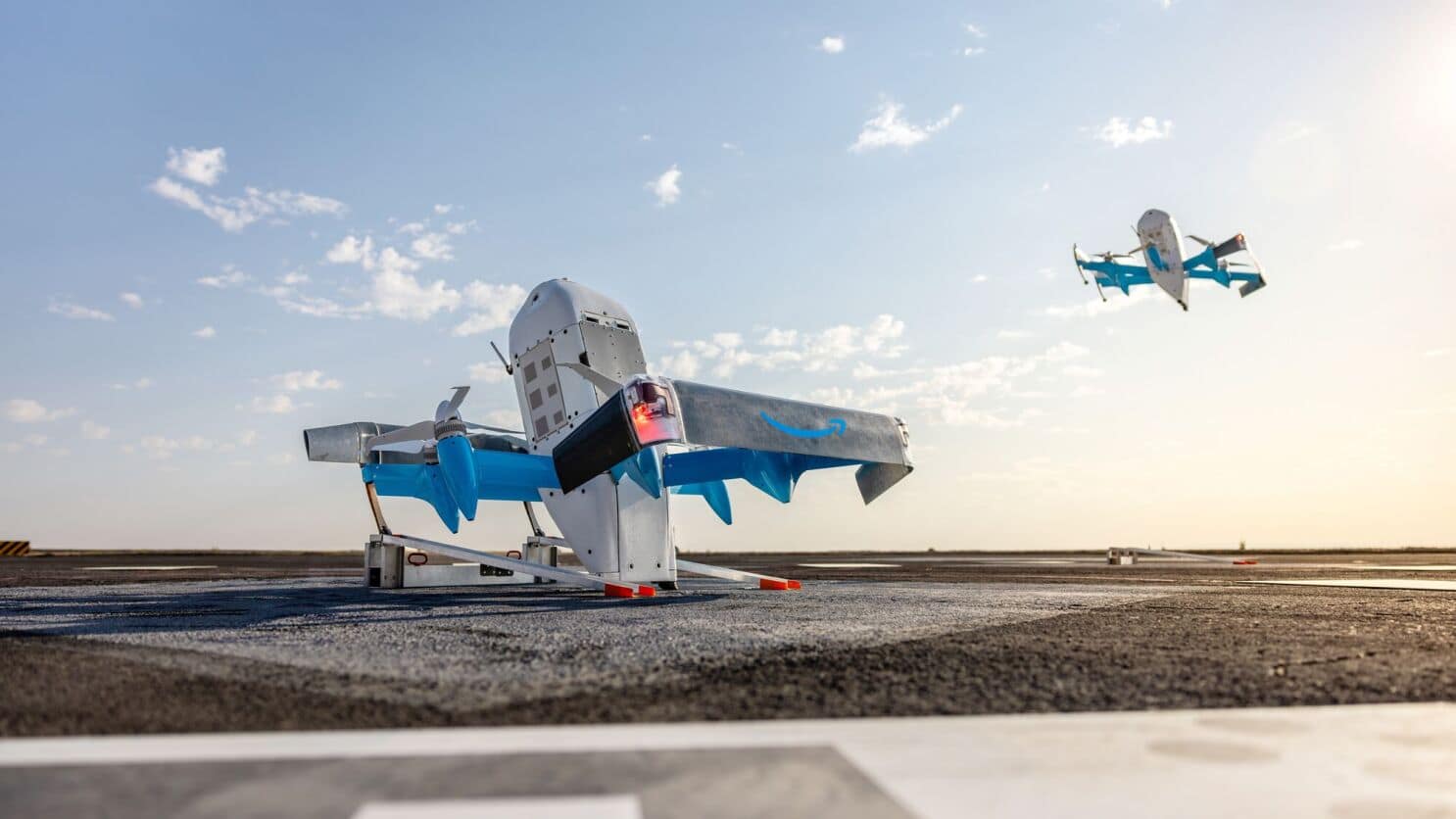
It helps to remember how long Amazon has been chasing this. Jeff Bezos first dangled Prime Air on American television back in 2013, promising parcels by drone within a handful of years. The reality has been a grind of prototypes, crashes and regulatory dead ends — including an earlier UK trial near Cambridge that Amazon abandoned in frustration. Measured against that hype, Darlington is both a genuine milestone and a reminder of how slowly the future actually arrives.
The skeptics, the noise and the cameras
Not everyone in Darlington is thrilled to be the test town. Some residents have raised concerns about noise, privacy and theft. The local council has so far permitted only a temporary structure with a single launchpad, while flagging a lack of evidence about how drone noise will affect people who live nearby.
Amazon's answer is that the MK30 is about as loud as an average van delivery, and that buzzing rotors are arguably less disruptive than slamming doors and reversing trucks. Independent measurements have put the drone in the region of a running dishwasher during delivery. Whether that reassures someone trying to enjoy a quiet garden is another question entirely.
The privacy worry is not paranoia. Delivery drones navigate using cameras and sensors, and Amazon's own documentation acknowledges they may capture overhead imagery of people and property near a drop-off. Customers can request that imagery of their address be removed, but it is less clear how incidental footage of neighbours is handled. As drones become a routine feature of suburban skies, those are questions regulators will have to answer in public, not in a trial's small print.
There is also Amazon's own safety record to reckon with. In the United States, where Prime Air operates in several states, MK30s have had a string of well-publicised mishaps — drones down in Oregon, a collision with a crane in Arizona, and an aircraft that clipped a Texas apartment building after losing its GPS signal. No one was hurt, and Amazon adjusted its procedures, but each incident is a reminder that putting autonomous aircraft over populated areas is unforgiving work.
Why Darlington actually matters
Strip away the novelty and Darlington is a real aviation milestone. Routine, repeatable BVLOS flights over a populated British town — coordinated with a commercial airport, inside dedicated airspace, under a national regulator's sign-off — is exactly the kind of operation the entire drone-delivery industry has been waiting to prove can be done safely. The UK is not alone in trying; Royal Mail is flying parcels to Orkney and the NHS has trialled drones carrying blood across London. But Amazon's Darlington service is the first to put autonomous retail delivery over ordinary back gardens.
The clip below shows what an MK30 delivery looks like up close — the descent, the drop, and the climb-out — which is the part that turns a concept video into something a regulator can actually evaluate.
Whether drone delivery ever becomes as ordinary as the doorbell is still an open bet. The caps are low, the costs are high, and the neighbours are not all convinced. But the hard part — convincing an aviation regulator that a pilotless aircraft can be trusted over your house — just happened in a quiet corner of north-east England. The rest is logistics.
Sources: About Amazon UK; Aerospace Global News; BBC; The Conversation (University of Reading); DroneXL.
Related Questions
Where does Amazon deliver by drone in the UK?
Amazon Prime Air launched drone deliveries in Darlington, County Durham — its first drone-delivery territory outside the United States. The UK’s Civil Aviation Authority approved the service as a trial running through the end of 2026, making it the country’s first beyond-visual-line-of-sight retail drone operation.
What is BVLOS drone delivery?
BVLOS stands for beyond visual line of sight, meaning the drone flies past the point where an operator can see it with their own eyes. Most drone rules require constant visual contact, so Amazon’s BVLOS approval in Darlington is a major regulatory milestone, not just a retail one.
What drone does Amazon Prime Air use?
Amazon uses its MK30 delivery drone, a hybrid vertical-takeoff design. It carries payloads up to 5 lb (2.2 kg) within a 7.5-mile (12 km) radius and aims to deliver in under two hours from order, according to Amazon.
How many drone deliveries can Amazon make per day?
In Darlington, Amazon can run up to roughly 10 flights an hour, capped at 100 deliveries a day on weekdays under the terms of its Civil Aviation Authority trial. The trial is authorised through the end of 2026.
Who regulates drone deliveries in the UK?
The Civil Aviation Authority (CAA) regulates UK drone operations. It approved Amazon’s Darlington service in January and authorised it as a trial through the end of 2026. Cargo drones are advancing fast worldwide — China recently flew a cargo drone autonomously.
Are delivery drones used elsewhere?
Yes. Drone logistics is expanding globally, from retail delivery to heavy cargo. China’s HH-200 cargo drone made its first autonomous flight, and military unmanned aircraft like the MQ-1 Predator pioneered long-endurance drone operations decades ago.

0 Comments