
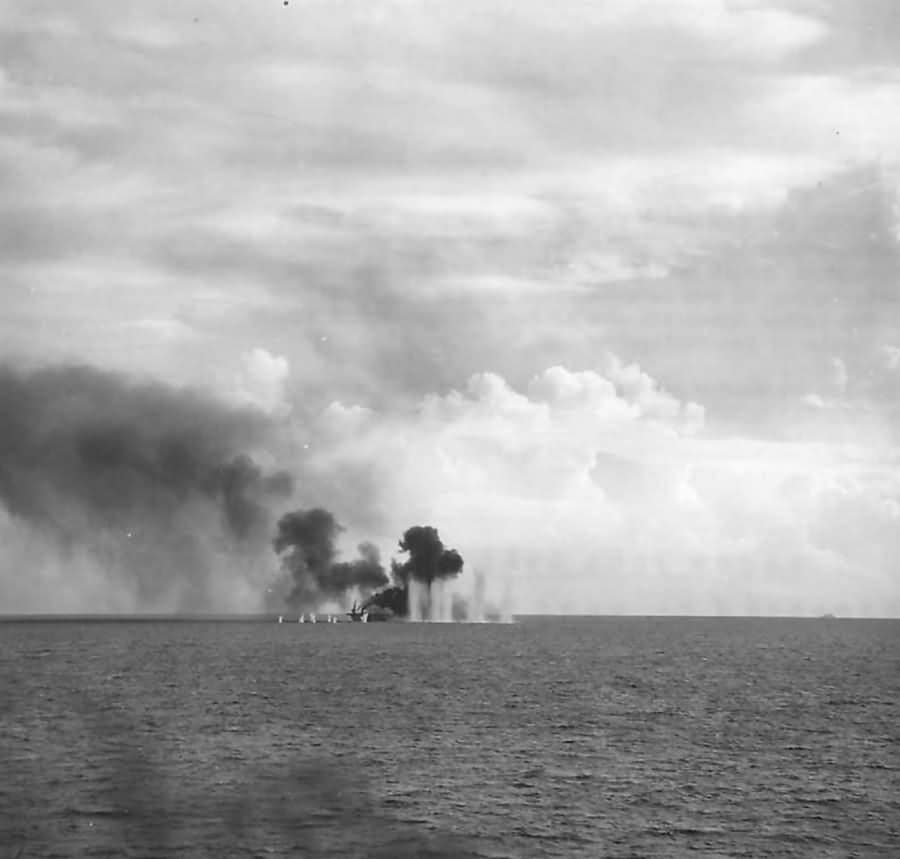
Just after dawn on October 25, 1944, lookouts on a cluster of small American ships off the island of Samar saw something that should not have been there: pagoda masts on the horizon. The most powerful surface fleet Japan could still put to sea — battleships led by the mighty Yamato and her 18.1-inch guns — had slipped through the night and was bearing straight down on them.
Standing in its path were thirteen thin-skinned ships never meant to fight battleships at all: six little escort carriers, three destroyers and four destroyer escorts. They were called Taffy 3. What they did in the next two hours became one of the most astonishing last stands in naval history.
• Battle: Battle off Samar, October 25, 1944 (part of the Battle of Leyte Gulf)
• Taffy 3: 6 escort carriers, 3 destroyers, 4 destroyer escorts (Rear Adm. Clifton Sprague)
• Enemy: Kurita’s Center Force — 4 battleships (incl. Yamato), ~8 cruisers, ~11 destroyers
• US losses: carriers Gambier Bay & St. Lo; destroyers Johnston & Hoel; destroyer escort Samuel B. Roberts
• Outcome: Kurita, believing he faced fleet carriers, turned back — the invasion beaches were saved
• Medal of Honor: Cmdr. Ernest E. Evans (USS Johnston), posthumous
A fight that could not be won
Taffy 3 existed to fly ground-support missions and hunt submarines. Its escort carriers were slow merchant hulls with a flight deck bolted on; sailors joked the “CVE” stood for “Combustible, Vulnerable, Expendable.” Their biggest guns were single five-inch mounts that could not punch through a battleship’s armor. Against them steamed the heaviest guns ever mounted on a warship.
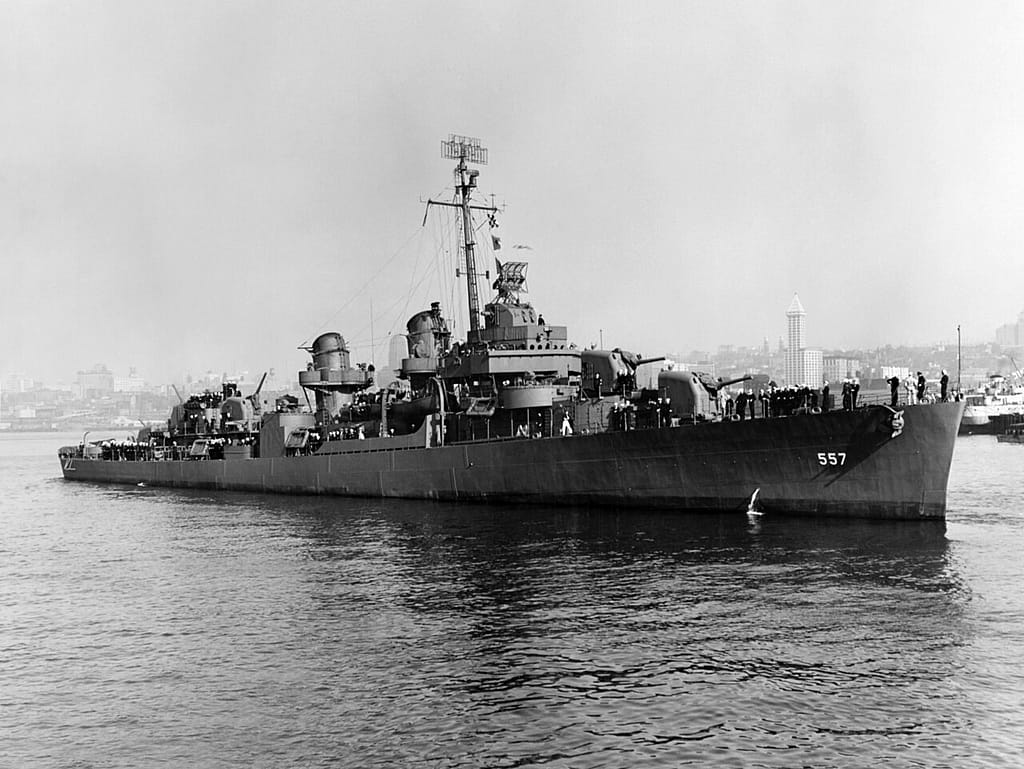
On the bridge of the destroyer USS Johnston, Commander Ernest Evans did not hesitate. He told his crew exactly what they were sailing into.
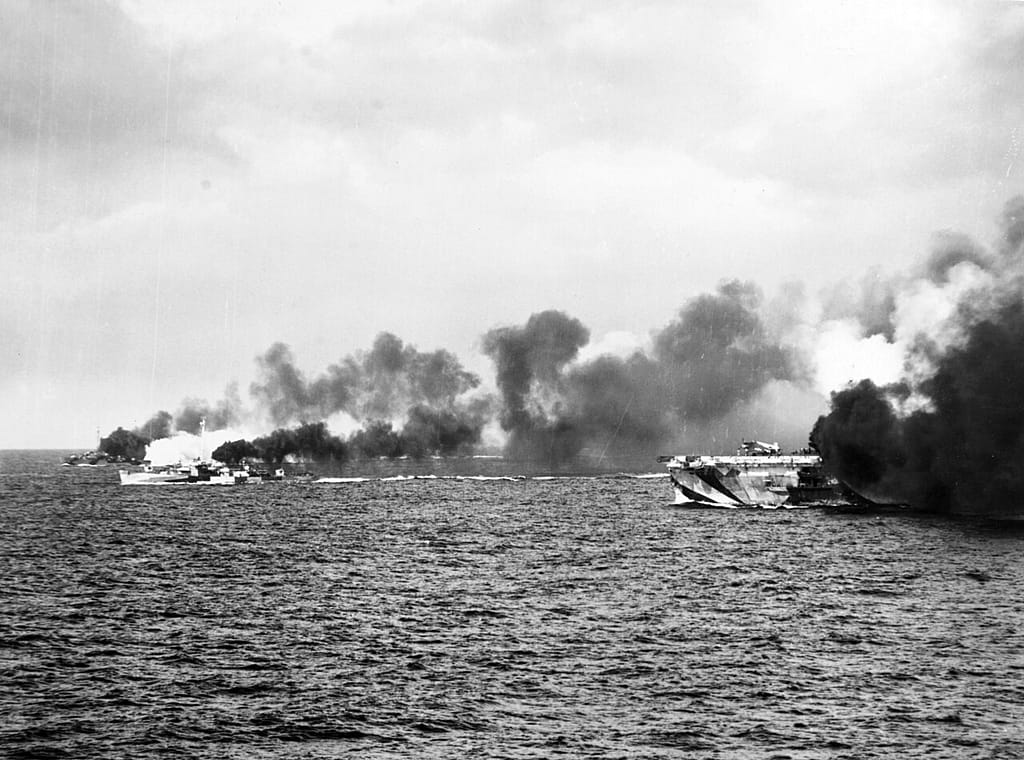
The tin cans charge
Sprague ordered his carriers to run flat-out for a rain squall and sent his destroyers to buy time. What followed defied every rule of a fair fight. The Johnston charged first, alone, straight at a wall of cruisers, firing as she went and loosing her torpedoes before turning away trailing smoke. Hoel, Heermann and the destroyer escort Samuel B. Roberts followed her in, weaving through shell splashes taller than their masts.
Overhead, the carriers’ Avengers and Wildcats attacked without pause — and when their bombs and torpedoes ran out, they made dry runs anyway, forcing Japanese battleships to turn and comb the water for torpedoes that were never dropped. Every minute of confusion was a minute the beaches lived.
Why the giant blinked
It should not have worked. Yet the sheer ferocity of the defense convinced Vice Admiral Kurita he had blundered into a fleet of full-size carriers and cruisers rather than a handful of escorts. Battered, out of formation and fearing worse, he ordered his ships to turn north and withdraw — with the invasion fleet almost within his reach.
The cost was terrible. Gambier Bay went down under gunfire, the only American carrier ever sunk by enemy surface shells. Johnston, Hoel and Samuel B. Roberts were lost with hundreds of their crews, and the carrier St. Lo was sunk by a kamikaze the same morning. Evans, last seen giving orders from the fantail of his ruined ship, was never found.
The legend that outlived them
Evans received the Medal of Honor posthumously — the first Native American in the U.S. Navy so honored. For the survivors, bobbing in shark-filled water for two days before rescue, the miracle was that any of them lived to tell it. For the men on the Leyte beaches, Taffy 3 was simply the reason they were still alive.
For the full account, the naval historian Jon Parshall walks through the battle in detail below.
Sources: Naval History and Heritage Command; Wikipedia, “Battle off Samar”; Warfare History Network; Sprague action report.
0 Comments