
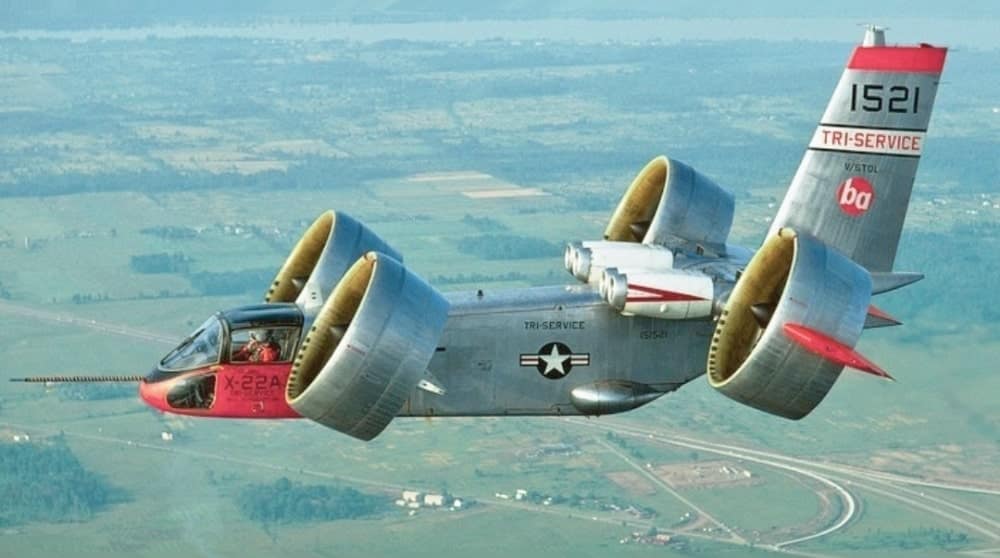
It looks like a Soviet defector's nightmare. Four giant ducted fans, each two metres in diameter, mounted on the corners of a stubby fuselage, tilting between horizontal and vertical flight. The whole machine hangs from those four fans like a hovercraft in the wrong dimension. And in 1967 — twenty years before Osprey first hovered — it was the most promising VTOL design on either side of the Atlantic.
The Bell X-22 was the United States Navy's serious attempt to skip the helicopter generation entirely. Two prototypes were built. Hundreds of test flights were flown over more than two decades. And the lessons learned in those flights are still being applied — by Bell itself — to the V-280 Valor and now to the MV-75 tiltrotor under development for the US Army. The X-22 may be the most consequential aircraft most people have never heard of.
Quick Facts
Designer: Bell Aerosystems
First flight: 17 March 1966
Crew: 2 pilots + up to 6 troops
Powerplant: 4× General Electric YT58 turboshafts driving 4 ducted fans
Max speed (level flight): 410 km/h (255 mph)
Built: 2 prototypes
Fan diameter: 2.13 m (7 ft) per duct
A different solution to the same problem
The 1960s were the decade everyone tried to solve VTOL. The British tried with the Hawker Harrier's vectored-thrust nozzle, which worked. The Germans tried with the Dornier Do 31 jet-VTOL transport, which flew but led nowhere. The Soviets tried with the Yakovlev Yak-38, which mostly killed its pilots. And the Americans tried no fewer than five separate paths simultaneously — Hiller X-18 tilt-wing, Curtiss-Wright X-19 tilt-prop, Ling-Temco-Vought XC-142 tilt-wing transport, Bell XV-3 tilt-rotor, and the X-22.
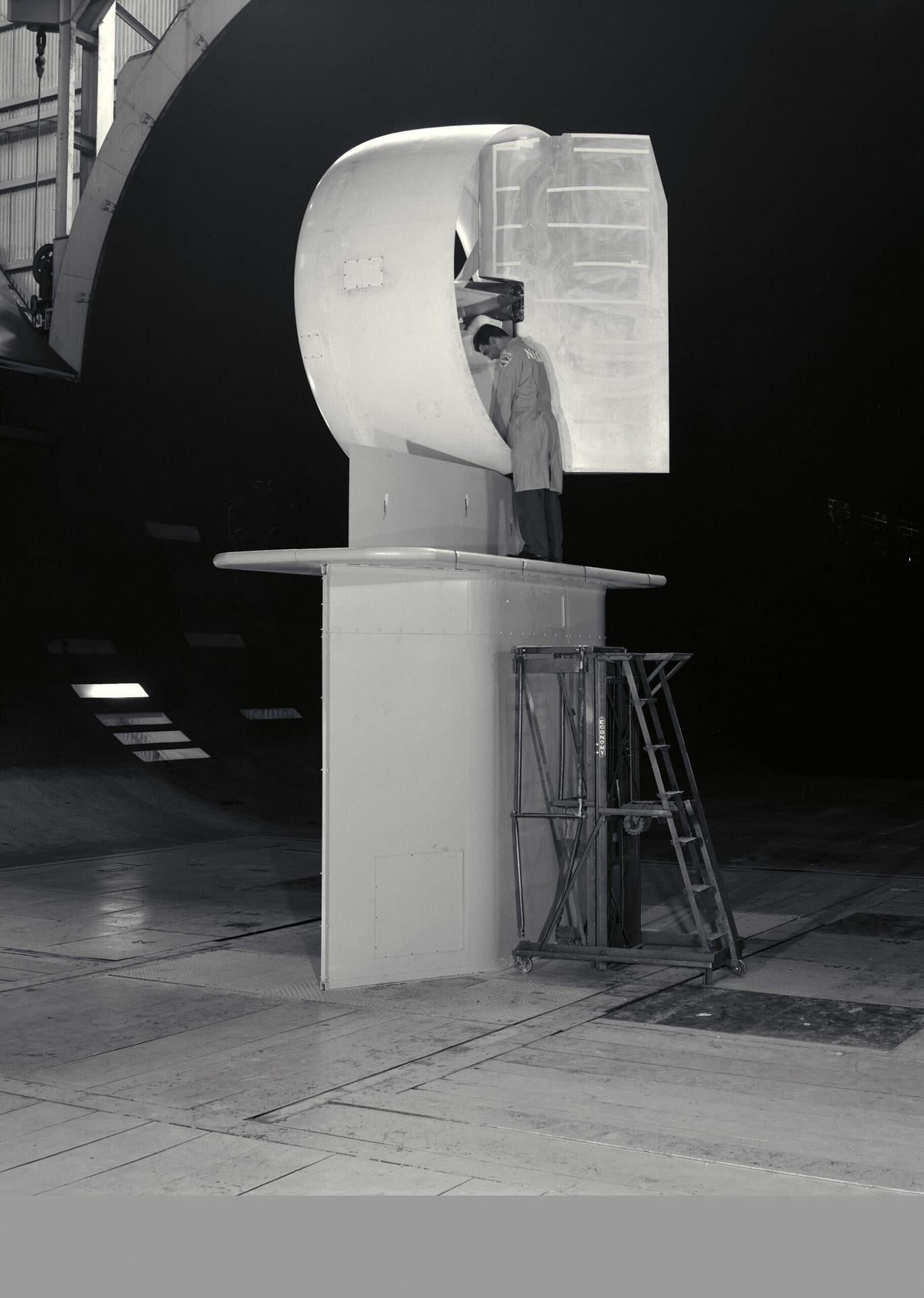
The X-22 was Bell's attempt to combine the best parts of all of them. Like the tilt-rotor, it kept the rotors at the wingtips. Like the tilt-wing, it tilted big lifting surfaces from vertical to horizontal flight. But unlike either, it put the fans inside ducts — circular fairings that increased static thrust by roughly 30 percent compared to an open propeller of the same diameter, and that protected the blade tips from foreign-object damage on rough field operations.
Why ducted fans matter
A ducted fan is, mechanically, a fan running inside a closely fitted shroud. The shroud captures and redirects the air that would otherwise spill around the blade tips. The result is more thrust, less noise, more safety on the ground, and — crucially — better hovering efficiency at lower speeds. Modern eVTOLs from Joby, Lilium, Eve and Archer have all settled on variations of the ducted-fan concept. The X-22 got there first by 60 years.
Why it never flew operationally
The X-22 worked. The second prototype made the transition from hover to wing-borne flight cleanly on multiple flights. It hit 410 km/h in level flight. It was designed to carry six troops. By every technical measure, the programme was a success.
Three things killed it. First, the helicopter. By 1968 the UH-1 Iroquois was in mass production at a fraction of the cost per airframe, and proving in Vietnam that you could move troops at speed without solving the VTOL transition problem. Second, the political pressure on defence budgets that came with Vietnam. And third, Bell's own tilt-rotor work on the XV-3 was producing data that suggested an aircraft with proprotors on the wingtips, not ducted fans, would scale better to large troop transports. The XV-15 followed the XV-3. The V-22 Osprey followed the XV-15. The V-280 Valor followed the V-22. The MV-75 — the Black Hawk replacement Bell now has on US Army contract — follows the V-280.
The X-22 never made it to production. The first prototype was written off in August 1966, when a propeller-control failure brought it down in a hard landing; the second flew research missions into the late 1980s. It survives at the Niagara Aerospace Museum in upstate New York, near where it was built. It is, in 2026, one of the most underappreciated VTOL aircraft anywhere. Walk up to it and you can see the genealogy of every modern tiltrotor, every eVTOL air taxi, every ducted-fan drone — running back to four engines, four ducts, and a Bell test pilot in upstate New York in 1967.
Sources: NASA Ames Research Center, Niagara Aerospace Museum, National Museum of the US Air Force.
Related Questions
What was the Bell X-22?
The Bell X-22 was an experimental American VTOL aircraft of the 1960s that used four ducted fans, mounted in tilting ducts, to take off vertically and then fly forward. First flown in 1966, it explored the tilt-duct approach to vertical flight decades before the V-22 Osprey.
How did the Bell X-22 take off vertically?
It had four ducted fans — propellers enclosed in circular shrouds — that could tilt. Pointed upward they lifted the aircraft straight up; tilted forward they drove it ahead like a conventional plane, letting the X-22 transition between vertical and horizontal flight.
Did the Bell X-22 predate the V-22 Osprey?
Yes — by roughly 30 years. The X-22 explored tilting-duct vertical flight in the mid-1960s, long before the V-22 Osprey's tiltrotor entered service. Though it never went into production, it was part of the long line of experiments that led toward practical VTOL transports.
How many Bell X-22s were built?
Only two prototypes were built. The X-22 first flew on 17 March 1966 and served as a research aircraft, studying how ducted-fan VTOL handled rather than entering operational service.
How fast was the Bell X-22?
In level flight the X-22 reached about 410 km/h (255 mph), powered by four General Electric turboshaft engines driving its 7-foot ducted fans. It could carry two pilots and up to six troops in the transport role it was designed to explore.
0 Comments