
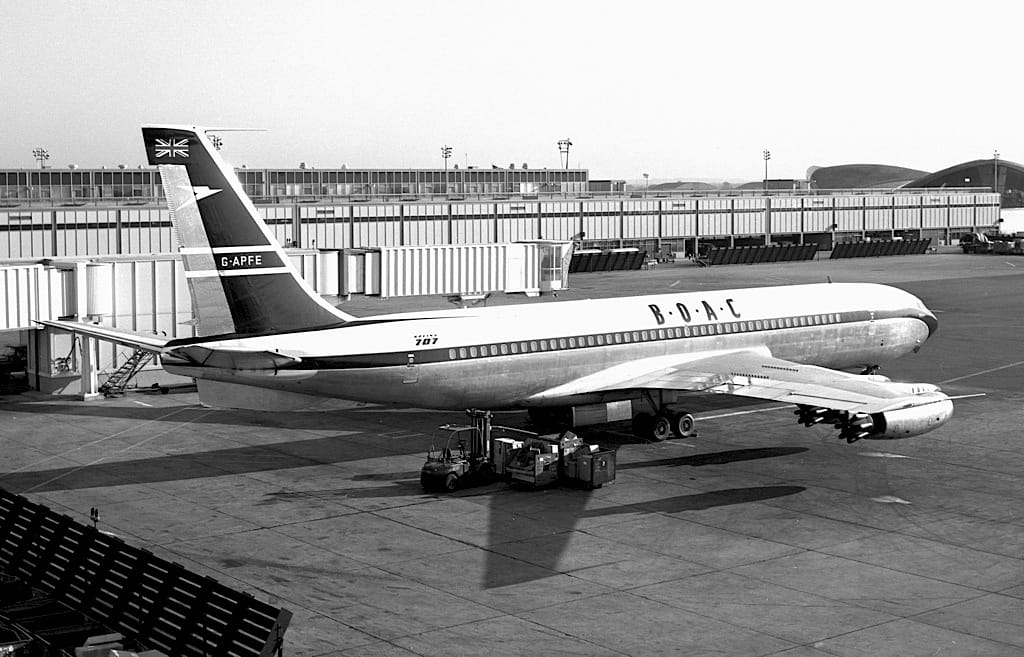
The passengers on BOAC Flight 911 were promised a treat: a close-up view of Mount Fuji, gleaming under a brilliant blue sky. Minutes later, the sky that looked so calm tore their Boeing 707 apart.
The disaster of 5 March 1966 is one of aviation's starkest lessons in a hidden danger — clear-air turbulence — and in how a beautiful, cloudless day can conceal air violent enough to destroy an airliner.
Quick Facts
- Date: 5 March 1966
- Aircraft: Boeing 707-436, G-APFE (BOAC)
- Route: Round-the-world flight; Tokyo Haneda to Hong Kong leg
- Cause: In-flight breakup in severe clear-air (mountain-wave) turbulence
- Location: Near Gotemba, at the foot of Mount Fuji
- Toll: All 124 aboard (113 passengers, 11 crew) killed
A detour for the view
Flight 911 left Tokyo's Haneda Airport at 1:58 p.m. Shortly before departure, the crew asked to switch from an instrument flight plan to visual rules, choosing a route that would carry the 707 close to Mount Fuji so passengers could admire Japan's most famous peak. Visibility was superb. The mountain stood crisp against the sky, and at least one passenger was filming it with an 8 mm cine camera.
The 707 climbed to around 16,000 feet and approached Fuji from the southwest, into the wind — straight toward the invisible violence waiting on the mountain's lee side.
The mountain's invisible wave
When strong winds pour over a large, isolated peak like Fuji, they can set up powerful standing waves and violent, churning rotors of air downwind — mountain-wave turbulence. On a humid day, those waves often reveal themselves as distinctive lens-shaped clouds. But 5 March was bone dry, and no clouds formed. The crew had no visual warning at all.
Flying into that turbulence at 320–370 knots, the 707 was hit by a gust far beyond what the airframe was built to take. The vertical fin failed and struck the horizontal stabilizer; the engine pylons tore away under enormous side loads. The aircraft broke up in the air and fell onto the forests below Fuji. There were no survivors.

What the tragedy taught
Flight 911 became a defining case study in clear-air and mountain-wave turbulence — the kind that gives no radar return and often no visible sign. Its lessons pushed forward the understanding of how terrain shapes the air above it, informing the forecasting, route planning and pilot training that keep modern flights clear of such zones.
It is a sobering reminder tucked inside a postcard-perfect scene: the calmest-looking sky can hide the most dangerous air, and even a machine as strong as a Boeing 707 has limits the atmosphere can exceed.
Sources: Wikipedia (BOAC Flight 911); This Day in Aviation; Simple Flying; Admiral Cloudberg.
0 Comments