
Quick Facts
Suspect: Tianrui Liang, 21, Chinese national studying at the University of Glasgow (Scotland)
Major: Aeronautical engineering
Arrested: April 7, 2026, at JFK Airport, New York
Location of Offense: Offutt Air Force Base, Nebraska
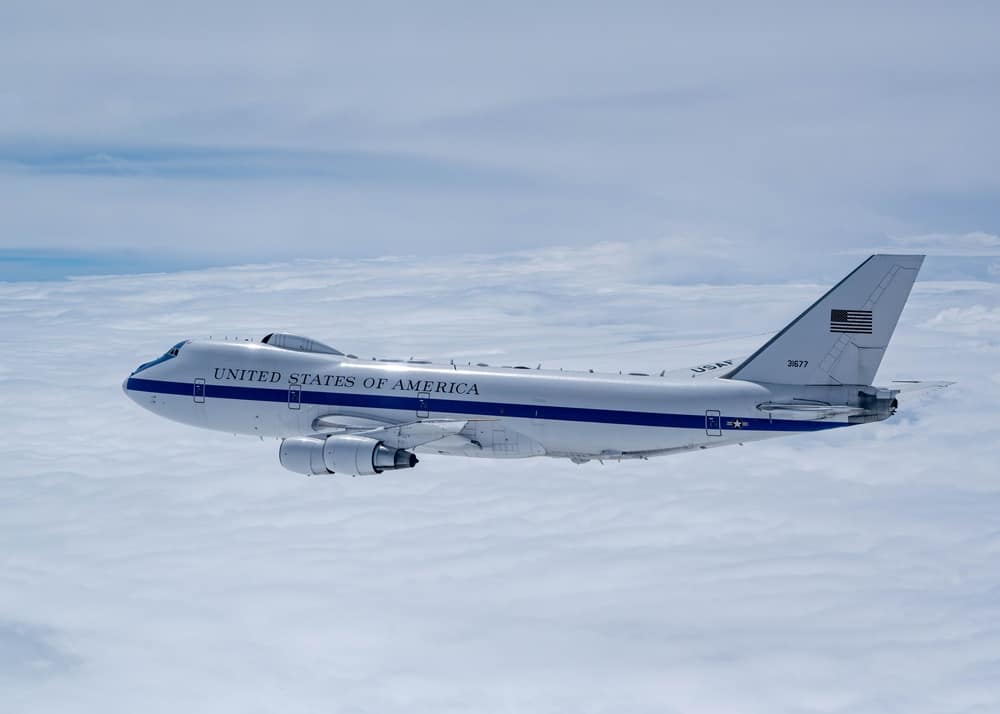
Aircraft Photographed: Boeing E-4B Nightwatch (“Doomsday Plane”) and Boeing RC-135 Rivet Joint (reconnaissance)
Charge: Unauthorized photography of a defense installation (18 U.S.C. § 795)
Base Tenant: U.S. Strategic Command (USSTRATCOM), 55th Wing (Air Combat Command)
The Doomsday Plane and the Spyplane
If you wanted to pick the two worst aircraft to photograph without permission, Liang chose brilliantly. The E-4B Nightwatch is the National Airborne Operations Center — a militarised Boeing 747-200 that serves as a flying command post for the President, the Secretary of Defense, and the Joint Chiefs of Staff in the event of a nuclear war or national emergency. At least one E-4B is on alert 24/7, ready to launch on minutes’ notice. The aircraft carries hardened communications gear designed to survive electromagnetic pulses and maintain command authority when ground-based systems are destroyed. It is, in the plainest possible terms, the airplane from which the end of the world would be managed.
Planespotter or Something More?
According to the FBI affidavit, Liang told investigators he used a planespotting website to find photography locations near Offutt. He admitted he knew photographing military installations without authorisation was illegal. His defence: the images were for his personal collection. The affidavit does not allege that Liang was acting on behalf of any foreign government. There is no accusation of espionage in the formal sense — only the unauthorised photography of a defence installation under 18 U.S.C. § 795, a federal law that restricts photographing military facilities without permission. But the context is hard to ignore. Liang is a Chinese national studying aeronautical engineering — a field with direct military applications. He chose to photograph two of the most strategically significant aircraft in the U.S. inventory. And he was intercepted trying to leave the country.A Pattern of Incidents
Liang’s arrest fits into a broader pattern. In recent years, Chinese nationals have been arrested or investigated for photographing or accessing restricted areas at multiple U.S. military installations. The cases have ranged from tourists wandering onto base perimeters to researchers with more systematic approaches. Offutt itself is a particularly sensitive target. Beyond STRATCOM and the 55th Wing, the base hosts the 557th Weather Wing and serves as a critical node in America’s nuclear command, control, and communications architecture. The aircraft parked on its ramp — E-4Bs, RC-135s, OC-135 Open Skies aircraft, and WC-135 Constant Phoenix nuclear detection planes — represent some of the most specialised and strategically important platforms in the entire Air Force. For a genuine planespotter, Offutt would be a dream location. For an intelligence service, it would be something else entirely. The FBI appears to be keeping its options open on which category Liang falls into.What Happens Next
Liang remains in federal custody. The charge he faces — unauthorised photography of a defence installation — carries a maximum penalty of one year in prison. But if additional charges related to espionage or acting as an unregistered foreign agent were to be filed, the stakes would rise dramatically. For now, the case is a reminder that aviation’s most innocent hobby — standing at a fence with a camera, watching planes — looks very different when the planes are nuclear command posts and the photographer is a foreign national with an engineering degree.Sources: The Aviationist, Fox News, The Aviation Geek Club, Stars and Stripes, FBI affidavit

 English
0 Comments