
Quick Facts
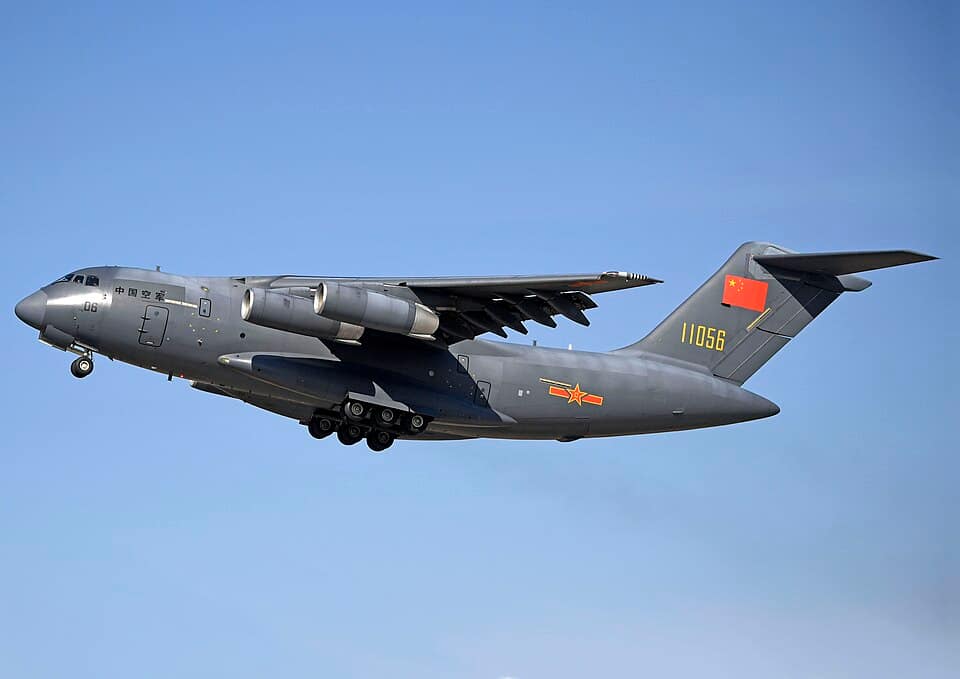
- Aircraft: Xi’an Y-20B — China’s strategic military airlifter, new production variant
- Engines: WS-20 high-bypass turbofans (indigenous) — replacing Russian D-30KP-2s
- WS-20 thrust: ~31,000 lbs per engine vs 26,450 lbs for the D-30KP-2
- First overseas flight: April 20, 2026 — to South Korea
- Escort: Four J-20 stealth fighters accompanied the return flight on April 22
- Mission: Repatriation of 13th batch of Chinese Korean War soldier remains
The Engine That Changes Everything
The Y-20B’s significance lies under its wings. The original Y-20A flew on Russian-built Soloviev D-30KP-2 turbofans — the same engines that power Russia’s Il-76 transport fleet. They are reliable, proven, and available. They are also a strategic vulnerability. Every D-30 China buys is an engine Russia can withhold, delay, or price-gouge. In a crisis, engine supply from Moscow becomes a chokepoint on Chinese military airlift capacity. The WS-20 eliminates that dependency. Developed by the Aero Engine Corporation of China, the WS-20 is a high-bypass turbofan producing approximately 31,000 pounds of thrust — a meaningful improvement over the D-30’s 26,450 pounds. The additional thrust translates directly into payload and range: the Y-20B can carry more cargo farther, and crucially, it can do so on engines manufactured entirely within China. The WS-20’s shorter, wider nacelles are visibly different from the long, narrow D-30 pods, making the two variants easy to distinguish in satellite imagery and photographs. Analysts have tracked the WS-20’s progression from test flights in 2022 to operational service in early 2025, with the Y-20B now entering serial production.Why Four J-20s?
Previous Korean War repatriation flights used Y-20As with conventional fighter escorts — typically J-16s or J-11s. The decision to assign four J-20 stealth fighters to this mission was a deliberate escalation in symbolism. The J-20 is China’s most advanced combat aircraft, a twin-engine stealth fighter that represents Beijing’s claim to great-power parity with the F-22 and F-35. Sending four of them as an escort for a transport mission is militarily unnecessary. Diplomatically, it is a billboard. The formation photographs, released through official PLAAF channels, were clearly pre-planned for public consumption. The message has multiple audiences. For domestic consumption, it demonstrates that China’s military-industrial complex can now power its largest aircraft with indigenous engines while fielding stealth escorts. For Washington, it signals that China’s airlift fleet is shedding its Russian dependencies faster than anticipated. For Taipei, it shows that the PLAAF’s power projection capability — the ability to move troops, equipment, and supplies across the strait — continues to grow.The Airlift Gap Narrows
The Y-20 programme is central to China’s ambitions beyond its immediate neighbourhood. The PLAAF currently operates an estimated 50-plus Y-20 variants, including tanker and airborne early warning configurations. Production is believed to be running at approximately one aircraft per month — a rate that would give China over 100 Y-20s by the end of the decade. For context, the U.S. Air Force operates 222 C-17 Globemasters and 52 C-5 Galaxies. China’s airlift fleet is still smaller, but the Y-20B closes the performance gap. With WS-20 engines and structural improvements, the Y-20B’s maximum payload is estimated to approach 70 tonnes — not far from the C-17’s 77-tonne capacity. A solemn repatriation mission became a technology demonstration. The remains of soldiers from a 1950s war came home aboard an aircraft that represents China’s 2030s military ambitions. That juxtaposition was no accident.Sources: The Aviationist, The War Zone, Bulgarian Military, Aviation Week


 English
0 Comments