

The pilot puts on a Bell helmet, climbs into a cockpit narrower than a kitchen drawer, and starts two engines with scarcely more combined power than a ride-on lawnmower. The whole aircraft, fully fuelled and with him in it, weighs 170 kilograms. The wingspan is just under five metres. And when the throttles open, the Colomban Cri-Cri does the kind of thing nobody expects: it loops, it rolls, it climbs at 1,200 feet a minute, and it lands at 35 knots on a piece of grass shorter than a tennis court.
It is the world’s smallest twin-engine aircraft. It is the world’s smallest aerobatic aircraft. It is also — extraordinarily — fully aerobatic, stressed for loops and rolls, and routinely flown at French and Swiss airshows by pilots who built theirs in a garage.
Quick Facts
Designer: Michel Colomban, France
First flight: 19 July 1973
Empty weight: 78 kg (172 lb)
Max takeoff weight: 170 kg (375 lb)
Wingspan: 4.9 m (16 ft 1 in)
Powerplant: 2× JPX PUL 212 (15 hp each)
Top speed: 220 km/h (137 mph)
Plans sold worldwide: Several thousand
A homebuilt that broke the rules
Michel Colomban was a French aerospace engineer working in the French aircraft industry in the 1960s when he became annoyed with what he saw as the unnecessary size and weight of the typical homebuilt aeroplane. The conventional homebuilt of the era — a Stinson, a Druine Turbulent, a Jodel D9 — was a single-seat aircraft of about 250 kg empty weight, built around a Volkswagen engine of about 60 horsepower. Colomban believed the same flight envelope could be reached with less than half that weight, less than half that power, and far better fuel economy.
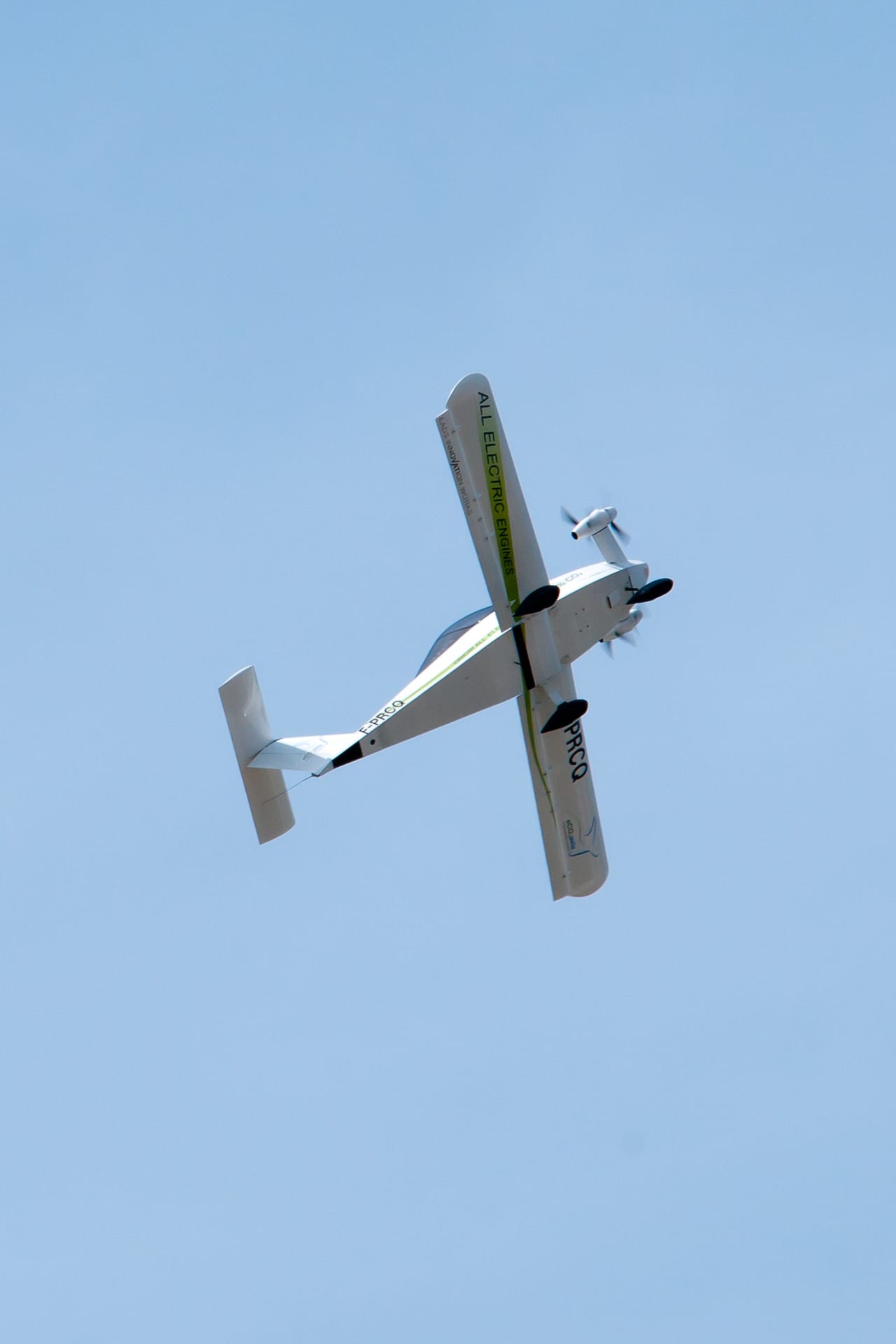
His solution was the Cri-Cri — French for “Cricket” — designed around a pair of small two-stroke engines originally built for chainsaws and snowmobiles. Each engine produced just 15 horsepower. Combined, the Cri-Cri’s two engines produced barely half the power of a typical VW-engined homebuilt. But because the airframe was built around thin aluminium skins bonded to lightweight foam — an unusually efficient sandwich construction for its day — the empty weight came in at 78 kilograms. The result was an aircraft with a power-to-weight ratio competitive with light helicopters.
The acrobatic credentials
Colomban himself was a glider aerobatic pilot. The Cri-Cri was designed for aerobatic flight from the start — loops, rolls, inverted flight, even snap rolls. Its low wing loading and high power-to-weight made it surprisingly capable in display flight. Cri-Cri aerobatic displays have been a fixture at airshows across France and Switzerland for decades.
The electric, the jet, and the airshow circuit
The Cri-Cri has spawned three improbable variants. French display pilot Hugues Duval has flown a Cri-Cri fitted with two tiny turbojets — the jet conversion, known as the MC-15J Cri-Cri Jet, is generally recognised as the world’s smallest twin-jet aircraft.
In 2010, EADS Innovation Works built an electric Cri-Cri using four brushless DC motors and lithium-polymer battery packs. It was designed for around 15 minutes of aerobatic flying on a single charge. The world speed record for an electric aircraft, meanwhile, went to a different electrified Cri-Cri: a two-motor Electravia conversion flown by Hugues Duval, which clocked just over 261 km/h in 2010.
And in 2015, Duval’s electric Cri-Cri crossed the English Channel — hours before the Airbus E-Fan made the same trip — although it had to be launched in mid-air from a carrier aircraft rather than taking off on its own.
The garage-built world record holder
Roughly 100 to 120 Cri-Cris are believed to be flying today across France, Switzerland, Belgium, the UK and the United States. Most were built by their owners over three or four years in suburban garages, working from Michel Colomban’s original plans — plans that are still sold by the designer and remain one of the most popular plans-built designs in European aviation.
A Cri-Cri is small. A Cri-Cri is loud — the chainsaw engines have that effect. A Cri-Cri is utterly unlike anything else you will ever sit inside that calls itself an aeroplane. But it loops, it rolls, it sets world records, and it does it on lawnmower fuel. That is, quietly, one of the best French achievements in aviation of the 20th century.
Sources: Aviation et Pilote, Musée de l’Air et de l’Espace, EADS Innovation Works.

 English
0 Comments