
There is a shipping container somewhere in the world right now that does not look like much. Steel box. Corner castings. Maybe a dent or two from a rough crossing. You have seen a million of them stacked at ports, rolling down highways on flatbeds, rusting in fields. Utterly forgettable. That, as it turns out, is the entire point.
DARPA — the Defense Advanced Research Projects Agency, the organisation whose previous bright ideas include the internet, stealth aircraft, and GPS — wants to turn containers exactly like that into self-contained air bases. Not for manned aircraft. For swarms. Up to 500 autonomous drones, stored, maintained, launched, recovered, and re-armed by robotic systems inside a standard Conex box, with a skeleton crew of humans involved in nothing more than defining the mission.
The agency issued Request for Information DARPA-SN-26-33 on April 14, 2026, through its Tactical Technology Office. Responses are due May 15. The document is dry reading — it is a government procurement notice, not a Tom Clancy novel — but the concept it describes is anything but.
• DARPA RFI DARPA-SN-26-33 published April 14, 2026 — responses due May 15
• Swarm size: Up to 500 autonomous Group 1-3 drones per constellation
• Autonomy target: Level 4 — humans define the mission, the system does the rest
• Container types: Conex, 463L pallets, Tricon modules, ISU containers
• Mission sets: ISR, targeting, strike, electronic warfare, communications relay
• Inspiration: Ukraine's Operation Spiderweb — 117 drones from concealed trucks, $7 billion in estimated damage
A Box That Thinks For Itself
What DARPA is after is not merely a drone storage unit. The container is envisioned as an autonomous drone operating hub — a miniature air base handling everything a conventional flight line does, minus most of the people. Internal logistics management. Payload integration. Pre-flight and post-flight diagnostics. Launch and recovery. Mission-data uploads. Recharge and refuel cycles. All robotic.
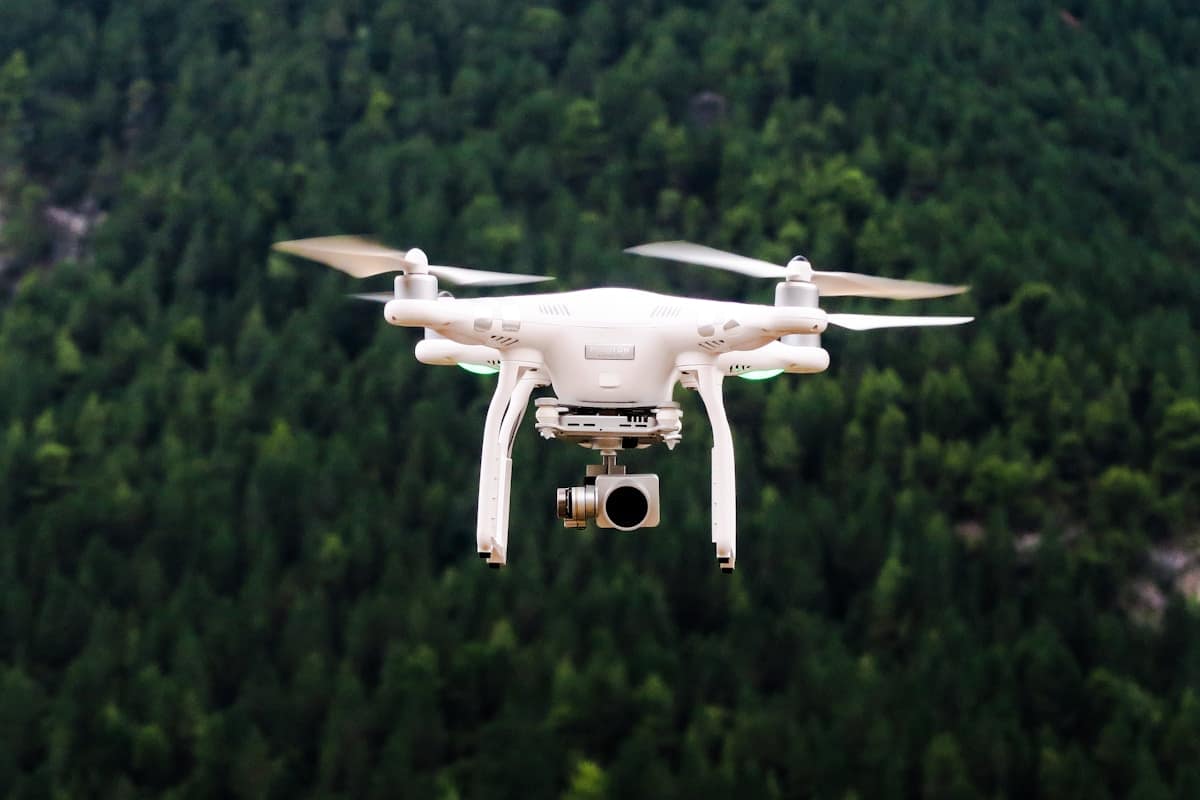
The drones — Group 1 through Group 3, meaning small systems up to roughly 1,320 pounds — must function in GPS-denied environments, using resilient navigation and spectrum-agile data links. DARPA calls the desired end-state an "autonomous constellation" — a networked swarm of up to 500 drones operating as a coordinated unit from one or more containerised hubs.

"The success of Ukraine's Operation Spider's Web did not hinge on technological novelty alone, but rather on the organisational ingenuity, deep reconnaissance, and logistical mastery that enabled Ukraine to strike at the core of Russia's strategic aviation assets."
Ukraine Wrote the Manual
To understand why DARPA is excited about shipping containers, you need to understand what Ukraine did on June 1, 2025. Operation Spiderweb was not the kind of operation that happens by accident. Planning reportedly began 18 months before execution. Ukrainian intelligence operatives spent a year and a half smuggling approximately 150 small strike drones into Russia through covert logistics routes. Then they loaded the drones into wooden sheds, bolted the sheds onto flatbed trucks, and hired unsuspecting Russian drivers to deliver them.
The targets were five of Russia's most sensitive air bases — home to strategic bombers, A-50 airborne early warning aircraft, and Tu-160 nuclear-capable jets. When each truck neared its target, the roof of the shed opened by remote control. The drones launched. 117 of them, simultaneously.
Ukrainian officials reported 41 high-value aircraft damaged or destroyed. Estimated damage: $7 billion. Total cost of the drone component: thousands of dollars per unit. The operation struck 34 percent of Russia's strategic cruise missile carriers in a single night.
The Geometry of Dispersed Warfare
What Spiderweb demonstrated is a fundamental shift in how air power relates to geography. Classical air power requires a fixed base: runways, hangars, fuel farms. Fixed bases are large, detectable, and in a peer conflict with long-range precision missiles, dangerously vulnerable.
The containerised swarm inverts this logic. A standard shipping container fits on a truck, a train, a ship, a C-17, or a CH-47 sling-load. The point is not the container. The point is that the capability moves. Constantly. Unpredictably. In vehicles indistinguishable from the hundreds of millions of containers moving through global logistics every day.
A constellation of 500 drones, deployed from dispersed containers, presents a targeting problem with no clean solution. You cannot bomb the airbase if the airbase is a truck.
Autonomy Level 4 and the Human Question
DARPA's RFI specifies Autonomy Level 4 as the target. In the DoD framework, that means human involvement is limited to mission definition. Once the human sets the objective, the system handles launch, execution, recovery, diagnostics, and relaunch. No pilot in the loop for individual decisions.
The harder question — one the RFI does not address — is legal and ethical. Autonomous systems making targeting decisions in contested airspace, without continuous human control, operate in territory that international humanitarian law has not fully mapped.
What Comes Next
The response deadline of May 15, 2026 will tell DARPA how mature the industrial base is. China is already experimenting with containerised swarm launchers. The United States is not inventing this idea — it is racing to formalise and scale it before potential adversaries do it better.
Somewhere, right now, a standard shipping container is sitting in a port. Nobody gives it a second look. In five years, that might be the most dangerous thing you have ever ignored.
Sources: The War Zone | Army Recognition | Aviation Week | DARPA RFI DARPA-SN-26-33 (SAM.gov) | CSIS
• Experience a Fighter Jet Flight with MiGFlug
Related Questions
What is DARPA's shipping-container drone base?
DARPA wants to turn ordinary shipping containers into self-contained, autonomous air bases. The concept stores, maintains, launches, recovers, and re-arms up to 500 drones inside a standard Conex box using robotic systems, with humans only defining the mission. DARPA issued the Request for Information (DARPA-SN-26-33) on 14 April 2026 through its Tactical Technology Office.
How many drones could fit in one container hub?
Up to 500 autonomous drones, operating as what DARPA calls an autonomous constellation, a networked swarm run from one or more containerized hubs. The drones span Group 1 through Group 3 (small systems up to roughly 1,320 pounds) and must work in GPS-denied environments, echoing the rise of cheap autonomous attack drones.
What is DARPA?
DARPA is the US Defense Advanced Research Projects Agency, the body behind breakthrough technologies including the internet, stealth aircraft, and GPS. Its Tactical Technology Office is now pursuing containerized drone hubs as a way to project autonomous air power from unremarkable, easily hidden steel boxes.
Why hide a drone base inside a shipping container?
Because shipping containers are everywhere and utterly forgettable, stacked at ports, rolling on highways, rusting in fields. Disguising a drone hub as ordinary cargo makes it extremely hard to spot or target. Robotic systems would handle logistics, payload integration, diagnostics, launch, recovery, and recharging with almost no human crew.
What inspired the containerized drone swarm concept?
Recent drone warfare, including Ukraine's Operation Spider's Web strike on Russian strategic aircraft, has shown how cheap, coordinated drones can hit high-value targets. Analysts note such successes hinge on organizational ingenuity and logistical mastery, the same forces driving Europe's robot wingmen and other autonomous programs.
0 Comments