
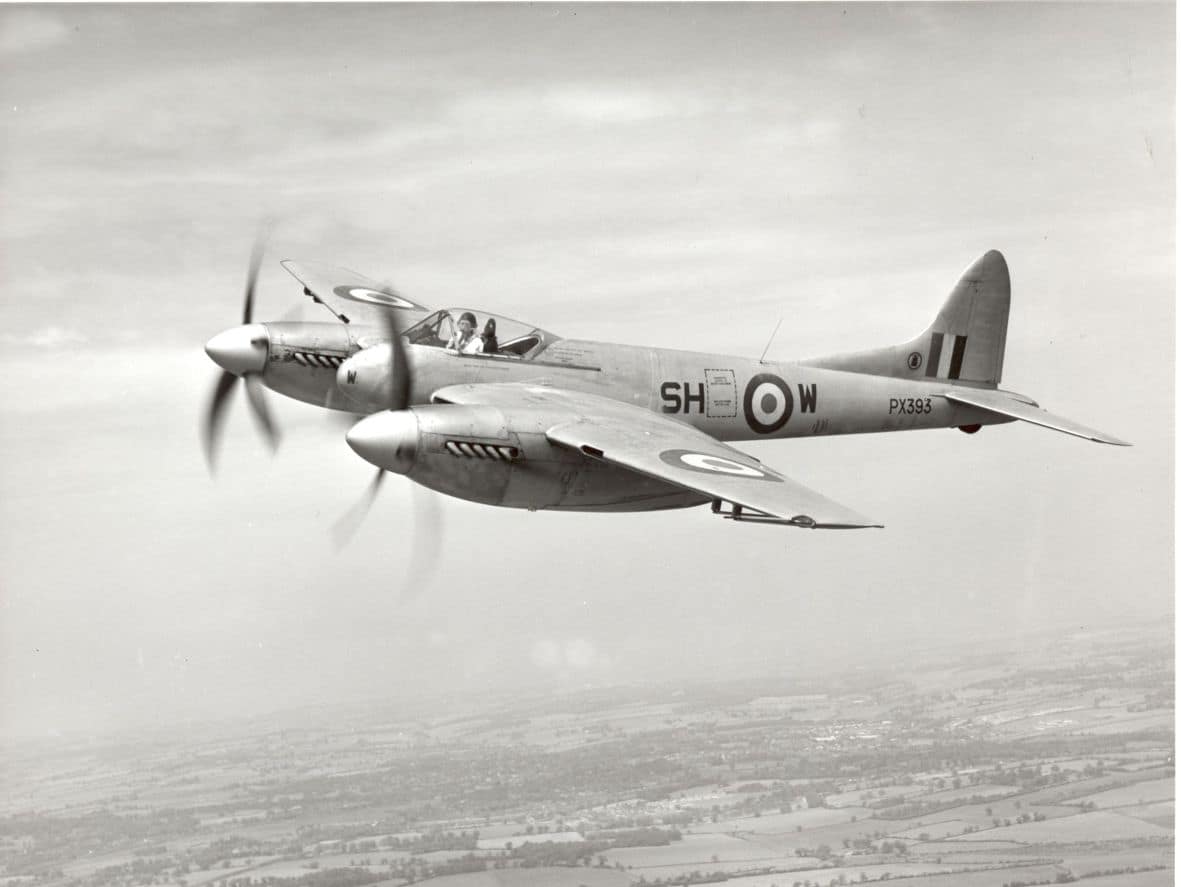
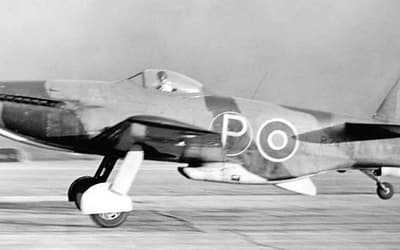
Eric “Winkle” Brown flew more different types of aircraft than any human being who has ever lived — nearly five hundred of them, from Spitfires to jets to captured German rocket planes. And of all of them, the one he wrote about with the most unguarded affection was a wooden twin-engined fighter that never fired a shot in the Second World War: the de Havilland Hornet.
It was, quite simply, the fastest twin piston-engined fighter ever built — a sleek, hot-rod descendant of the legendary Mosquito that arrived just a heartbeat too late for the war it was designed to win.
Quick Facts
- Aircraft: de Havilland DH.103 Hornet; first flew 28 July 1944
- Lineage: a slimmer, faster single-seat development of the de Havilland Mosquito
- Engines: two Rolls-Royce Merlins, 2,070 hp each, with “handed” opposite-turning propellers
- Speed: around 475 mph — the fastest twin-piston fighter ever
- Armament: four 20 mm Hispano cannon
- Service: RAF and Fleet Air Arm; combat in Malaya; retired 1956
A Hot-Rod Mosquito
The Hornet grew out of the Mosquito, and it shows: the same graceful lines, the same clever wooden construction of balsa sandwiched between plywood. But it was an entirely fresh design, slimmed to the bone for one purpose — speed and range enough to escort bombers across the vast distances of the Pacific war against Japan.
De Havilland gave it two slim-line Merlins with a trick up their sleeve: the propellers turned in opposite directions, cancelling out the vicious torque that made powerful twins a handful on take-off. The result was blistering. The prototype hit 485 mph, and pilots found an aircraft with fighter-like handling and, in Eric Brown’s words, an excess of power that made vertical manoeuvres feel “rocket-like.”
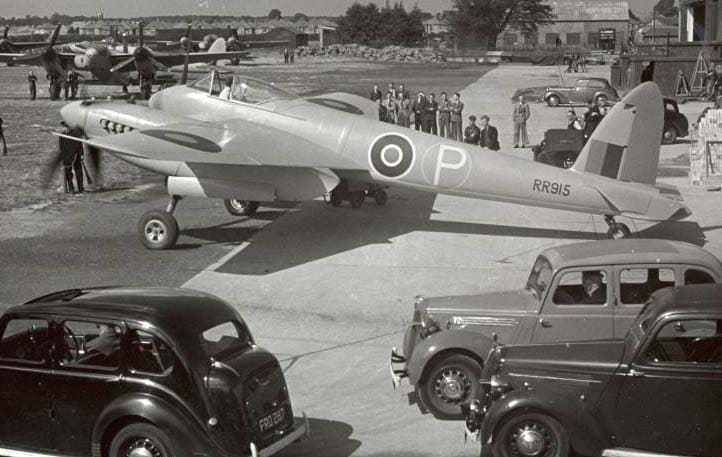
Too Late for the Big War
There was just one problem: the timing. The Hornet first flew in the summer of 1944 and did not reach squadrons until 1946 — after the war it was built to fight had ended. And by then the jet age had arrived. The Gloster Meteor, the de Havilland Vampire and their successors were already making even the fastest propeller fighter look like yesterday’s idea.
So the Hornet became a magnificent aircraft in search of a war. It served as an RAF day fighter at home, set point-to-point speed records, and thrilled crowds at air races. A navalised Sea Hornet flew from the Royal Navy’s carriers. But its moment as a front-line fighter was always going to be short.

One Real War, in the Jungle
The Hornet did find combat, far from Europe. In the early 1950s, RAF Hornets based in Singapore fought through the Malayan Emergency, using their long range and heavy punch to loiter for hours over the jungle and strike Communist guerrilla positions with rockets and bombs. One squadron alone flew some 4,500 operational sorties over five years — more than any other in the Far East.
The last operational Hornet sortie was flown in 1955, and within a year the type was gone, its wooden airframes deteriorating in tropical storage. Not one complete Hornet survives today — a sad fate for what may have been the finest piston-engined fighter Britain ever built.
The Hornet is the great “what if” of the propeller age: an aircraft so good that the man who flew nearly five hundred types loved it above almost all others, born into a world that had already decided the future belonged to the jet. It was the perfect answer — to a question the war had stopped asking.
Sources: Wikipedia; Eric Brown, Air International (“Viewed from the Cockpit: Sea Hornet Supreme”, 1982); Philip J. Birtles, The De Havilland Hornet.
0 Comments