
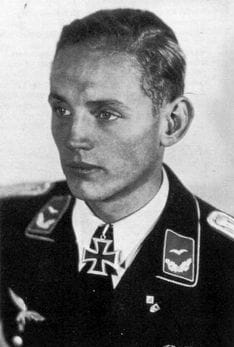
Quick Facts
| Nationality | German 🇩🇪 |
| Aerial Victories | 352 (all-time record — never broken) |
| Aircraft Flown | Bf 109G/K |
| Wars | World War II (Eastern Front) |
| Born / Died | 19 Apr 1922 – 20 Sep 1993 (age 71) |
| Unit | JG 52 |

Two hundred and fifty-two kills above his nearest rival. A total so staggering that historians spent decades attempting to disprove it. Erich "Bubi" Hartmann is the highest-scoring fighter ace in the entire history of aerial warfare — and the number is not even close.
The Boy Pilot
Born in 1922 in Weissach, Germany, Erich Hartmann grew up fascinated by aviation — his mother was a glider pilot, and he followed her into the air as a teenager. He joined the Luftwaffe in 1940 and was posted to JG 52 on the Eastern Front in 1942. His first combat missions were disastrous; he was so eager and undisciplined that his wingman had to rescue him repeatedly. His early nickname was "Bubi" — the kid.
Then something clicked. Under the guidance of experienced pilots, Hartmann developed a combat philosophy of ruthless simplicity: get close, aim precisely, fire once. He described his ideal engagement as closing to within 50 metres before opening fire — so close that he could see the rivets on the enemy aircraft. At that range, he almost never missed.

352 Victories: The Number That Defies Belief
By the end of WWII, Erich Hartmann had 352 confirmed aerial victories — all but seven of them against Soviet aircraft on the Eastern Front. He flew 1,404 combat missions, was shot down or forced to land 16 times (always managing to return to his unit), and was never seriously wounded. His kill rate was extraordinary: on some days he claimed five, six, or even seven victories.
Soviet pilots knew him as the "Black Devil of the South" due to the black tulip markings on his aircraft's nose. He was so feared that Soviet pilots reportedly broke formation and fled when they identified his aircraft approaching. He was awarded the Knight's Cross with Oak Leaves, Swords and Diamonds — Germany's highest military decoration — and became the most decorated German serviceman of WWII.
Ten Years in a Soviet Prison Camp
After the war, Hartmann was captured by Soviet forces and spent ten years in Soviet prison camps, repeatedly refusing to cooperate with attempts to use him as a propaganda tool or to establish a "German" air force under Soviet supervision. He was finally released in 1955 and returned to West Germany, where he was welcomed as a hero.
He served in the new Bundeswehr's Luftwaffe until 1970, became one of its first jet pilots, and repeatedly clashed with superiors over tactics and aircraft procurement — never losing the forthright stubbornness that had defined him since his days as Bubi the undisciplined rookie. He died in 1993 at the age of 71.
The Black Tulip and the Soviet Pilots Who Refused to Fight
By early 1944 Hartmann's Bf 109 was unmistakable. He had painted a stylised black tulip across the nose cowling — a design that wrapped from the spinner back along the engine cover in petal-like points. Other German pilots laughed. The Soviets stopped laughing within weeks.
VVS pilots learned to recognise the marking, and large numbers of Soviet aircraft began refusing combat with the Tulip aircraft entirely — turning hard for home the moment the silhouette was identified. Hartmann's kill rate paradoxically dropped. The opposition was running before he could engage.
On 21 March 1944, he had the tulip painted over. The kills came straight back. Over the following two months, flying an anonymous Bf 109, Hartmann scored more than 50 additional victories.
The Record That Will Never Be Broken
Modern air combat — with precision missiles, beyond-visual-range engagements, and small, professional air forces — makes Hartmann's record functionally impossible to repeat. Three hundred and fifty-two kills. It stands alone in aviation history, the high-water mark of an era when the sky was a killing ground and one man, flying the same Bf 109 day after day, turned it into his personal domain.
“The fundamentals of flying never change. What changes is only the machine. The sky, the enemy, the moment of decision — those are eternal.”
— Erich Hartmann — final interview“See — Decide — Attack — Reverse. Eighty per cent of my kills never knew I was there.”
Erich Hartmann — describing his combat doctrine in interviews with biographers Trevor Constable and Raymond F. Toliver (The Blond Knight of Germany, 1970)
Watch: Erich Hartmann Documentary
Yarnhub tells the full Erich Hartmann story — “The World’s Greatest Flying Ace.”
Related Questions
Who was the highest-scoring fighter ace of all time?
Erich Hartmann is the highest-scoring fighter ace in the history of aerial warfare, with 352 confirmed victories. A German Luftwaffe pilot nicknamed "Bubi," he flew the Bf 109 with JG 52 on the Eastern Front during World War II. His record has never been approached, let alone broken.
How many planes did Erich Hartmann shoot down?
Erich Hartmann shot down 352 aircraft, all but seven against Soviet forces on the Eastern Front. He flew 1,404 combat missions and was shot down or forced to land 16 times, always returning, and was never seriously wounded. Behind him rank Gerhard Barkhorn with 301 and Günther Rall with 275.
What was Erich Hartmann's combat tactic?
Hartmann's philosophy was ruthless simplicity: get close, aim precisely, fire once. He preferred closing to within 50 metres before opening fire — so close he could see the rivets — making misses almost impossible. Early on he was an undisciplined rookie nicknamed "Bubi" (the kid) before mastering the craft.
Why did Soviet pilots fear Erich Hartmann?
Soviet pilots reportedly fled when they recognised Hartmann's aircraft, which carried distinctive black tulip nose markings. His extraordinary kill rate — sometimes five to seven victories in a single day — made him the most feared fighter pilot on the Eastern Front, and the most decorated German serviceman of the war.
What happened to Erich Hartmann after World War II?
After the war Hartmann was captured by Soviet forces and spent ten years in prison camps, refusing to cooperate with propaganda efforts. Released in 1955, he joined West Germany's Bundeswehr Luftwaffe, became one of its first jet pilots, and served until 1970. He died in 1993, aged 71.
Has anyone broken Erich Hartmann's record of 352 kills?
No, and almost certainly no one ever will. Modern air combat involves far fewer aircraft and engagements, so Hartmann's 352 victories stand as an effectively unbreakable record. He remains the benchmark against which all of history's greatest fighter pilots are measured.
0 Comments