
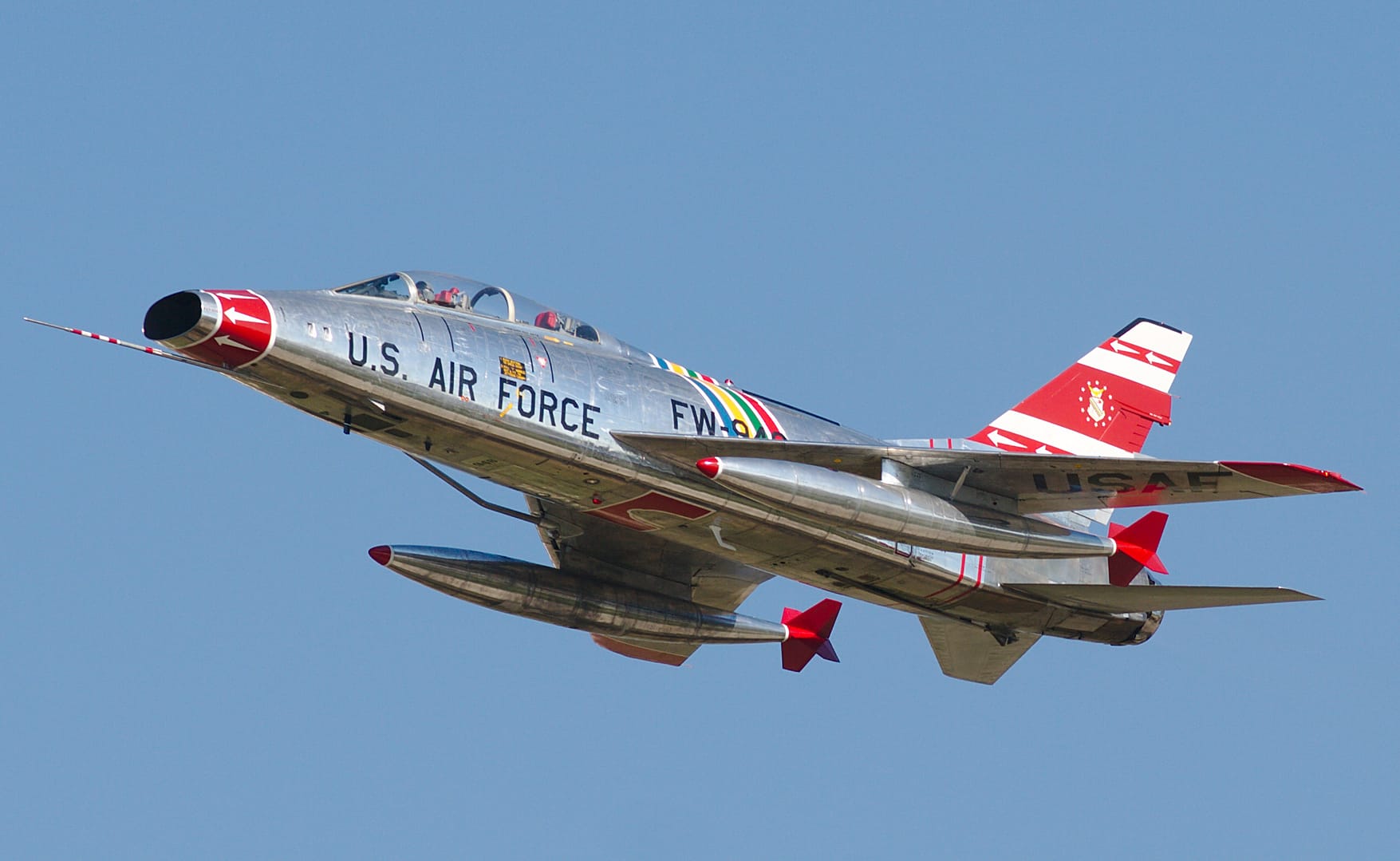
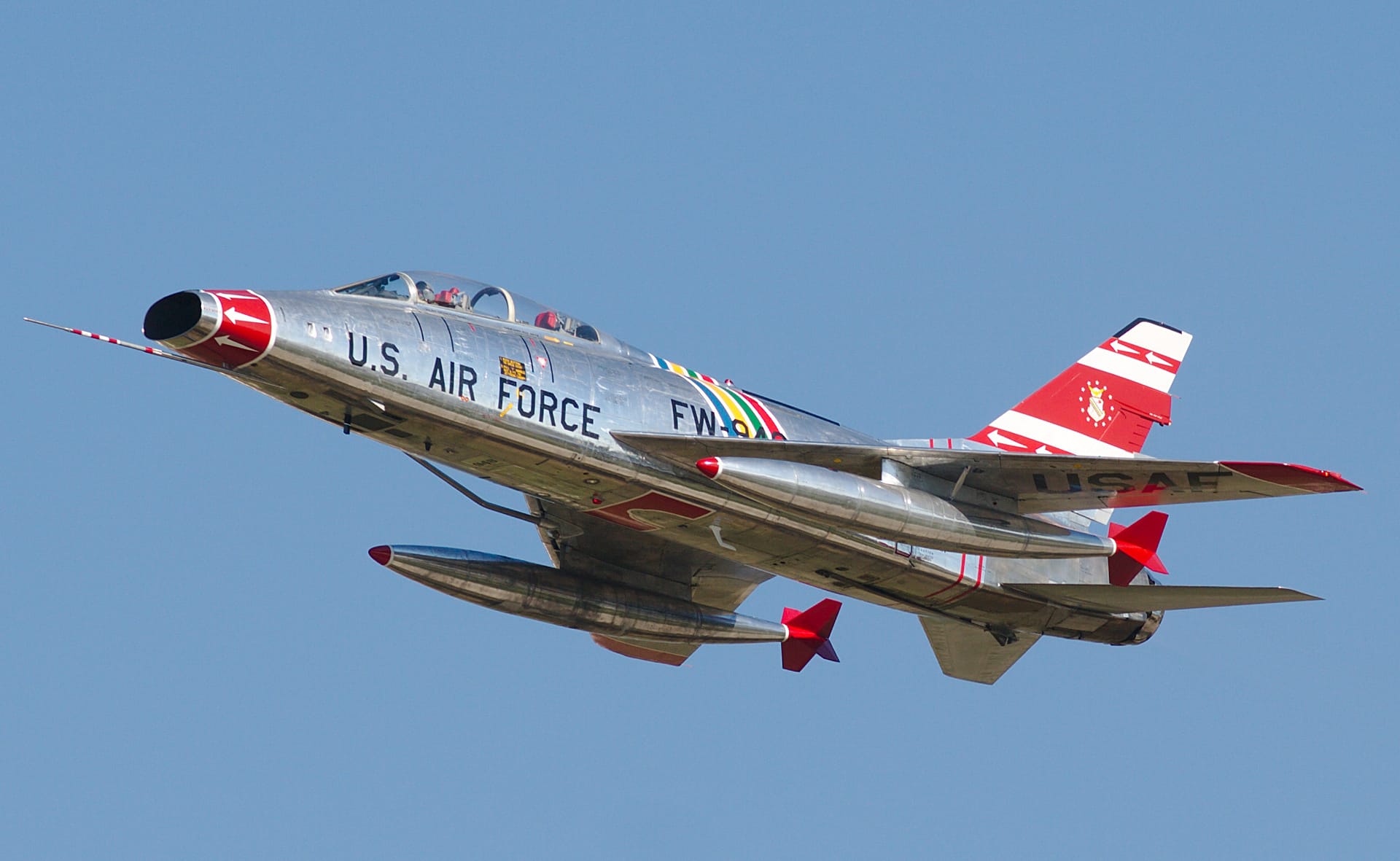
Imagine the worst-case scenario from the Pentagon perspective in 1957: the Soviet Union launches a surprise nuclear strike against NATO. The first warheads land on every U.S. and allied air base in Western Europe within the first ten minutes. Every runway is cratered. Every alert F-100 Super Sabre sits trapped on the apron with nowhere to take off from. NATO loses its tactical nuclear strike capability in the opening seconds of the war.
The proposed solution was as bold as it sounds. Bolt a massive solid-rocket booster to the underside of the F-100, mount the whole fighter on a steel ramp pointing up at a 20-degree angle, and launch it like a missile straight off the ramp into flight. Zero runway required. Zero takeoff roll. Zero-Length Launch. ZEL. They actually built it. They actually tested it. And it actually worked.
Quick Facts
Aircraft: North American F-100D Super Sabre
Booster: Astrodyne XM-34 solid-propellant rocket, 130,000 lbf thrust for 4 seconds
Concept: Zero-Length Launch (ZEL) — fighter launched directly off a tilted ramp, no runway required
First piloted launch: 26 March 1958, Edwards Air Force Base, California
Pilot of first launch: Al Blackburn, North American Aviation test pilot
Acceleration: Roughly 4 g sustained; 0 to 275 mph in 4 seconds
Total test launches: Dozens across the F-84, F-100, F-104G and MiG-19 programmes
Aircraft tested with ZEL: F-84 Thunderjet, F-100 Super Sabre, F-104G Starfighter (West German Luftwaffe), MiG-19 (Soviet Union)
Reason for cancellation: Strategic doctrine shifted toward dispersed alert and ballistic missiles; logistics of pre-positioned boosters proved impractical
Operational deployment: Zero. ZEL never went operational anywhere.
Why ZEL existed
The Cold War in 1957 was a constant calculation of how to absorb a Soviet first strike and still hit back. NATO’s tactical nuclear deterrent in Europe — F-84F Thunderstreaks, F-100D Super Sabres, later F-104G Starfighters armed with single Mk 28 thermonuclear bombs — was based at fixed airfields. Every Soviet planner knew exactly where those airfields were. Every Soviet planner had targeted them with megaton-class warheads.
The U.S. Air Force’s problem was straightforward. If the Soviets struck first, the alert nuclear-armed fighters could not reach their targets because their runways no longer existed. The deterrent only worked if the bombers could survive the opening strike — and in 1957, they almost certainly could not.
Several solutions were studied. Hardened aircraft shelters helped a little. Dispersal to civilian airports helped a little more. Pop-up alert pads at remote sites helped a bit more. But none of them solved the runway problem. So North American Aviation, working with Astrodyne (a North American–Phillips Petroleum joint venture developing solid-rocket boosters), proposed something more radical: what if the fighter did not need a runway at all?
How it worked
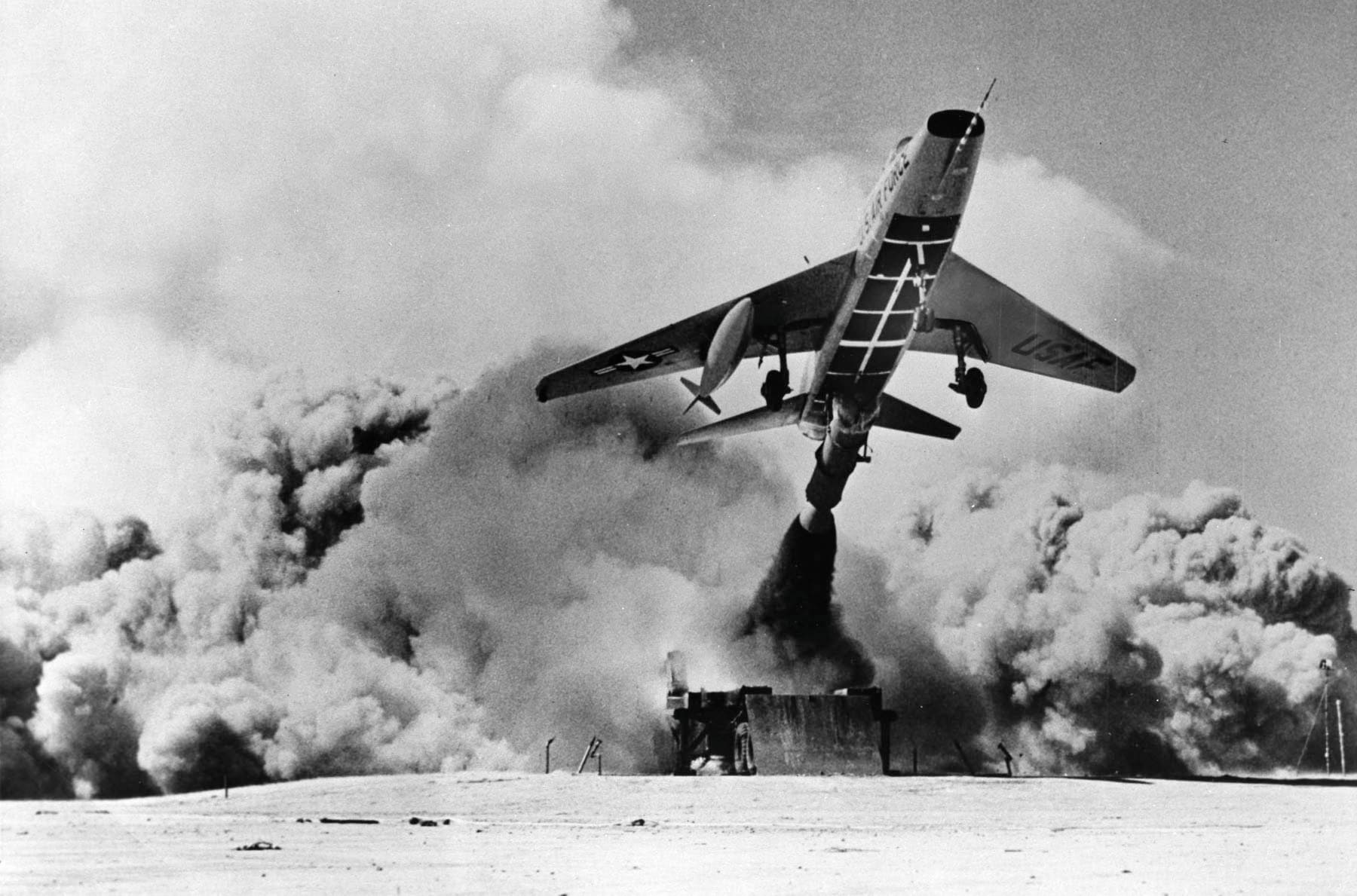
The ZEL launcher was a steel lattice ramp angled at roughly 20 degrees above horizontal. The F-100D was mounted on the ramp via attachment lugs near the centre of gravity. Underneath the rear fuselage, behind the main landing gear well, a 14-foot Astrodyne XM-34 solid-propellant rocket booster was bolted. The booster generated 130,000 pounds of thrust for four seconds — far more than the F-100’s own J57 afterburning turbojet, which produced about 17,000 pounds.
The launch sequence was simple. The pilot strapped in. He started the J57 and ran it to military power. He selected afterburner. He pressed the launch button. The booster ignited. The F-100 accelerated from a standing start to roughly 275 miles per hour in four seconds, climbing off the ramp at the booster’s sustained 4 g acceleration. At burnout, the booster automatically jettisoned (small explosive bolts severed the attachment) and parachuted to the desert floor, where ground crews would later recover and recondition it. The F-100 transitioned to normal afterburner-only climb and proceeded on its mission.
The first successful unmanned launch was in December 1957. The first piloted launch was on 26 March 1958 at Edwards Air Force Base, flown by North American Aviation test pilot Al Blackburn, who recovered the aircraft normally and landed it. On his second launch, on 11 April 1958, the booster failed to separate cleanly and Blackburn ejected safely — the most serious mishap of the test programme.
Why it never went operational
By the time the F-100 ZEL programme was wrapping up its successful test phase in 1960, the strategic landscape had shifted under it. Several developments made the concept progressively less attractive:
The Soviet ICBM threat had escalated. The earliest R-7 missiles entered service in 1959. Pre-launch warning times against an ICBM attack on Europe were measured in minutes, not hours. There was simply not enough time for a ZEL fighter to load, taxi to the launch ramp, configure for ZEL launch, and execute the launch sequence — much less complete its strike mission before its targets were already being hit.
The U.S. nuclear deterrent had pivoted to ballistic missiles. Submarine-launched Polaris (operational 1960), land-based Minuteman (operational 1962), and the airborne alert SAC bomber force absorbed most of the second-strike mission. The tactical fighter-bomber nuclear role survived but became less central to deterrence calculations.
The logistics of ZEL were nightmarish in practice. Each launcher required pre-positioned boosters, an inventory of recoverable parachute kits, specialised launch crews, and rebuild facilities for spent boosters. Putting all of this at a dispersed site without making the site itself an obvious target proved very hard.
The West German Luftwaffe revived ZEL in the early 1960s for the F-104G Starfighter (the famous “Luftwaffe ZeLL” trials, flown first at Edwards and later at Lechfeld in Bavaria). The Soviet Union tested a MiG-19 ZEL launcher, the SM-30. None of them deployed operationally. ZEL ended its life in the late 1960s as a technically successful concept whose operational case had quietly evaporated.
The afterlife of an unused idea
ZEL never made it into a NATO contingency plan. The Astrodyne XM-34 boosters were eventually disposed of. The ramps were scrapped. The F-100s that participated in the test programme returned to normal squadron service and were eventually retired and parted out like the rest of their type.
But the concept did not entirely die. The U.S. Navy’s steam catapults — and the current EMALS electromagnetic systems on the Ford-class carriers — are direct descendants of the same idea: launch a fighter into flight with external thrust, no runway required. The Soviet Yakovlev Yak-38 and Yak-141 VTOL fighters, the Harrier family, the F-35B, and several modern VTOL UAVs all solve the no-runway problem with different technology. The problem ZEL was built to solve is, in 2026, more relevant than ever — drones and dispersed operations are reshaping how air forces think about runway dependence.
The ZEL F-100 sits in the history books as a beautifully solved problem that nobody quite needed. The footage of a fighter blasting off a tilted ramp on a desert morning in 1958, riding a four-second column of solid-rocket fire, still looks like something out of science fiction. It was real. It worked. And then the world moved on.
Watch: U.S. Air Force archive footage of an F-100D Super Sabre being launched via the Zero-Length Launch (ZEL) system in the late 1950s.
Sources: U.S. Air Force Test Center historical records; North American Aviation programme histories; Astrodyne Corporation rocket booster archives; The Aviation Geek Club; The Aviationist (Luftwaffe ZeLL coverage).

 English
0 Comments