
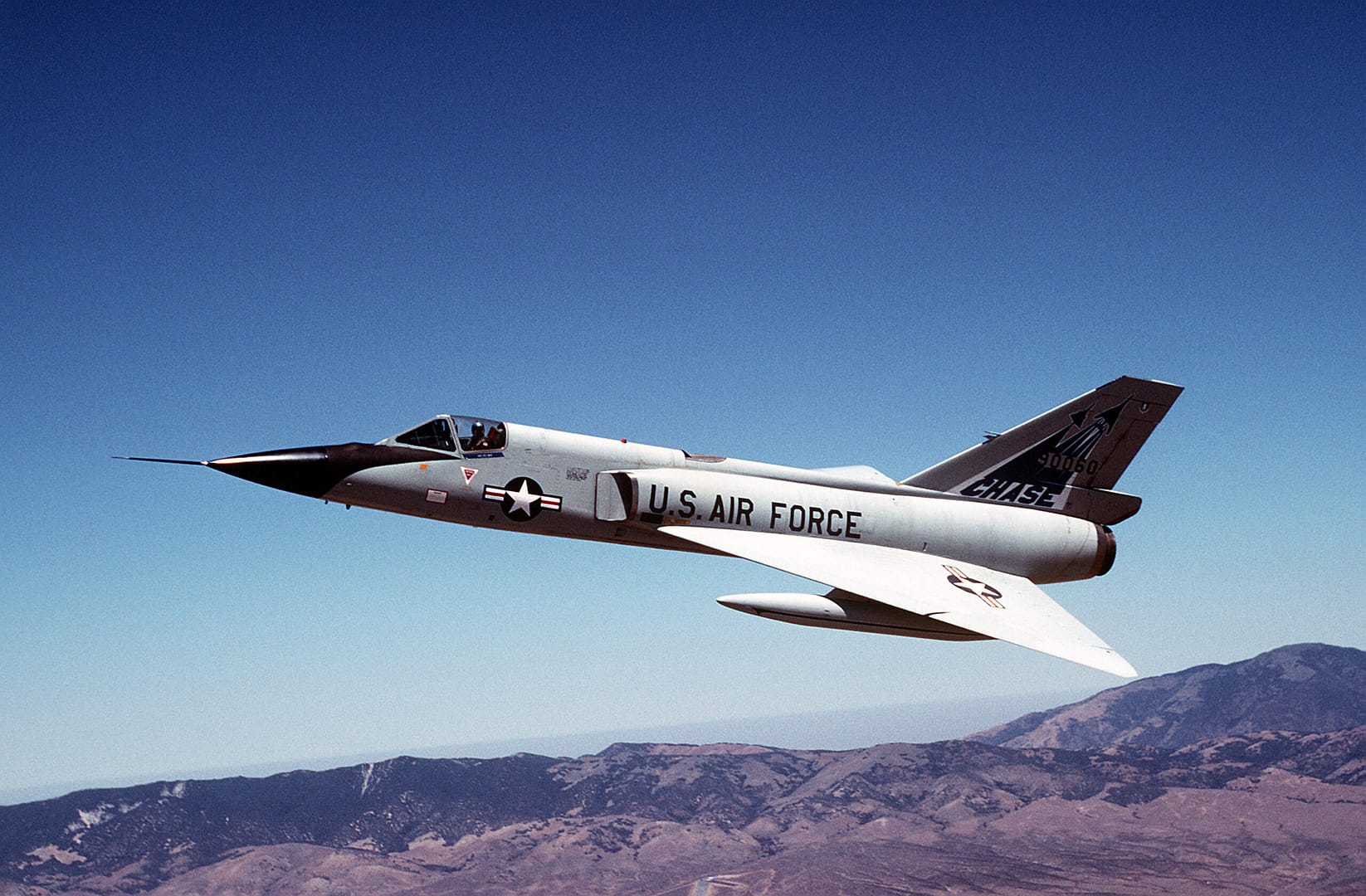
On 6 June 1961, somewhere over the White Sands Missile Range in New Mexico, Technical Sergeant James A. Howell of the U.S. Air Force was strapped into the back seat of a specially-instrumented Convair F-106B Delta Dart. The aircraft climbed to 23,336 feet and accelerated to 497 miles per hour — Mach 0.76 at that altitude. At that point, on his own command, TSgt Howell pulled the handle, was rotated onto his back and fired clear of the aircraft by the rocket-powered seat, separated from it, and parachuted safely back to the desert floor.
It was the first live human test of the Convair B-seat — the supersonic-capable encapsulated ejection system developed for the F-106 fleet. Howell volunteered. The video footage of the ejection, originally classified, has been one of the most-watched real-test ejection clips on YouTube for the last decade. It is also a window into one of the most consequential — and least appreciated — corners of aviation safety history.
Quick Facts
Aircraft: Convair F-106B Delta Dart (two-seat trainer variant)
Date: 6 June 1961
Location: White Sands Missile Range, New Mexico
Test pilot subject: Technical Sergeant James A. Howell, U.S. Air Force
Ejection altitude: 23,336 ft
Ejection speed: 497 mph (Mach 0.76 at that altitude)
System tested: Convair “B-seat” supersonic rotational ejection seat
Developer: Convair, Stanley Aviation, and Aircraft Mechanics Inc; designed under the ICESC (Industry Crew Escape System Committee) programme
Programme duration: 1 January 1956 – 30 June 1961 — over five years of rocket-sled and unmanned ejection testing before the live human test
Result: Successful; Howell parachuted to safety with no injuries
Operational deployment: F-106A/B fleet retrofitted with the B-seat; B-seat also influenced the F-111 escape capsule and the B-1A crew escape module
The supersonic ejection problem
The early 1950s discovered, very expensively, that ejecting a pilot from a fighter at supersonic speed was not just hard — it was usually fatal. The first-generation ejection seats developed in the late 1940s assumed subsonic ejection at relatively low altitude. They were largely effective in the 250-450 knot envelope. Above that, the dynamic pressure on the pilot’s body during the ejection sequence could break limbs, dislocate shoulders, snap necks, and tear the helmet and parachute riser away from the body before the canopy ever inflated.
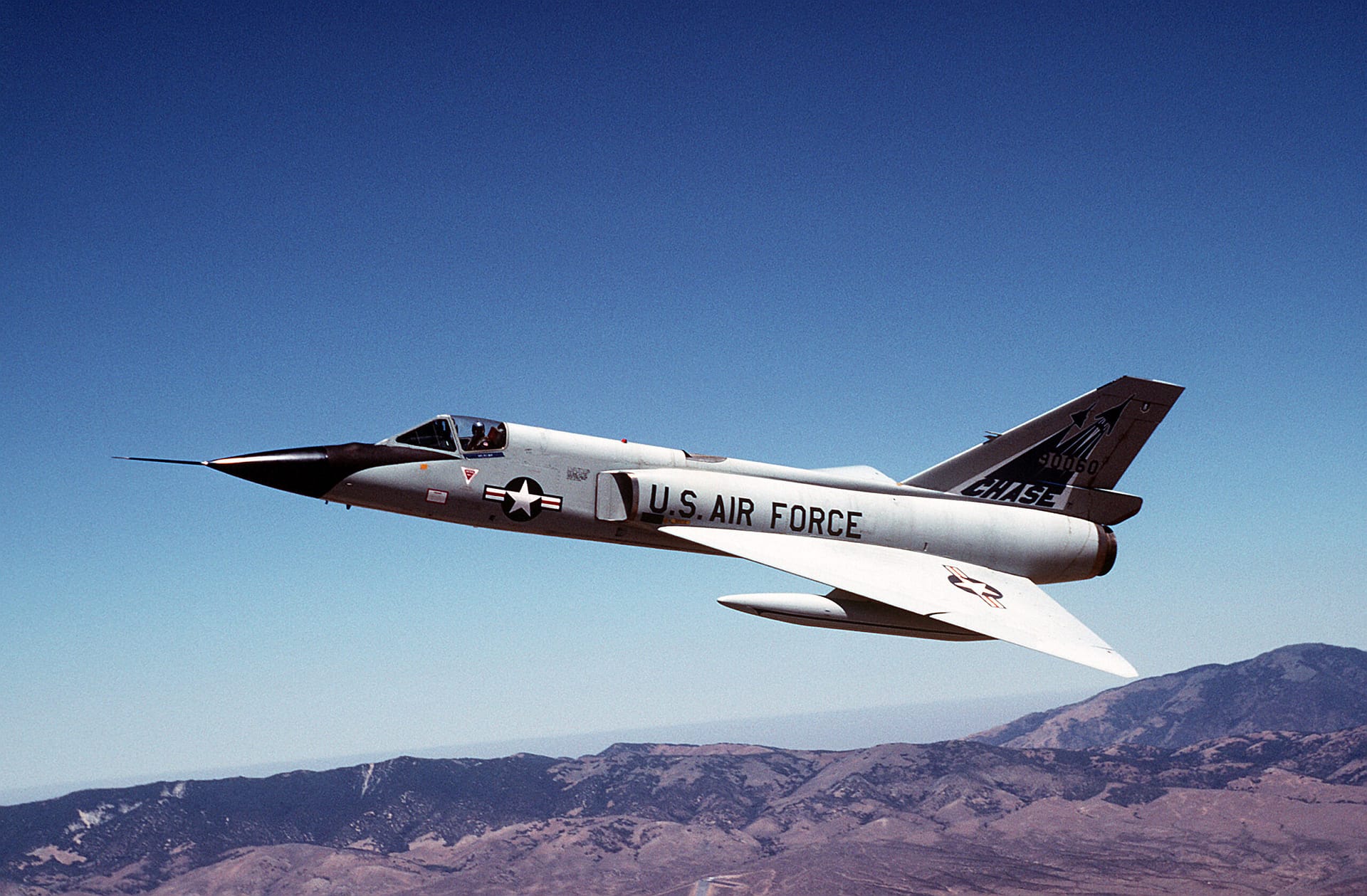
The U.S. Air Force began losing pilots to high-speed ejection in the F-100, F-101, F-104, and early F-105 fleets. By 1955, the Air Force Flight Test Center at Edwards had documented enough cases to conclude that a fundamentally different approach was needed for aircraft routinely operating above Mach 1. The Industry Crew Escape System Committee (ICESC) had been formed to develop a supersonic crew-escape system, with a test programme that ran from January 1956. Convair, building the F-106 Delta Dart for the Air Defense Command interceptor role, took the lead on the design.
The B-seat concept
The Convair B-seat — officially the Convair Supersonic Rotational B-seat — was not a seat in the conventional sense. Before ejection it rotated the pilot 90 degrees into a supine, feet-up position, then fired him clear of the airframe riding the rocket-powered seat on his back like a bobsled, stabilised by extendable booms. The posture was designed to protect the pilot from the windblast that a conventional upright ejection seat could not avoid at high speeds. Once clear of the aircraft and descending below 15,000 feet, a stabilisation chute pulled the pilot away from the seat and deployed his personal parachute.
The engineering challenge was extraordinary. The seat had to fit inside the existing F-106 cockpit without major redesign. Its sequence — more than 30 pyrotechnic devices — had to fire in precise order without injuring the pilot. The mechanism had to release the pilot reliably whether the ejection was at 250 knots and 1,000 feet or at Mach 2 and 50,000 feet. Convair and Stanley Aviation (a major postwar ejection-seat innovator, the company behind several other USAF escape systems) spent four years on the design before they were willing to put a human inside one.
Why Howell volunteered
The choice of a Technical Sergeant — rather than a commissioned officer test pilot — for the live-ejection test was deliberate. In that era the Air Force considered volunteer enlisted aircrew, with extensive ejection training, preferable for the first live tests of new escape systems. The reasoning was twofold: enlisted volunteers had broader training in the maintenance and rigging of ejection equipment (so they understood exactly what they were testing), and they could be selected from a much larger pool than the very small cadre of jet-rated officer test pilots.
Howell was an experienced parachute specialist who had trained for the test on the rocket-sled rigs at Holloman AFB, where the B-seat had already been through years of sled and unmanned flight testing.
The actual ejection went as the engineers had predicted. The seat rotated Howell into the supine position and fired clear of the F-106B with the expected acceleration profile, stabilised by its booms. The stabilisation chute pulled him free of the seat, his personal parachute deployed, and Howell landed in the desert, where he was picked up by the recovery helicopter.
What the B-seat made possible
The successful Howell test cleared the B-seat for fleet deployment. The entire F-106 inventory — about 300 aircraft active at the time — was retrofitted over the following years. The B-seat became standard issue for the F-106A single-seat and F-106B two-seat interceptors that ringed North America during the worst years of the Strategic Air Command vs Long Range Aviation standoff. Several F-106 pilots subsequently ejected operationally in real engine failures or in-flight emergencies. While the B-seat saved a number of lives, it also suffered several fatal failures — the complicated ejection sequence proved unreliable, and in 1964 the USAF ordered its replacement by a simpler Weber rocket-powered zero-zero seat, fitted across the fleet from 1965.
More importantly, the B-seat established the technical and procedural template for the next generation of supersonic escape systems. The General Dynamics F-111 Aardvark used a fully encapsulated crew module — a more elaborate version of the same idea, in which the entire two-seat cockpit detached and parachuted to safety as one unit. The first three Rockwell B-1A prototypes also flew with an encapsulated crew escape module during their flight test programme, before the design switched to conventional ejection seats for the production B-1B.
Why it did not become the standard
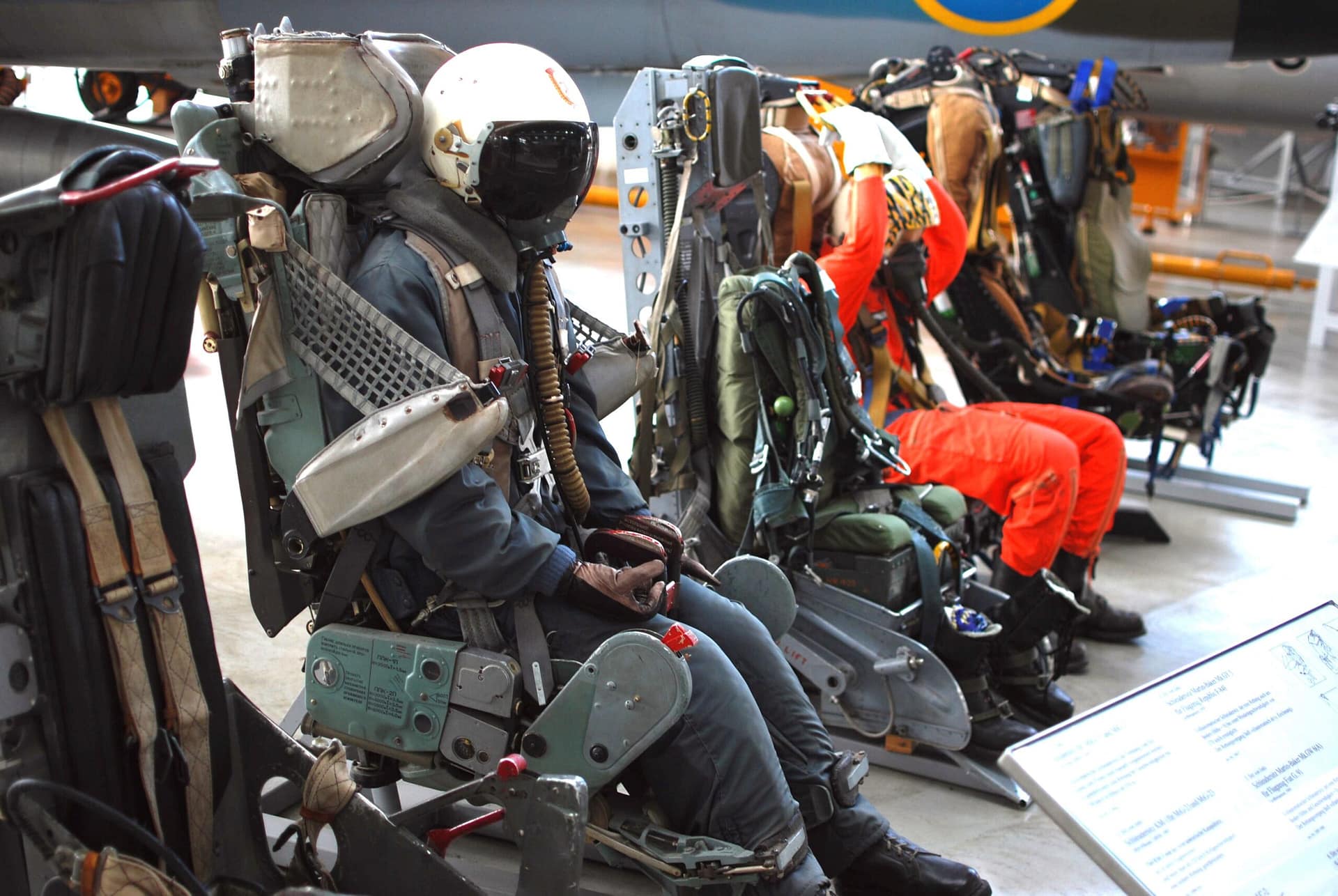
Complex escape systems — the B-seat’s rotation sequence and the fully encapsulated crew modules that followed it — were eventually overtaken by improved open-seat designs. Several factors pushed the industry away from them. They were heavy, complex, and expensive. They took up cockpit volume that designers wanted for other purposes. Most importantly, the next generation of open ejection seats — Martin-Baker’s Mk 5, Mk 7, and Mk 10 series, and the ACES II series that became standard across the F-15, F-16, F-22, and F-35 fleets — were able to handle supersonic ejection envelopes through faster sequencing, better arm-restraint systems, and improved windblast protection on the seat itself.
The Convair B-seat sits in the history books as the proof that the problem could be solved. The fact that it was solved differently in subsequent generations does not diminish the achievement. Without the B-seat, the F-106 fleet would have spent twenty years at the front line of North American air defence with crew survivability at the upper end of its performance envelope no better than the F-100’s. With the B-seat — and the live human test that TSgt James A. Howell volunteered for — every F-106 pilot who pulled the handle for real over the next two decades came home.
Watch: archive footage of supersonic ejection seat testing from the era, including the experiments that led to the operational F-106 B-seat.
Sources: F-106 Delta Dart Veterans Association; Air Force Flight Test Center historical archives; Convair company records; The Ejection Site (ejectionsite.com).


 English
0 Comments