
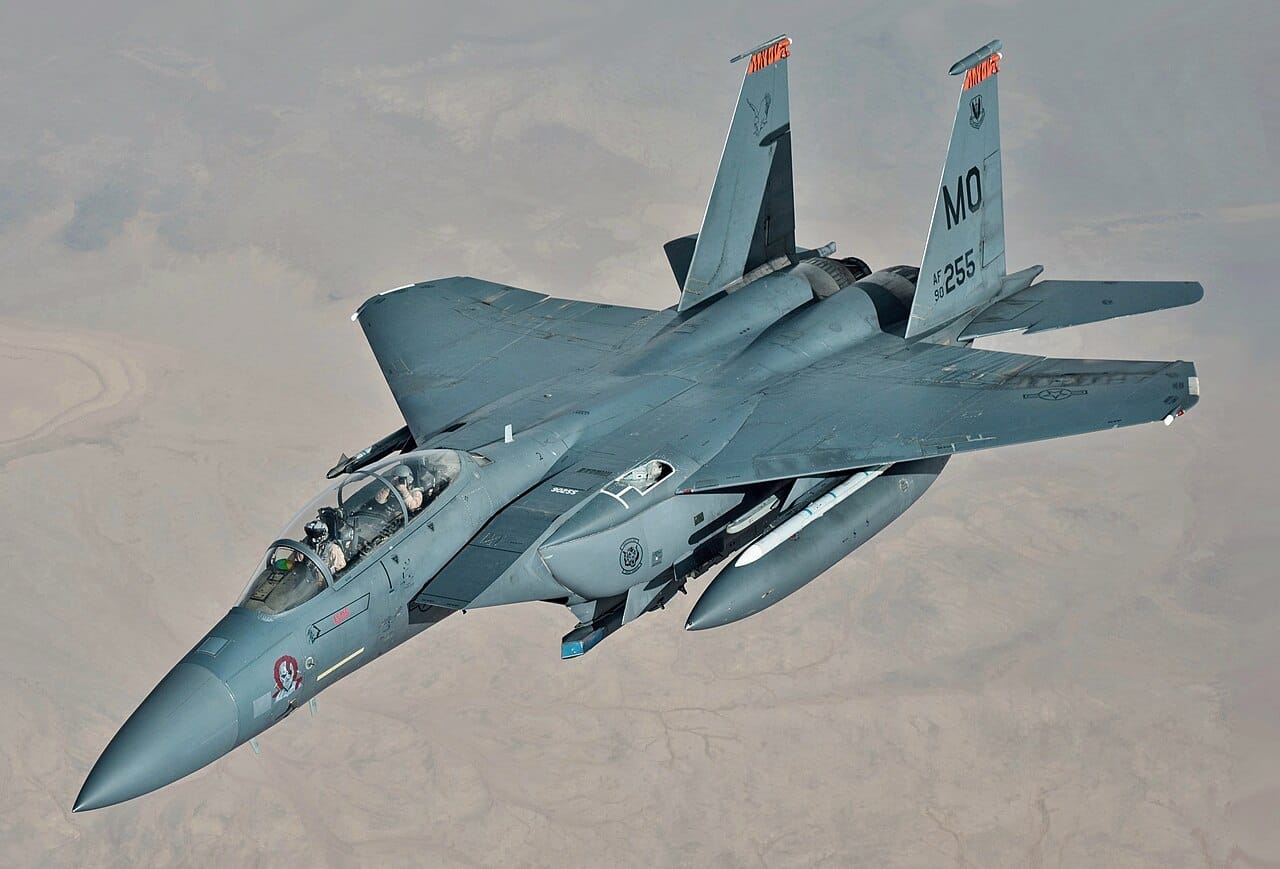
The United States Air Force has opened a dedicated depot installation line for the Eagle Passive/Active Warning Survivability System at the Warner Robins Air Logistics Complex in Georgia. Designated the EPAWSS Speedline, the facility decouples the electronic warfare upgrade from routine programmed depot maintenance, a bottleneck that had constrained fielding to aircraft already cycling through heavy overhaul.
The first F-15E Strike Eagles are scheduled to arrive at the Speedline in June 2026. Ninety-nine airframes are slated for retrofit. The move represents a deliberate acceleration of a programme that received full-rate production clearance in early 2025, when the Air Force awarded Boeing a $615.8 million contract to manage installation of the BAE Systems-developed suite.
EPAWSS replaces analogue electronic warfare equipment that entered service during the Cold War. The system provides instantaneous, full-spectrum threat detection, geolocation, and countermeasures—capabilities that the Air Force considers non-negotiable as the F-15E continues to operate in increasingly contested electromagnetic environments.
Quick Facts
- Facility: EPAWSS Speedline at Warner Robins Air Logistics Complex, Georgia
- Launch date: May 26, 2026; first aircraft arriving June 2026
- Fleet scope: 99 F-15E Strike Eagles to be retrofitted; all F-15EXs equipped from the factory
- System: AN/ALQ-250 EPAWSS, developed by BAE Systems
- Contract: $615.8 million Boeing installation contract (January 2025)
- Key advantage: Standalone line eliminates five-to-seven-year wait for scheduled PDM cycle
- IOC: EPAWSS achieved initial operational capability in early 2024
The PDM Bottleneck
Under the previous arrangement, EPAWSS could only be installed on F-15Es that were already at Warner Robins for programmed depot maintenance—a comprehensive overhaul that each airframe undergoes on a fixed rotation. The problem: an F-15E that completed PDM last year would not return for another five to seven years, regardless of how urgently the Air Force wanted the electronic warfare upgrade on that particular jet.
The Speedline dissolves that dependency entirely. Aircraft can now be pulled from operational squadrons, sent to Warner Robins for EPAWSS installation, and returned to their units without waiting for the next PDM window. The result is a parallel production stream that should substantially compress the timeline for achieving fleet-wide coverage across all 99 F-15Es designated for the retrofit.
“The integration of advanced electronic warfare suites, such as EPAWSS, ensures the F-15E will not just survive, but actively disrupt and dismantle adversary kill chains in the most highly contested, electromagnetically dense environments.”
Lt. Col. Matthew Heil, EPAWSS Materiel Leader, F-15 Program Office
What EPAWSS Actually Does
The AN/ALQ-250 EPAWSS is not a simple radar warning receiver replacement. It is a fully integrated electronic warfare management system that fuses radar warning, missile approach warning, geolocation, and electronic countermeasures into a single cognitive architecture. BAE Systems designed the system for upgradeability, using an open software framework that allows rapid capability insertion as new threats emerge.
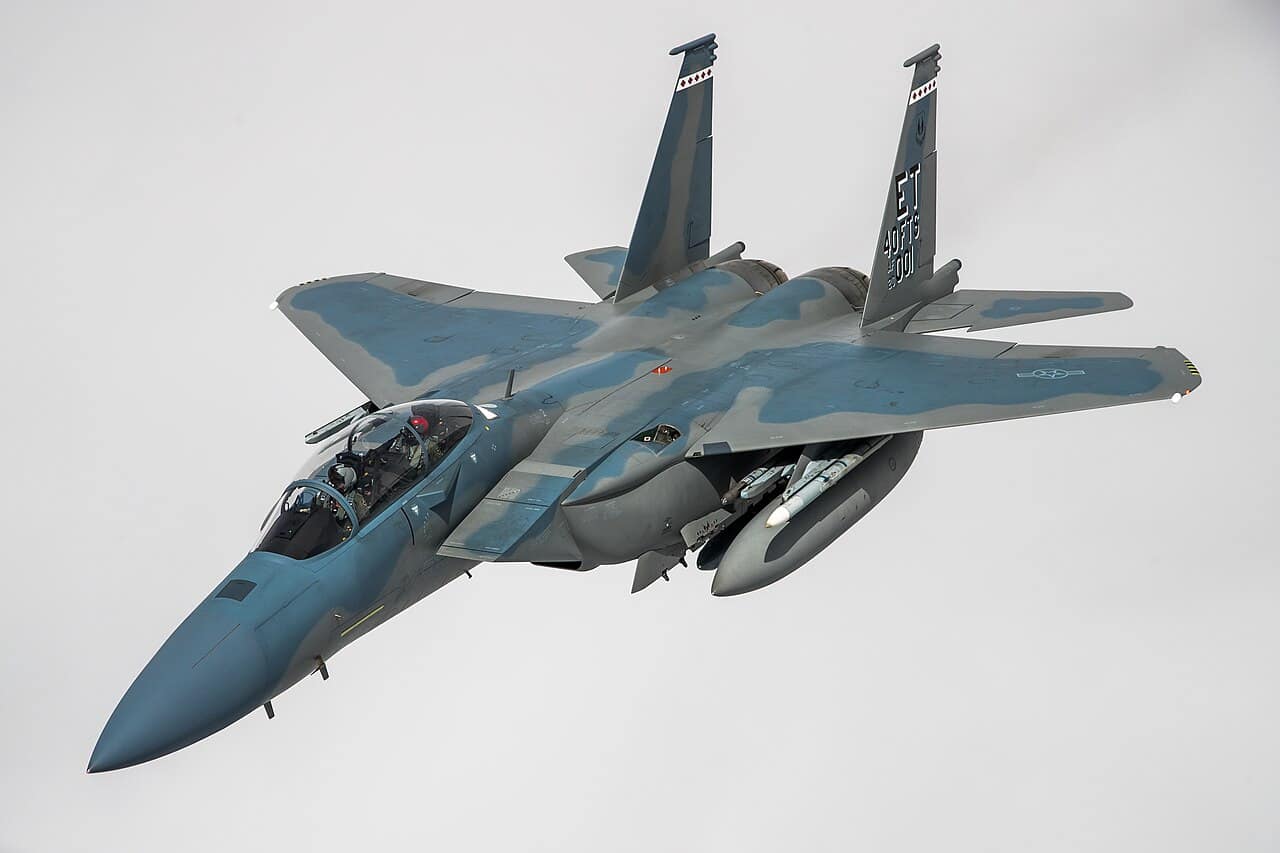
The system represents a generational leap over the legacy Tactical Electronic Warfare System that the F-15E has carried since the 1980s. Where TEWS relied on analogue processors and a limited threat library, EPAWSS employs digital signal processing and cognitive algorithms that can identify and respond to previously unknown emitters in real time. The Air Force describes the capability as “instantaneous full-spectrum EW.”
The first operationally equipped F-15E was delivered to the 48th Fighter Wing at RAF Lakenheath, England, in January 2025—a deliberate choice that placed the most advanced Strike Eagles at NATO’s front door. The Speedline at Warner Robins will now ensure that the remaining fleet catches up at an accelerated pace.
“EPAWSS was designed for upgradeability and rapid capability insertion. We are using agile software development to provide iterative upgrades to fielded EW systems—allowing our customers to defeat future electromagnetic threats.”
Amy Nesbitt, EPAWSS Programme Manager, BAE Systems
Strategic Context: The Strike Eagle’s Second Life
The EPAWSS programme is part of a broader effort to extend the operational relevance of the F-15E well into the 2040s. The Strike Eagle was conceived as a deep-strike platform in an era when the primary electronic threat was Soviet ground-based radar. Today’s threat environment includes advanced integrated air defence systems, networked surface-to-air missiles, and adversary electronic attack capabilities that can degrade or deny communications and sensor links.
Without EPAWSS, the F-15E would be increasingly vulnerable in the electromagnetic domain. With it, the airframe gains the ability to detect, classify, and counter threats that did not exist when the aircraft first flew. BAE Systems has already begun development of a successor capability, but EPAWSS remains the bridge that keeps the Strike Eagle viable until a next-generation platform is ready.
Sources: Air & Space Forces Magazine, DefenseScoop, Defense News, The Aviationist, AFMC Public Affairs

 English
0 Comments