
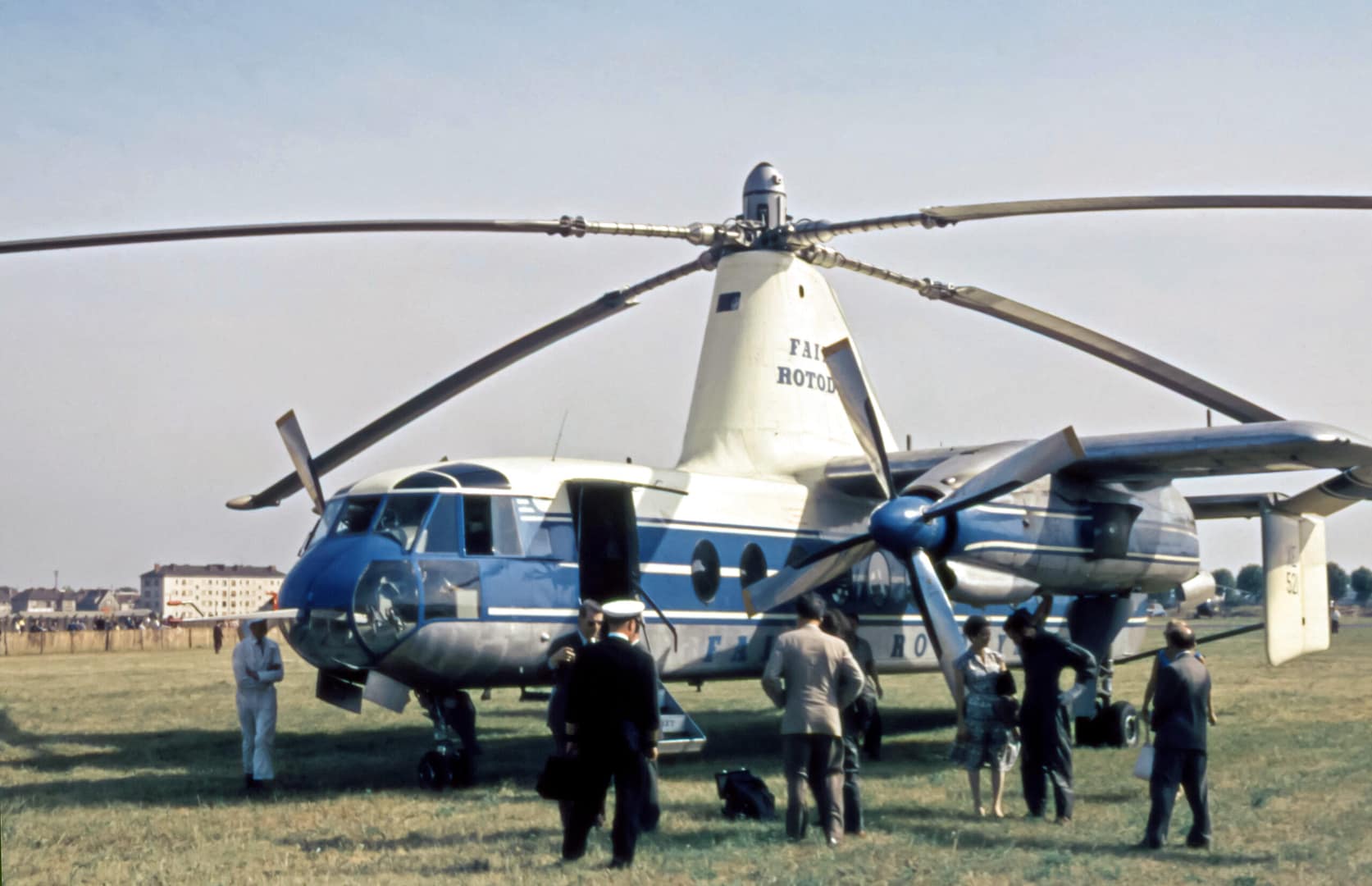
City to city, with no airports. Take off from a small concrete pad in central London, climb vertically, transition forward, cruise at 190 miles per hour, descend, land on a concrete pad in central Paris. No taxi, no train, no airport security. In June 1959 a demonstration flight took it from London to the Brussels heliport and on to Paris to prove the concept. The aircraft was big enough for forty passengers. The interior was a proper airliner cabin with windows and proper seats. The technology worked. The numbers worked. The market wanted it.
One thing killed it. Noise. The Fairey Rotodyne — a compound gyroplane powered by jet-tip rotor blades that made it sound, on takeoff and landing, like every fighter aircraft in the Royal Air Force inventory firing up simultaneously inside a parking garage — was simply too loud for any city that might have wanted to land it downtown. Engineering eventually solved most of the noise problem. By the time it did, the political and financial support was gone, and the most innovative compound rotorcraft anyone has ever flown was scrapped in 1962.
Quick Facts
Aircraft: Fairey Rotodyne
Type: Compound gyroplane (also called a gyrodyne)
Builder: Fairey Aviation Company, United Kingdom
First flight: 6 November 1957 (Y prototype)
Length: 58 ft 8 in (17.88 m)
Rotor diameter: 90 ft (27.43 m)
Engines: Two Napier Eland turboprops, 2,800 shp each
Rotor power: Tip-jet — compressed air bled from the turboprops, mixed with fuel, burned at jet nozzles on the rotor blade tips (vertical flight only)
Cruise speed: 190 mph (305 km/h)
Speed record: World rotorcraft speed record over 100 km course, January 1959
Passenger capacity: 40 (intended production version)
Programme cancelled: February 1962
Total built: 1 prototype
Why anyone built it
In the 1950s, the most visible problem with commercial aviation was the airport. Airports were enormous, expensive, far from city centres, and growing faster than the cities they served could absorb them. The London-to-Paris business traveller in 1955 was facing a four-hour total journey to fly a 60-minute route: 90 minutes to Heathrow on the Piccadilly Line, 30 minutes for check-in and security, 60 minutes flying, 30 minutes for immigration, 60 minutes from Orly into central Paris. Every minute of which was spent not actually moving.
The vertical-takeoff airliner was supposed to solve this. A 40-passenger rotorcraft that could take off from a concrete pad next to Waterloo Station and land on a pad next to the Gare de l’Est could deliver business travellers door-to-door in roughly the same total time it takes to fly today — about two hours. The economics, the planners thought, would be irresistible.
The challenge was that conventional helicopters in the 1950s topped out around 130 mph. The route distances that mattered — London-Brussels, London-Paris, London-Manchester, the trans-Channel city pairs — needed cruise speeds closer to 200 mph to compete with rail. And the existing helicopter aerodynamics could not produce 200 mph from a single main rotor; the retreating blade would stall and the aircraft would tumble.
The tip-jet trick
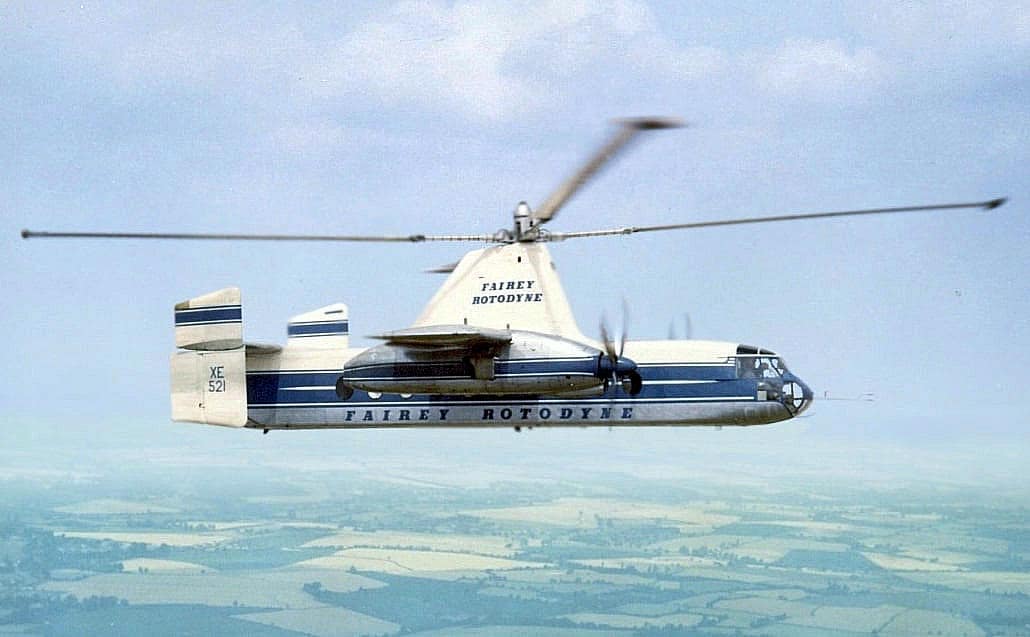
Fairey’s solution was the most ingenious rotorcraft engineering of the 1950s. The Rotodyne used its main rotor only for vertical takeoff, vertical landing, and hover. In cruise flight, the main rotor was unpowered — it autorotated, like a gyrocopter, providing about 60% of the lift while the stubby wings provided the rest. Forward thrust came from two Napier Eland turboprops mounted on the wings. With the rotor unpowered, there was no torque reaction problem and therefore no need for a heavy tail rotor or anti-torque tail boom.
For the vertical takeoff and landing phases, the main rotor was powered by tip-jets. Compressed air was bled from the two Eland turboprops, piped through the rotor mast, out along hollow rotor blades, and mixed with kerosene at jet nozzles mounted on the tip of each blade. The mixture was ignited and produced thrust directly at the rotor tips — spinning the rotor without any mechanical drive at all. No gearbox. No transmission. No torque feedback through the airframe.
This was a brilliant solution to several problems at once. It eliminated the heavy transmission gearbox that limited every conventional helicopter’s payload. It eliminated the tail rotor. It freed up the entire fuselage interior for passenger cabin space. And it produced a rotorcraft with the cruise speed of a conventional turboprop airliner.
It also produced what is, almost certainly, the loudest aircraft Britain ever built.

The noise problem
The tip-jets were the problem. Burning kerosene at the tip of a rotor blade spinning at near-supersonic tip speed produced a shriek unlike anything else in aviation. John Farley, later chief test pilot of the Harrier, recalled that from two miles away it would stop a conversation. The noise was the first thing anyone who witnessed a test flight at White Waltham, the Berkshire airfield where the Rotodyne flew from 1957 onwards, remembered about it.
The fundamental issue was that the noise was concentrated in frequencies the human ear is most sensitive to, generated by tens of explosions per second at the rotor tips, and broadcast in all directions by the rotor disc. Conventional noise abatement — exhaust mufflers, fuselage insulation — addressed almost none of it.
Fairey threw enormous engineering effort at the problem. By 1961, after four years of test flying, the engineers had reduced the tip-jet noise from roughly 113 decibels to about 96 decibels measured at 600 feet — less than a passing London Underground train — and silencers still in development were expected to cut it further. BEA, New York Airways, Japan Air Lines and Sabena had all expressed commercial interest, contingent on noise being brought down further, and Kaman Aircraft held the US licence for the type. The Royal Air Force was interested in a military variant for tactical transport. By every measure that mattered to the programme’s engineers, the Rotodyne was on a trajectory to be operationally deployable by 1964 or 1965.
Why it was cancelled
The cancellation in February 1962 had less to do with the noise (which was demonstrably being solved) than with British aerospace politics. The Macmillan government had merged Fairey Aviation, Westland, Saunders-Roe, and Bristol Helicopter into a single national rotorcraft company in 1960. The new Westland Helicopters, dominated by Westland’s board, had its own corporate priorities — primarily the licence-built Sikorsky S-58 (Westland Wessex) and the Sea King — and saw the Rotodyne as a distraction from those programmes.
British European Airways, which had been the most enthusiastic launch customer, lost confidence after years of slipping timelines. The Ministry of Aviation under successive Conservative governments grew tired of writing additional cheques for further noise-reduction work. The military requirement evaporated when the Army settled on conventional helicopters for its tactical lift programme. By early 1962, there was nobody politically willing to defend the Rotodyne, and the programme was cancelled.
The one prototype was scrapped. The technology — including the tip-jet rotor system — was effectively shelved. Various subsequent compound gyroplane projects (the Soviet Kamov Ka-22, the American Sikorsky XH-59 and X2, the Eurocopter X3) revived bits of the concept, but none have used the tip-jet rotor since.
The Rotodyne in 2026
The Rotodyne is one of the great "what if" aircraft of British aviation. If it had reached production, it might have established a permanent urban-mobility category that civil aviation has been trying to recreate for sixty years. The current eVTOL boom (Joby, Archer, Lilium, EHang) is, in operational terms, trying to deliver almost exactly what the Rotodyne promised — except smaller, electric, and entering service eight decades after the original concept first flew.
The Bristol VTOL helipads that BEA had planned for central London in the early 1960s were never built. The cross-Channel commuter route never opened. The "no airports" promise that Fairey’s engineers were selling in 1959 is now, in 2026, the central promise of the eVTOL industry — and the noise problem that killed the Rotodyne is, for slightly different technical reasons, still the central engineering challenge for every eVTOL operator trying to certify city-centre operations.
The lesson the Rotodyne offers is that the future of urban aviation has been a few years away for about 70 years now. Fairey came closer than anybody else has, with mid-twentieth-century materials and engines and noise-suppression technology. The fact that nobody has yet built a successor that actually works in operational service tells you most of what you need to know about how hard the problem is.
Watch: full documentary on the Fairey Rotodyne — Britain’s vertical-takeoff airliner that could have made every city-pair flight a downtown-to-downtown trip.
Sources: Fairey Aviation programme archives; Westland Helicopters company history; British European Airways operational planning records; Aviation Week (1957-1962 coverage).
Related Questions
What was the Fairey Rotodyne?
The Fairey Rotodyne was a British experimental aircraft of the late 1950s that combined a helicopter's rotor with an aeroplane's wings and turboprops. This compound gyroplane could take off vertically like a helicopter yet cruise fast like a fixed-wing airliner.
Why was the Fairey Rotodyne cancelled?
Noise killed it. The Rotodyne drove its rotor for vertical flight using tip-jets — burning fuel at the blade tips — which produced a deafening roar. Despite promising performance, the unbearable noise made it unacceptable for city-centre operations, and the programme was abandoned.
How did the Fairey Rotodyne fly?
For vertical takeoff and landing it spun its rotor with tip-jets: compressed air bled from the turboprops was mixed with fuel and burned at nozzles on the rotor-blade tips. In cruise, the wings and two Napier Eland turboprops took over, letting it fly forward efficiently like an aeroplane.
How fast was the Fairey Rotodyne?
It cruised at about 190 mph (305 km/h) — far faster than a conventional helicopter of the era — while still being able to take off and land vertically. That blend of speed and VTOL was exactly what made the concept so promising.
What is a compound gyroplane?
A compound gyroplane combines features of helicopters and fixed-wing aircraft: it has a rotor for vertical flight plus wings and forward-thrust engines for efficient cruise. The Fairey Rotodyne was a leading example, aiming to merge a helicopter's VTOL with an airliner's speed.
Related Posts
NASA’s Scissors Plane: The AD-1 Oblique Wing
The Ryan XV-5 Vertifan: Jet Fans in the Wings
0 Comments