

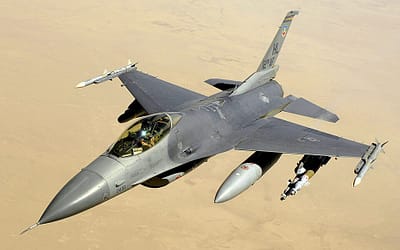
Kill marks on a fighter are not just paint. They are a public statement — the Air Force confirming that this airframe, with this pilot, killed that target. New images released this week of a U.S. Air Force F-16 show something nobody has seen on a USAF Viper in decades: a small silhouette of an AGM-88 High-speed Anti-Radiation Missile painted below the cockpit. A HARM kill mark.
The HARM is the U.S. military’s primary radar-killer — a missile that homes on enemy surface-to-air-missile radars and destroys them mid-transmission. Killing a HARM-equipped enemy is hard. The reverse — killing an enemy radar with a HARM — is the entire reason “Wild Weasel” units exist.
This is the first publicly displayed HARM kill on a U.S. F-16 since the Iraq War, and almost certainly the first associated with Operation Epic Fury — the recent campaign against Iranian air defences.
Quick Facts
Aircraft: F-16C/CJ (Block 50/52), 79th Fighter Squadron, 20th Fighter Wing (per visible unit markings)
Marking: Silhouette of an AGM-88 HARM
Weapon: AGM-88 HARM (exact variant not disclosed)
Target type: Enemy air-defence radar (SAM site or early warning)
Likely theatre: Operation Epic Fury / Iran air campaign
Previous USAF HARM kills: Iraq 1991, Iraq 2003, Serbia 1999
What it confirms: U.S. F-16s actively conducted SEAD strikes during Epic Fury
A SAM Site, Killed in Real Time
The Wild Weasel mission is one of the most dangerous in modern combat aviation. The pilot’s job is to bait an enemy SAM operator into “lighting up” — turning on the missile system’s tracking radar — and then put a HARM down its throat before the SAM can fire. The technical name is “Suppression of Enemy Air Defences” or SEAD. Pilots call it “First In, Last Out.”
The HARM rides the enemy’s own emissions home. Even if the SAM operator shuts down the radar mid-engagement, the missile remembers the last bearing and impacts the antenna anyway. The result is a destroyed radar — and, more often than not, a destroyed crew.
The Significance of a Single Silhouette
The U.S. Air Force is normally tight with kill marks. They are not approved casually, and a single painted icon represents an officially confirmed kill — either visually witnessed, electronically verified, or both. The fact that this F-16 now wears one means the Air Force has decided to acknowledge the kill publicly.
The exact target has not been disclosed. But the timing of the photograph — released as the dust settles on the Iran air campaign — points strongly to an Iranian air-defence radar or SAM system taken out during Epic Fury.
Why It Matters
Operation Epic Fury was supposed to be a stealth-led campaign — B-2s, F-35s, F-22s, drones. The presence of HARM kill marks on conventional F-16s suggests that, behind the scenes, traditional fourth-generation Wild Weasels did a lot of the unglamorous, lethal SEAD work in the campaign’s early phases. The radar suppressors got there before the bombers.
And one of them is now flying around with the receipt.
Sources: The Aviationist, U.S. Air Force public affairs imagery, DVIDS.

 English
0 Comments