

Twenty-Three Years of Invulnerability
The last combat shootdown before Friday dates to April 8, 2003, when an Iraqi Roland surface-to-air missile struck an A-10A Thunderbolt II over downtown Baghdad. The pilot survived. After that — nothing. Not over Iraq, not over Afghanistan, not over Syria, not over Libya. Retired Brigadier General Houston Cantwell, a former fighter pilot who served four combat tours and is now a senior fellow at the Mitchell Institute for Aerospace Studies, put it bluntly: the long streak was partly an illusion. For twenty years, the US fought insurgencies, not air forces. The enemies had Kalashnikovs and IEDs, not radar-guided missiles. Iran is different. Despite the damage inflicted on its integrated air defence network by US and Israeli strikes last year, the country still fields a layered system of radars, fixed SAM batteries, and mobile launchers. CENTCOM has confirmed over 13,000 sorties and 12,300 targets struck since Epic Fury began on February 28 — and through all of that, according to Cantwell, US aircraft were being shot at daily.A Shoulder-Fired Missile, Not a Radar Lock

Air Superiority Is Not Air Supremacy
Taleblu drew a distinction that cuts to the heart of the matter. The US has air superiority over Iran — the ability to fly where it wants, when it wants, and hit what it chooses. It does not have air supremacy — the complete elimination of the enemy’s ability to fight back. The difference is not academic. Air superiority means you control the sky. Air supremacy means the sky is safe. Over Iran, it is not safe. As Taleblu put it: a disabled air defence system is not a destroyed air defence system. And Iran’s remaining assets — mobile launchers, MANPADS, decentralised IRGC cells — are exactly the kind of threat that survives a massive bombing campaign. The regime is fighting for survival, and survivable weapons are all it needs. Justin Bronk, senior research fellow for airpower at the Royal United Services Institute in London, reinforced that assessment. The campaign against Iranian air defences has been effective, he acknowledged, but effective is not the same as complete. There is not a total absence of threat. Residual systems — particularly mobile and man-portable ones — remain active across western Iran, and every sortie into that airspace carries risk that no amount of SEAD can fully eliminate. Retired Lieutenant General David Deptula, dean of the Mitchell Institute for Aerospace Studies, framed the losses in broader terms. Air superiority does not mean zero risk, he said. What distinguishes modern Western airpower is not invulnerability but the ability to penetrate, survive, and sustain operations while keeping losses exceptionally low. The shootdowns, in his view, do not invalidate the larger reality — but they do expose the gap between public expectation and operational fact.A Race Against Time on the Ground
When a pilot ejects over hostile territory, the clock starts immediately. Cantwell, who has trained for exactly this scenario, described the sequence: assess injuries, establish your position, transmit your location before the enemy intercepts the signal. The parachute descent is the best — and sometimes only — chance to survey the terrain and pick a direction. After that, the pilot is on foot in a desert, likely injured, racing to stay ahead of enemy search parties while coalition forces mount a rescue. The Iranians, meanwhile, are working to jam communications or spoof the pilot’s location signal. Two Blackhawk helicopters involved in the rescue were also hit by Iranian fire. Their crews were unharmed. The A-10 that went down was part of the same rescue effort. The price of retrieving one American from Iranian territory is measured in aircraft, not just hours.What the Numbers Say — and What They Don’t
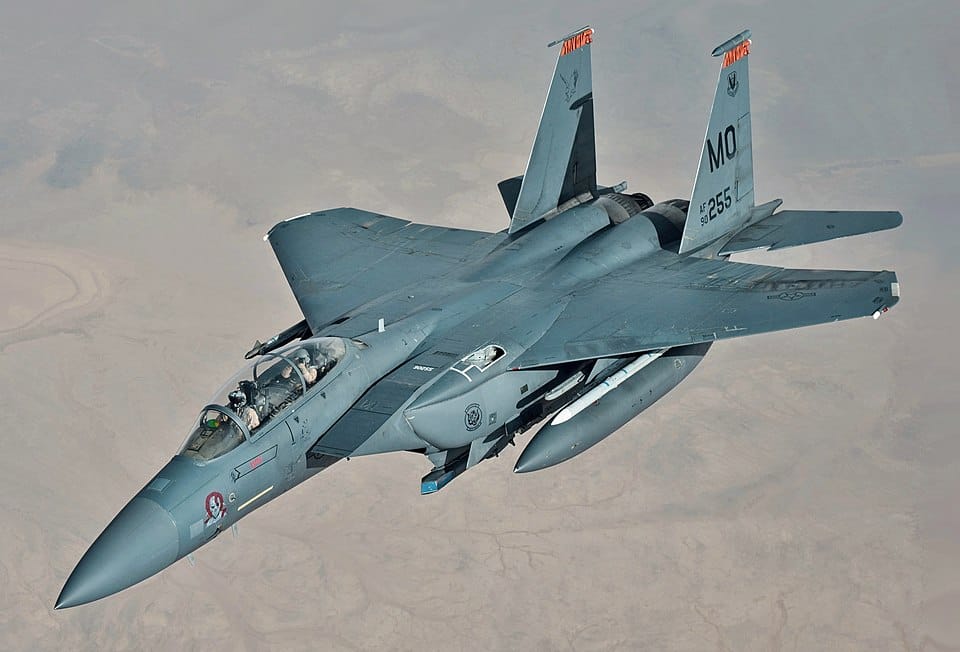
Cancian’s WWII comparison is striking, but the real lesson is political, not mathematical. Three percent losses were the cost of business in 1944. In 2026, as Cancian noted, every loss is politically unacceptable. The American public has spent two decades watching wars where air losses simply did not happen. Friday shattered that expectation. The F-15E that went down belonged to the 494th Fighter Squadron — the “Panthers” — who deployed twelve Strike Eagles from RAF Lakenheath to the Middle East in January. Debris photos confirmed the unit’s distinctive red tail flash and US Air Forces in Europe badge. For a squadron that has flown combat from England to the Persian Gulf, this is the cost of being the tip of the spear. Thirteen thousand sorties. Two confirmed shootdowns. A loss rate so low it rounds to zero. But zero is what the public expected — and what it no longer has. Sources: Associated Press (via Tages-Anzeiger), AP, Air & Space Forces Magazine, CBS News, NBC News, The War Zone, Military Times, Royal United Services InstituteRelated Questions
When was the last US combat aircraft shot down before 2026?
Before April 3, 2026, the last U.S. combat aircraft downed by enemy fire was an A-10A Thunderbolt II hit by an Iraqi Roland missile over Baghdad on April 8, 2003. That gave the U.S. a 23-year streak with no combat shootdowns until an F-15E was lost over Iran.
What US aircraft was shot down over Iran in 2026?
An F-15E Strike Eagle from the 494th Fighter Squadron, 48th Fighter Wing (RAF Lakenheath), was shot down over Iran on April 3, 2026. It limped toward Kuwaiti airspace before the crew ejected; both were later rescued in a complex CSAR operation.
What likely shot down the F-15E over Iran?
Analysts assess a shoulder-fired MANPADS as the most probable weapon, rather than a fixed SAM battery. Iran's larger systems were heavily degraded, but its surviving mobile and man-portable defences remained dangerous to low-flying aircraft.
Why did US aircraft go 23 years without being shot down?
For two decades the U.S. mostly fought insurgencies — enemies armed with rifles and IEDs, not radar-guided missiles or air forces. Analysts say the long streak was partly an illusion of facing foes that lacked real air defences, rather than pure invulnerability.
What was the F-15E doing over Iran?
The F-15E Strike Eagle was flying combat missions in Operation Epic Fury, the U.S.-led air campaign against Iran launched on February 28, 2026. By early April more than 13,000 sorties had been flown, part of a day that also saw a second aircraft lost.
0 Comments