
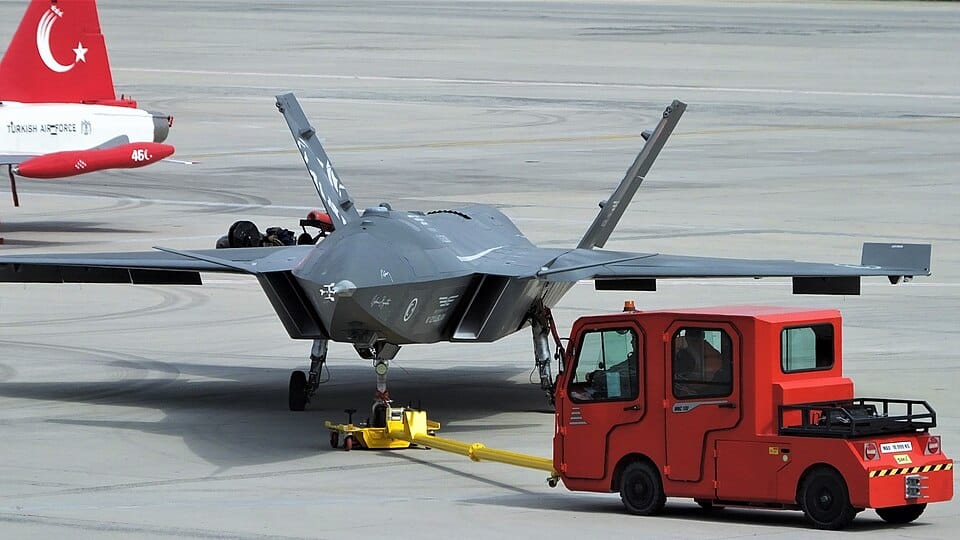
Turkish defence giant Baykar has secured the first export contract for its revolutionary Bayraktar Kızılelma unmanned combat aircraft, signing a landmark deal with Indonesia at the SAHA 2026 defence exhibition on May 6, 2026. The agreement covers an initial batch of 12 aircraft with options for 48 additional units, potentially bringing the total fleet to 60 Kızılelma fighters — a deal that cements Indonesia as the launch export customer for what many regard as the world’s most ambitious unmanned fighter programme.
Quick Facts
- Contract signed: SAHA 2026, May 6, 2026
- Buyer: Republic of Indonesia
- Initial order: 12 aircraft
- Options: 48 additional (total potential: 60 aircraft)
- MTOW: 8,500 kg
- Payload capacity: 1,500 kg
- Deliveries begin: 2028
- Includes: Local production, technology transfer, training package
- Announced by: Baykar CEO Haluk Bayraktar

The Kızılelma: Turkey’s Unmanned Fighter Takes the Global Stage
The Bayraktar Kızılelma — named after the mythical “Red Apple” of Turkic folklore, symbolising an unattainable ideal — represents a quantum leap in unmanned combat aircraft design. With a maximum takeoff weight of 8,500 kilograms and a payload capacity of 1,500 kilograms, the Kızılelma occupies a performance envelope that blurs the line between traditional unmanned aerial vehicles and manned fighter jets. It is designed to operate autonomously or under remote control, carrying a diverse array of air-to-air and air-to-ground munitions that give it genuine combat lethality in contested airspace.
Baykar CEO Haluk Bayraktar personally announced the Indonesian deal at SAHA 2026, Turkey’s premier defence and aerospace exhibition held in Istanbul. Speaking to an audience of defence officials and industry representatives from dozens of countries, Bayraktar described the agreement as a validation of Turkey’s vision for the future of unmanned combat aviation and a testament to the deep strategic partnership between Ankara and Jakarta.
The Kızılelma programme has been closely watched by defence analysts worldwide since its first flight. The aircraft features a low-observable airframe design, an advanced sensor suite, and the ability to carry weapons including beyond-visual-range air-to-air missiles — capabilities that place it in a category previously reserved for manned fighters. Its development represents Turkey’s ambition to move beyond the tactical drone market it currently dominates and into the realm of strategic unmanned combat platforms.

Indonesia’s Strategic Calculus: Unmanned Power for an Archipelago Nation
For Indonesia, the Kızılelma acquisition addresses a fundamental strategic challenge. As the world’s largest archipelago nation, spanning more than 17,000 islands across 5,000 kilometres of equatorial waters, Indonesia faces enormous demands on its air defence capabilities. The Kızılelma’s combination of long endurance, significant payload capacity, and relatively low operating costs makes it an ideal platform for patrolling vast maritime territories where the cost of maintaining continuous manned fighter coverage would be prohibitive.

The deal also includes provisions for local production and technology transfer, a critical element for Jakarta, which has made indigenous defence manufacturing capability a cornerstone of its national defence strategy. Under the agreement, Indonesian industry will participate in the production of Kızılelma components, building a domestic capability that could eventually support the maintenance, repair, and potentially even the further development of the aircraft within Indonesia. A comprehensive training package ensures that Indonesian personnel will be equipped to operate and maintain the system from the outset.
Deliveries are scheduled to begin in 2028, giving both Baykar and the Indonesian military time to establish the infrastructure, training programmes, and support facilities necessary to integrate such an advanced system. The initial batch of 12 aircraft will likely serve as an operational evaluation fleet, with the option for 48 additional units exercised based on the results of that evaluation and the evolving strategic environment in the Indo-Pacific region.
Reshaping the Global Drone Market
The Indonesian deal is significant not just for the numbers involved but for what it signals about the shifting dynamics of the global defence market. Turkey has already established itself as one of the world’s leading exporters of unmanned aerial systems, with the Bayraktar TB2 achieving iconic status for its role in conflicts from Libya to Ukraine. The Kızılelma takes this a step further, offering customers a capability that was previously available only to a handful of nations with advanced manned fighter programmes.
The export of a jet-powered, weapons-capable unmanned combat aircraft of this class is a first for Turkey and places Baykar in direct competition with American, Chinese, and European manufacturers who are developing similar platforms. The fact that Indonesia — a major Southeast Asian military power with access to Western, Chinese, and Russian equipment — chose the Turkish Kızılelma over competing offerings speaks to both the aircraft’s capabilities and the attractiveness of the commercial terms, particularly the technology transfer provisions.
For the broader defence industry, the message is clear: the era of unmanned combat aircraft as exportable, operational military systems has arrived. The Kızılelma is no longer a prototype or a concept — it is a product, with a customer, a delivery schedule, and a price tag. As other nations evaluate their own unmanned combat aircraft requirements, the Turkish-Indonesian deal will serve as a benchmark against which all future offerings will be measured.
The Red Apple of Turkic legend may have been an unattainable ideal, but Baykar’s Kızılelma is proving to be anything but. With Indonesia as its first international operator, the aircraft is poised to become one of the defining weapons systems of the next decade.
Sources: Baykar Defence, SAHA 2026 exhibition, Jane’s Defence, Indonesian Ministry of Defence.

 English
0 Comments