Hours after American fighter jets cratered Iranian radar installations across the southern coast, Tehran opened three new fronts. Drones hit Bahrain. Drones hit Kuwait. Long-range missiles slammed into an air base in Jordan. The IRGC claims it struck 21 American targets and destroyed an F-35 hangar.
The geography tells the story: this is no longer a Hormuz problem. Iran just demonstrated it can reach U.S. forces across the entire Gulf theatre and beyond — and it will.
For the pilots, ground crews, and intelligence officers on those bases, the question is no longer whether Iran will escalate. The question is how far.
Quick Facts
Trigger: U.S. CENTCOM precision strikes on Iranian air defence and radar sites near the Strait of Hormuz, 9 June
Iran targets: U.S. Fifth Fleet HQ in Bahrain, Ali Al-Salem Air Base in Kuwait, Azraq Air Base in Jordan
IRGC claims: 21 U.S. targets struck, 4 destroyed — including an F-35 hangar at Azraq
Casualties: At least one Indian civilian killed in Kuwait; U.S. military casualties not yet confirmed
Significance: First simultaneous Iranian attack on three separate Gulf-state host nations
Three Bases, One Night
The IRGC Navy launched drone attacks against the U.S. Fifth Fleet headquarters at Naval Support Activity Bahrain and Ali Al-Salem Air Base in Kuwait in the early hours of 10 June. Almost simultaneously, long-range missiles struck Azraq Air Base in eastern Jordan — home to a significant U.S. Air Force presence including F-35 operations.
Kuwait’s air defences intercepted at least some of the incoming munitions, according to initial reports. The IRGC claimed it shot down a U.S. MQ-9 Reaper drone over the Iranian city of Jam during the same window of operations.
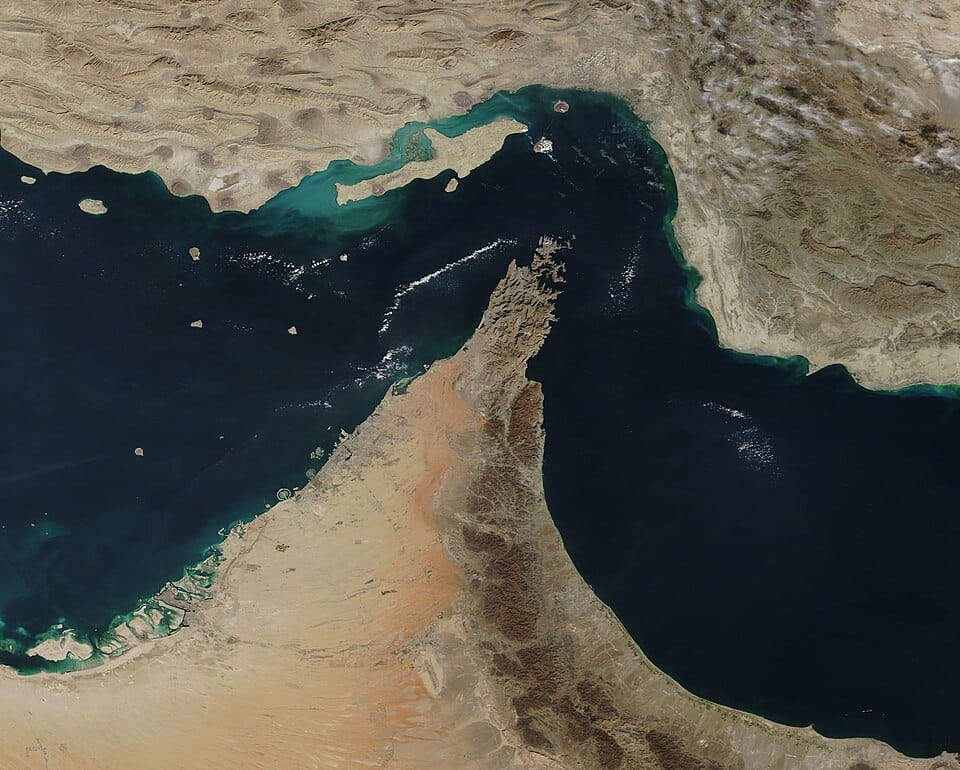
The Strait of Hormuz — through which 21% of global oil flows. The chokepoint is now the epicentre of a widening air war between the U.S. and Iran.
Iran’s army framed the strikes as direct retaliation for the U.S. precision attacks on Iranian air defence, radar, and ground control sites near the Strait of Hormuz — which themselves were retaliation for the shootdown of a U.S. Army AH-64 Apache helicopter hours earlier.
The Jordan Strike Changes the Calculus
The drone attacks on Bahrain and Kuwait, while serious, follow an established pattern. Iran has previously targeted Gulf-based U.S. installations with one-way attack drones. The Azraq missile strike is different.
Jordan sits over 1,000 kilometres from the Iranian coast. Hitting it with ballistic missiles — not drones — signals that Iran possesses and is willing to use strategic reach well beyond the Gulf littoral. Azraq hosts American F-16s and has supported F-35 rotational deployments. The IRGC’s claim of destroying an F-35 hangar, if true, would represent the first confirmed ground destruction of F-35 infrastructure by a state adversary.
The claim remains unverified by U.S. Central Command, which has not yet released a damage assessment.
Twenty-One Targets, Four Destroyed?
The IRGC’s claim of striking 21 U.S. targets and destroying four requires heavy scepticism. Iranian state media routinely inflates battle damage. During Operation Epic Fury’s opening weeks, Tehran claimed to have sunk a U.S. destroyer that was photographed operating normally three days later.
What is verifiable: explosions were reported at multiple locations, Kuwait activated its air defence network, and at least one Indian civilian was killed by debris from a drone strike near Kuwait’s main airport area. The human cost on U.S. bases has not been disclosed.
The Escalation Spiral
The sequence is now self-reinforcing. An Iranian drone hits an Apache. America strikes Iranian radar. Iran hits three countries. Each side frames its action as retaliation; each retaliation generates the next trigger.
The dual-carrier presence in the Gulf — USS Abraham Lincoln and USS George H.W. Bush — gives the U.S. enormous firepower but also enormous exposure. Every base, every tanker in the air, every helicopter on patrol is now a potential trigger for the next round.
For the Gulf states caught in the middle — Bahrain, Kuwait, Jordan, and the UAE — the calculus is brutally simple: hosting American forces makes them targets, but expelling American forces makes them defenceless.
Sources: Al Jazeera, CNN, Jerusalem Post, Express Tribune, WION News, Iran International, CENTCOM statement
On October 24, 2003, three British Airways Concordes landed at London Heathrow within minutes of each other. One arrived from Edinburgh. One from the Bay of Biscay, where it had made a farewell supersonic run. One from New York — the last-ever scheduled supersonic...
A pilot pulls the handle. Two and a half seconds later, they are floating under a parachute. In between, they have been subjected to forces that would kill an unrestrained human being — and the engineering that makes it survivable is among the most violent and precise...
Every fighter jet ever designed starts with the same question: one engine or two? The answer shapes everything — the aircraft's size, weight, cost, survivability, performance envelope, and the missions it can fly. It is the single most consequential decision in combat...

 English
0 Comments