It took losing an E-3 Sentry to Iranian missiles to make the Pentagon do what it should have done years ago. Secretary of Defense Pete Hegseth has submitted a budget amendment to the White House adding funding for the E-7A Wedgetail to the fiscal year 2027 budget request — reversing a decision made just months earlier to zero out the programme. The loss of an aging AWACS aircraft during Operation Epic Fury apparently concentrated minds.
The E-3 Sentry fleet has been in crisis for years. The aircraft — based on the Boeing 707 airframe — entered service in 1977. The oldest airframes are approaching 50 years old. Readiness rates have been abysmal: at times, fewer than half the fleet has been mission-capable. The Air Force has been trying to retire the E-3 and replace it with the E-7 Wedgetail — a modern airborne early warning platform based on the Boeing 737 — but budget fights kept pushing the timeline to the right.
Then one of them was destroyed on the ground by an Iranian missile strike.
Quick Facts
Aircraft: E-7A Wedgetail (Boeing 737-based AEW&C)
Replaces: E-3 Sentry (Boeing 707-based AWACS, in service since 1977)
Budget action: SecDef submitted FY2027 budget amendment to fund E-7
Trigger: E-3 Sentry destroyed in the Iranian missile attack on Prince Sultan Air Base during Operation Epic Fury
E-3 fleet age: Oldest airframes ~49 years old
E-7 operators: Australia (6), Turkey (4), South Korea (4), UK (3 on order)
The E-3 was not lost in the air: it was destroyed on the ground when Iranian ballistic missiles and drones struck Prince Sultan Air Base in Saudi Arabia in late March 2026. The E-3’s role — orbiting at high altitude, providing the radar picture that directs fighters and bombers to their targets — made the AWACS fleet a priority target for Tehran. Its loss immediately degraded the coalition’s ability to coordinate complex air operations in the theatre.
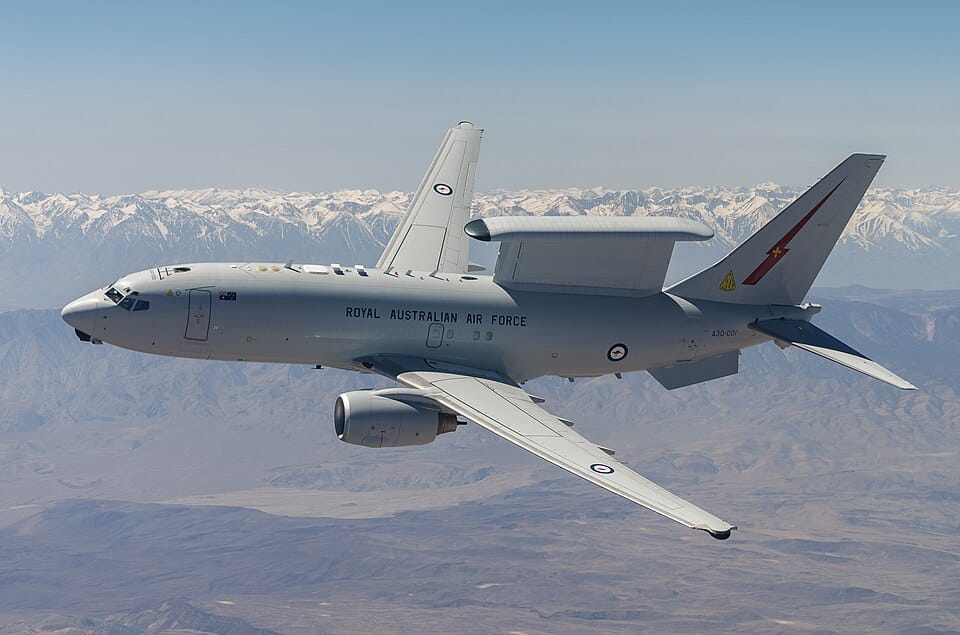
A Boeing E-3 Sentry AWACS. The destruction of one on the ground at Prince Sultan Air Base during Operation Epic Fury forced the Pentagon to reverse its budget deferral of the E-7 Wedgetail replacement. Photo: Wikimedia Commons
The loss also exposed a hard truth: the E-3 fleet was already too small and too old to sustain wartime operations. With one fewer aircraft, the remaining Sentries were pushed harder, and readiness — already below 50 per cent on some days — became even more precarious.
Air Force leaders have made the case bluntly for years: the E-3 has been the backbone of coalition command and control for decades, but a 1977-era aircraft is being flown into 2026 threat environments — and the E-7 is a necessity, not a luxury.
The long-standing Air Force argument — voiced by senior commanders for years
What the E-7 Brings
The Wedgetail is not just a newer AWACS — it is a fundamentally more capable platform. Its MESA (Multi-role Electronically Scanned Array) radar provides 360-degree coverage without the E-3’s iconic rotating dome, which creates mechanical reliability problems and blind spots during rotation. The E-7’s radar is electronically steered, meaning it can track multiple threat sectors simultaneously and switch modes in milliseconds.
Australia has operated six E-7s since 2012 and considers them a generation ahead of the E-3. Turkey, South Korea, and the United Kingdom have also ordered the type. The Royal Air Force took delivery of its first E-7 in 2025, debuting it at RIAT — an ironic footnote given today’s cancellation of that same airshow.
The Budget Reversal
Earlier this year, the Pentagon’s budget request had zeroed out E-7 funding, effectively cancelling the programme. The decision was widely criticised by Air Force leadership and members of Congress, who argued that the E-3’s declining readiness made delay unacceptable.
The Iran war changed the math. The budget amendment submitted by Hegseth does not detail the exact funding level, but it signals that E-7 procurement will be accelerated rather than stretched. The Air Force has previously estimated it needs at least 26 E-7As to replace its E-3 fleet.
For a programme that has spent years stuck in budget purgatory, losing an E-3 in combat was the grim catalyst that finally broke the logjam. The Wedgetail is coming — the only question now is how fast.
Sources: Air & Space Forces Magazine, Defense News, The Aviationist
As the Third Reich’s fortunes collapsed, its engineers reached for ever more extreme ideas. Some were genuinely brilliant. Some were merely enormous. And a few belonged squarely in science fiction. Hitler’s faith in war-winning “wonder weapons”...
In 1942, with the tide of the Pacific war already turning against them, Japanese planners sketched out an aircraft of breathtaking ambition. It would take off from Japanese soil, fly across the Pacific, bomb the industrial cities of the United States — and then,...
For the last few years, the main battle tank has been written off as a dinosaur — a 70-tonne monster that a $500 drone can turn into scrap. So why is China pouring resources into tanks? Because it is building a very different kind: lighter, cheaper, more...



 English
0 Comments