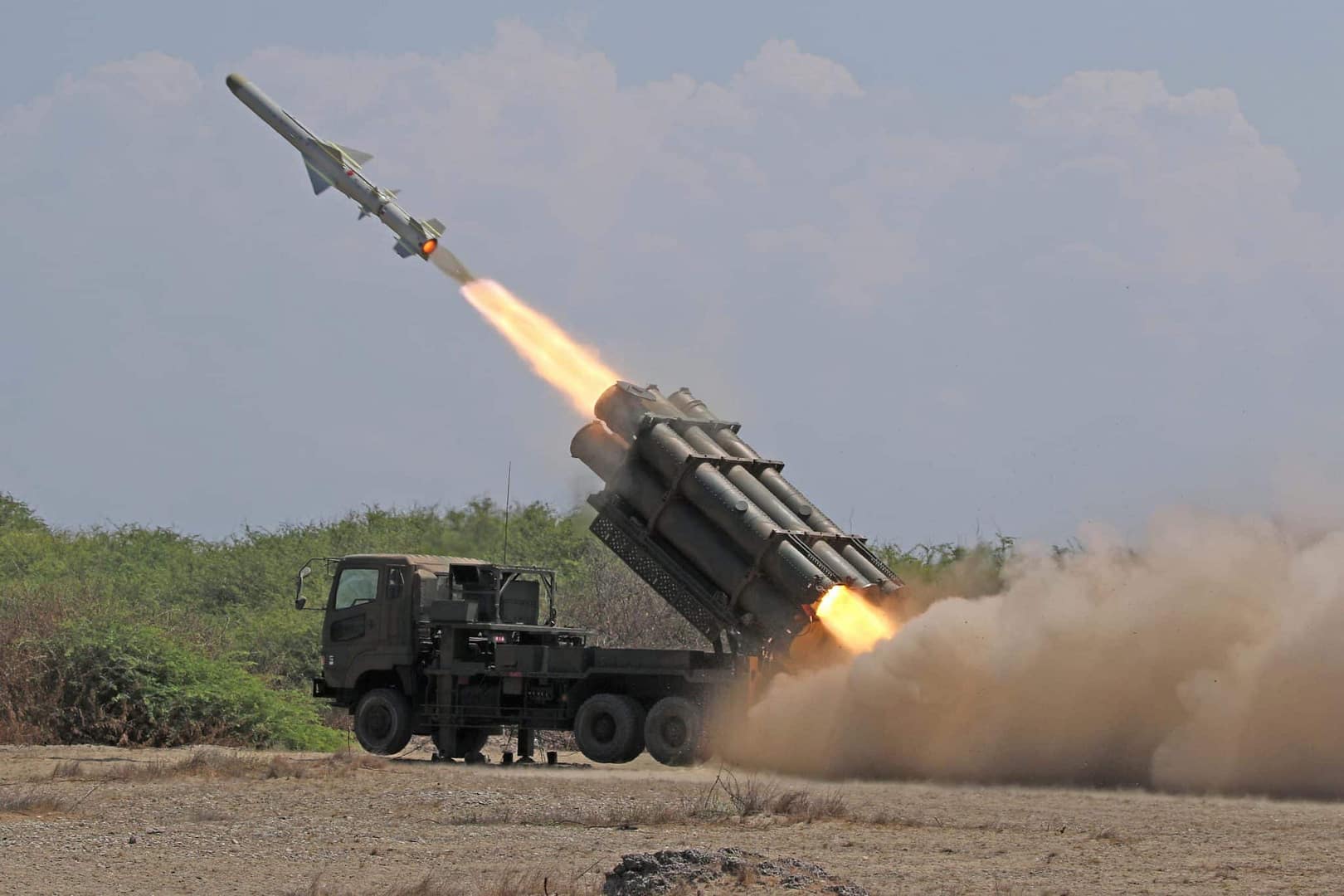
The morning of May 6, 2026, was clear over the Culili Point sand dunes south of Laoag. A six-wheeled launcher — Japanese, bearing the roundel of the Ground Self-Defense Force — sat squat in the sand, its six canisters pointed west toward open water. At 10:30 a.m., two Type 88 anti-ship missiles tore free in quick succession, trailing fire across a pale Philippine sky. Six minutes later, fifty miles offshore, the BRP Quezon ceased to exist.
What made the moment extraordinary wasn’t the technology. The Type 88 is more than 35 years old. What made it extraordinary was what happened when you pulled at the threads of history. The ship that burned and sank beneath the South China Sea — once named USS Vigilance, commissioned in 1944 to fight Imperial Japan — was just sent to the bottom by Japanese missiles, from Philippine soil, 81 years after the war that made such a scene unthinkable.
History does not repeat. But sometimes it does something stranger: it loops.
Quick Facts
Date: May 6, 2026
Exercise: Balikatan 2026 (April 20 – May 8), 41st iteration
Launch site: Culili Point sand dunes, near Laoag, Ilocos Norte, northwestern Luzon, Philippines
Missiles fired: Two Type 88 surface-to-ship missiles (JGSDF)
Target: BRP Quezon (PS-70), decommissioned Philippine Navy corvette
Distance: ~75 km (≈50 miles) offshore
Time to impact: Six minutes
Historical first: Japan’s first combat missile launch outside its own territory since WWII; first Japanese combat troops on Philippine soil since WWII
Also involved: US, Canada, Philippines (~17,000 troops, 7 nations)
A Ship With a Story
You can’t tell this story without telling her story first.
USS Vigilance was laid down in Seattle in November 1942, originally destined for the Royal Navy under Lend-Lease. The US Navy kept her, commissioned her in February 1944, and sent her into the Pacific. She swept convoy routes between Pearl Harbor and the Marshall Islands, screened approaches at Guam, Peleliu, and Ulithi — the island anchorages that staged the final push toward Japan. She was a workhorse of a ship, an Auk-class minesweeper: 221 feet of steel, unglamorous, essential.
After the war, USS Vigilance faded from the Navy’s roster. In 1967 she was transferred to the Philippine Navy, where she became BRP Quezon — named for Manuel Quezon, the first President of the Philippine Commonwealth. She served another 53 years in Philippine waters, a ghost of a different era slowly rusting into history, before her decommissioning in March 2021.
BRP Rizal (left) and BRP Quezon — the Rizal-class corvettes that served the Philippine Navy for decades. USS Vigilance, which fought Japan in the Pacific in 1944, became BRP Quezon after transfer in 1967. US Navy photo / Public domain
The ship that once hunted mines laid by Japan’s enemies, in a war fought against Japan, decommissioned and sitting in Philippine waters for three years — nobody planned this particular ending. But when planners for Exercise Balikatan 2026 needed a target ship for a maritime strike event, BRP Quezon was available. Japan’s Type 88 regiment would fire. The script wrote itself.
The Shot That Broke 80 Years of Restraint
Exercise Balikatan — Tagalog for “shoulder to shoulder” — has run annually between the Philippines and the United States since 1991. This year’s iteration was the largest in the exercise’s history: 17,000 troops, seven nations, nineteen days. And for the first time, Japanese combat troops participated directly. Roughly 1,400 JGSDF personnel deployed to the Philippines — the first Japanese combat deployment to Philippine soil since August 1945.
The maritime strike event at Culili Point was the capstone. A single JGSDF launcher vehicle — a 6×6 chassis carrying six canistered Type 88 missiles — moved into position in the dunes. Seventy Japanese personnel were involved in the firing. Philippine Defense Secretary Gilberto Teodoro Jr. watched alongside his Japanese counterpart, Shinjiro Koizumi.
Japan Ground Self-Defense Force Type 88 surface-to-ship missile launcher — the same system fired from Luzon on May 6, 2026. The six-tube launcher travels on a 6×6 chassis and carries a range of up to 180 km. US Marine Corps / Wikimedia Commons
Two missiles left their tubes. Six minutes passed. BRP Quezon’s fate was confirmed: struck, sinking, gone. A ship that fought against Japan in 1944 was sunk by Japan in 2026, from the soil of the country Japan occupied during that same war.
Teodoro kept his remarks measured but pointed: “We have seen how it works and it is something that we can interoperate with in the future.” The strategic message needed no elaboration.
“From planning to forming to resource management, it will only get smoother and better.”
Gilberto Teodoro Jr. — Secretary of National Defense, Philippines (witnessing the Type 88 firing, May 6, 2026)
The Irony China Noticed
Beijing did not miss the symbolism. Chinese state media and official spokespeople lodged protests almost immediately, framing the exercise as a provocation — a forward deployment of Japanese firepower on a strategic island chain that, in any future Taiwan conflict, would be vital terrain.
They are not wrong about the geography. Culili Point sits on the northwestern tip of Luzon, facing directly into the Luzon Strait — the narrow passage between the Philippines and Taiwan through which the Chinese People’s Liberation Army Navy would need to transit to break into the wider Pacific. The Type 88’s published range is 180 kilometers. From Culili Point, that reach covers much of the strait.
“Balikatan’s real value is showcasing our resolve to work together to defend the Philippine archipelago and to uphold the rules-based international order,” said General Romeo Brawner Jr., Chief of the Armed Forces of the Philippines. The general’s words were careful. The missiles were blunt.
USS Chief (AM-315), a sister ship to USS Vigilance in the Auk-class minesweeper program — the same class as the ship that became BRP Quezon. Commissioned in 1944, these vessels swept mine-laden waters across the Pacific theater. US Navy / Wikimedia Commons
The presence of Canadian forces — another first for Balikatan — amplified the signal. This was not simply a bilateral US-Philippines drill. It was a multilateral demonstration that the First Island Chain could be defended by a coalition, and that Japan was now part of that coalition in a way it had not been since the Meiji era.
Good to Know: Japan’s Pacifist Constitution — and How This Breaks the Mold
For most of the postwar era, this moment would have been constitutionally impossible. Article 9 of Japan’s 1947 constitution — written under American occupation — renounces war and prohibits Japan from maintaining “war potential.” For decades, this was interpreted as barring offensive weapons, overseas military deployments, and any military action beyond the defense of the home islands.
The story of how Japan arrived at Culili Point is the story of Article 9’s slow unwinding. In 2015, Prime Minister Shinzo Abe reinterpreted the constitution to allow “collective self-defense” — the right to fight alongside allies even when Japan itself is not directly attacked. In 2022, following Russia’s invasion of Ukraine and accelerating Chinese military activity near Taiwan, Japan released a new National Security Strategy. It announced plans to double defense spending and acquire “counterstrike capability” — long-range missiles able to hit enemy territory.
The Type 88 is old technology, but its deployment to Luzon was a live demonstration of the new doctrine. Japan is, quietly and deliberately, becoming a country that fires weapons outside its borders again for the first time in eight decades. The reciprocal access agreement with the Philippines, ratified in September 2025, provided the legal scaffolding. Balikatan 2026 provided the occasion.
The Type 88 itself will soon be replaced by the far more capable Type 12, which Mitsubishi Heavy Industries has extended to a range of over 1,000 kilometers. If the Type 88 firing was a statement, the Type 12 will be a declaration.
What a Minesweeper Means in 2026
There is something quietly devastating about the BRP Quezon’s final chapter. She was not a glamorous ship. She was never an aircraft carrier or a destroyer. She was the kind of vessel that does the dangerous, unglamorous work — clearing mines so other ships can pass safely. She spent the war keeping lanes open so the American advance toward Japan could continue.
And then, 81 years later, Japan’s missiles sent her to the seafloor — not in anger, but in partnership, as a training target, as a prop in a strategic performance aimed at a different adversary entirely.
History’s ironies are rarely tidy. The BRP Quezon’s end is not a tragedy. It is something stranger: a strange closing of a loop that began in the Pacific in 1944, routed through the Cold War and the post-war order, and resolved itself on a May morning above the Luzon Strait, in a sky filled with the exhaust plumes of weapons built by the country the ship once helped to defeat.
Balikatan means “shoulder to shoulder.” On May 6, 2026, Japan and the Philippines stood shoulder to shoulder on sand dunes south of Laoag, and the world noticed.
Sources: Naval News (Gordon Arthur), Stars and Stripes, The War Zone, Army Recognition, Japan Times, Philippine News Agency, GMA Network
Every so often, a clip resurfaces online claiming that the Hollywood star Emma Stone made history as “the first civilian to fly in an F-22 Raptor.” It collects millions of views, a flurry of amazed comments, and the occasional breathless re-share. It is...
Ask almost anyone which aircraft won the Battle of Britain and you will get the same answer: the Spitfire. It is one of the most beautiful machines ever built, and it has earned its legend. But it is, at best, only half the story. The aircraft that actually shot down...
In a refrigerated room hidden beneath London’s Smithfield Meat Market in 1943, behind a screen of hanging animal carcasses, a future Nobel Prize winner was busy perfecting a recipe. Not for food — for a building material. His task: prove that you could...



 English
0 Comments