
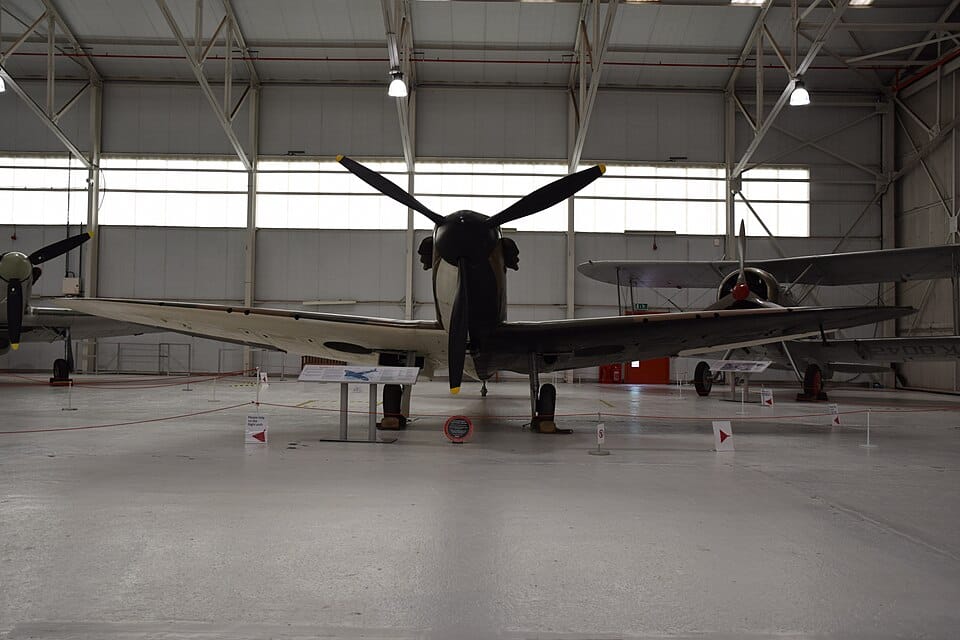
Quick Facts
| Nationality | British 🇬🇧 |
| Aerial Victories | 38 (highest confirmed British ace of WWII) |
| Aircraft Flown | Spitfire Mk.II through Mk.XIV |
| Wars | World War II |
| Born / Died | 9 Mar 1915 – 30 Jan 2001 (age 85) |
| Unit | 616 Sqn RAF, No. 144 Wing RCAF |

With 38 confirmed aerial victories, Air Vice-Marshal James Edgar "Johnnie" Johnson is the highest-scoring British fighter ace of the Second World War. Unlike many aces who burned bright and fast, Johnson survived the entire conflict, accumulated his victories steadily across years of intensive combat, and emerged as one of the most thoughtful and respected fighter leaders the RAF ever produced.
Early Life and Entry into the RAF
Born on 9 March 1915 in Barrow upon Soar, Leicestershire, Johnson studied civil engineering before joining the RAF Volunteer Reserve in 1939. He was accepted for pilot training just as the war was beginning, and his early career was almost derailed by a shoulder injury that required surgery. Determined not to miss the war, he concealed the extent of his condition long enough to get into combat.
The Spitfire Years
Johnson flew Spitfires throughout his entire combat career — exclusively. He joined 616 Squadron in 1940 and served through the Battle of Britain period, though his shoulder injury meant his contribution in that critical phase was limited. He truly came into his own in 1941 and 1942 during the RAF's offensive sweeps over occupied Europe, leading formations of Spitfires in complex, fast-moving engagements against the Luftwaffe's best fighters.
Johnson was known for his exceptional situational awareness — the ability to track multiple aircraft in a complex dogfight while simultaneously leading his formation. He shot down his victims with cold efficiency, usually achieving surprise before the enemy pilot even knew he was there.
Wing Commander and Beyond
By 1943, Johnson was commanding a Spitfire wing, leading squadrons from Canada, New Zealand, and Britain on offensive operations. He was awarded the Distinguished Service Order three times and the Distinguished Flying Cross twice — among the most decorated fighter pilots in the RAF. He flew in the Normandy campaign and continued operations until the war's end.
Johnson later wrote two highly regarded books about his experiences — Wing Leader (1956) remains one of the finest personal accounts of fighter combat ever published. He continued to serve in the post-war RAF, eventually retiring as an Air Vice-Marshal. He died on 30 January 2001 at the age of 85, one of the last of the great wartime aces.
Johnnie Johnson's 38 victories and his long, distinguished career as both pilot and leader make him the definitive British fighter ace of the Second World War — a man who mastered not just the art of aerial combat, but the far harder art of leadership under fire.
“The Spitfire was not just a machine. She was poetry. She was us — everything we were and everything we hoped to be.”
— Air Vice-Marshal Johnnie Johnson, CBE DSO DFCWatch: Johnnie Johnson Documentary
Related Questions
Who was Johnnie Johnson?
Air Vice-Marshal James Edgar 'Johnnie' Johnson (1915–2001) was the highest-scoring British fighter ace of World War II, with 38 confirmed aerial victories. Flying the Supermarine Spitfire throughout the war, he survived the entire conflict and became one of the RAF's most respected fighter leaders, known for his exceptional situational awareness and tactical skill.
How many kills did Johnnie Johnson have?
Johnnie Johnson scored 38 confirmed aerial victories, the highest of any British-born RAF pilot in World War II. Unlike aces who scored quickly and were soon lost, Johnson accumulated his victories steadily from 1941 to 1945 during offensive sweeps over occupied Europe. Nearly all of his kills were against enemy fighters, achieved with what observers called cold efficiency.
What plane did Johnnie Johnson fly?
Johnnie Johnson flew the Supermarine Spitfire throughout his wartime career, from the Mk.II to the Mk.XIV. The Spitfire's agility suited his style of gaining surprise and striking before the enemy reacted. While the Spitfire is the more celebrated fighter, the Hawker Hurricane actually shot down more enemy aircraft during the Battle of Britain.
Was Johnnie Johnson in the Battle of Britain?
Johnnie Johnson saw little action in the Battle of Britain because a shoulder injury, from an old rugby accident, kept him largely grounded during that critical period. He came into his own later, in 1941–42, leading Spitfire formations on offensive operations over occupied Europe, and by 1943 was commanding a wing of Canadian, New Zealand and British squadrons.
How was Johnnie Johnson decorated?
Johnnie Johnson was one of the most decorated RAF fighter pilots, awarded the Distinguished Service Order three times and the Distinguished Flying Cross twice. He led squadrons through the Normandy campaign and flew until the war's end, then remained in the RAF and rose to Air Vice-Marshal before retiring. He died in 2001, aged 85.
Who was the top-scoring fighter ace of World War II?
The top Allied scorers varied by nation: Johnnie Johnson led British-born RAF pilots with 38, America's Richard Bong topped US pilots with 40 in the Pacific, and the highest-scoring aces of all were German Luftwaffe pilots on the Eastern Front, some credited with hundreds. Johnson's total is remarkable for being earned across years of intense combat that he survived.
0 Comments