
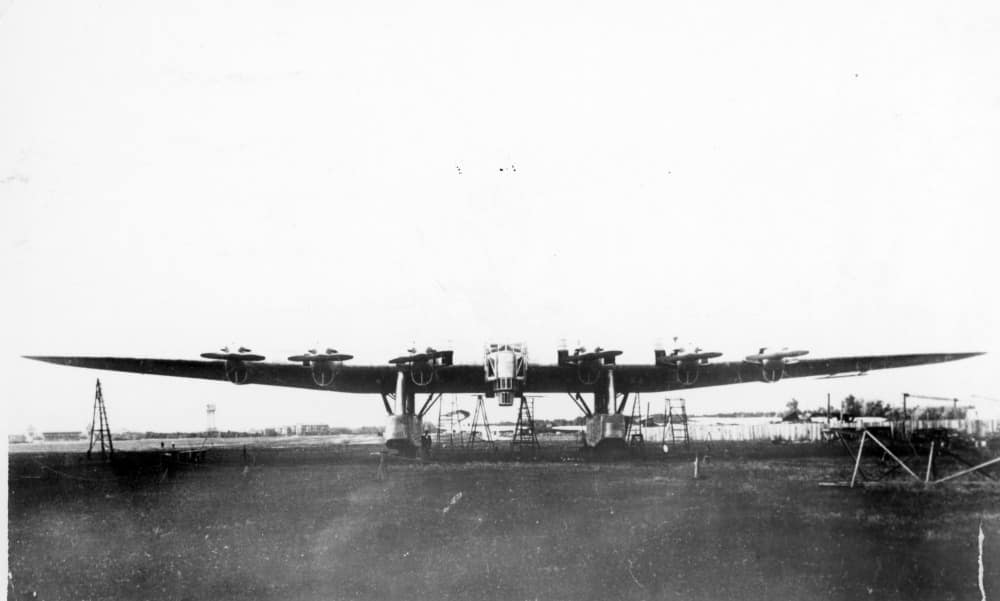
Autumn, 1933. On a grass airfield outside Kharkiv, a shape rolls out of its hangar that looks less like an aeroplane and more like a building that has decided to fly. Its wing stretches 53 metres from tip to tip — thick enough for a grown man to walk inside it and take a seat. Six engines glint along the leading edge, a seventh faces backwards, and two long tail booms trail behind like the arms of some mechanical leviathan.
Soviet workers called it simply “the giant.” The rest of the world barely knew it existed. For a few glorious months in 1933, the Kalinin K-7 was arguably the biggest aircraft on Earth — a flying fortress conjured from Stalin-era ambition and home-smelted steel. And then, on a single grey November afternoon, it shook itself apart and took most of its crew with it.
This is the story of one of aviation’s wildest dreams, and the fatal flaw hidden inside its own bones.
• Aircraft: Kalinin K-7, heavy experimental bomber / transport
• Designer: Konstantin Kalinin, Kharkiv, Ukraine
• First flight: 11 August 1933
• Powerplant: Seven Mikulin AM-34 V-12 engines, 750 hp each — six tractor on the leading edge plus one pusher at the rear
• Wingspan: 53 m; wing area 454 m²; length 28 m
• Crash: 21 November 1933, structural failure of a tail boom
• Death toll: 14 aboard plus one on the ground (15 total)
• Built: One completed; two more begun, cancelled 1935
A Cathedral With Wings
To understand the K-7, forget the sleek airliners you know and picture instead a “flying wing” the size of a small cathedral. Konstantin Kalinin, a World War I aviator turned aircraft designer, was obsessed with the idea that the future of flight lay in the wing itself. Why bolt a fragile fuselage onto a wing when the wing could be the aircraft?
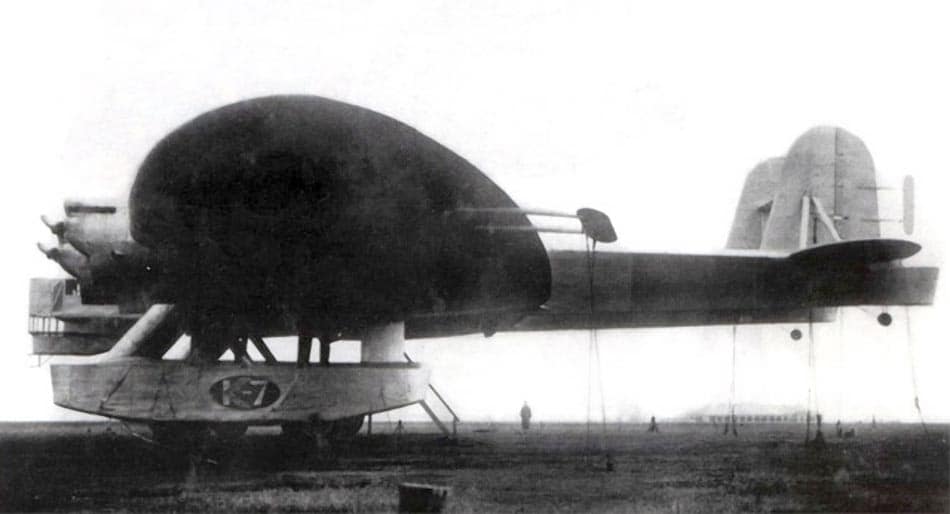
So he made his wing monstrously thick — 2.3 metres deep at the root — and hollowed it out. Inside that cavernous aerofoil he planned to seat 120 passengers, with the airframe welded together from KhMA chrome-molybdenum steel rather than the imported alloys the Soviets could ill afford. Twin booms carried the tail. Two great pods slung beneath the wing housed the fixed landing gear and, in the bomber version, gun turrets. In its military dress the K-7 was to bristle with cannon and machine guns and haul many tonnes of bombs. It was, by almost any measure, one of the largest aircraft built before the jet age.
Seven Engines and a Steel Dream
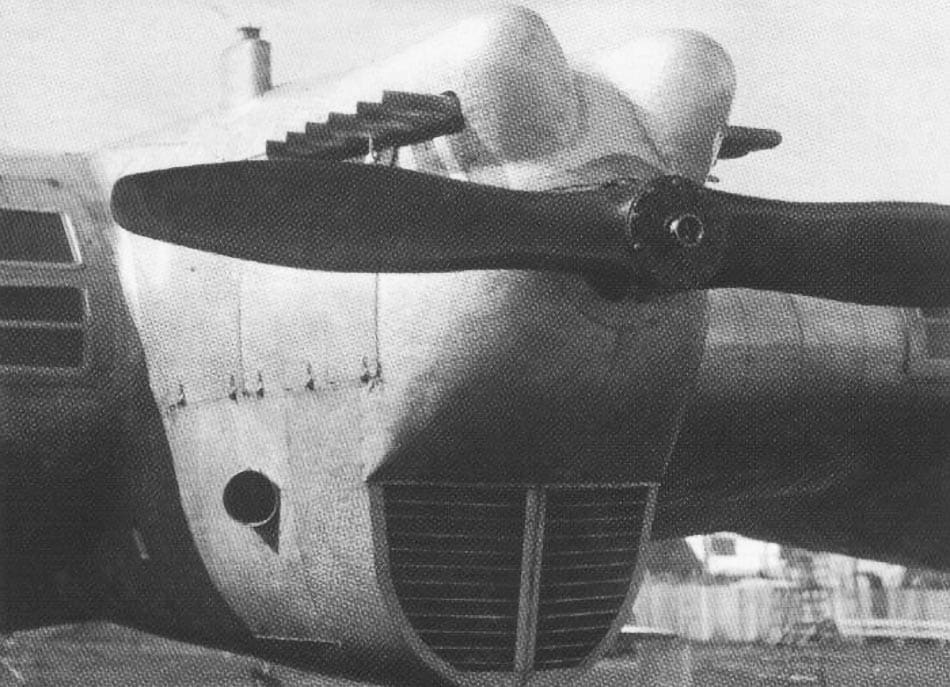
Here is the detail that makes aviation enthusiasts do a double-take. The K-7 was designed around six Mikulin AM-34 engines — big liquid-cooled V-12s of 750 horsepower apiece — strung along the leading edge of the wing, all pulling. Simple, elegant, symmetrical.
Then the arithmetic went wrong. As the design matured, the projected loaded weight blew past what six engines could lift. Rather than start over, Kalinin’s team simply bolted on more power: a seventh engine, mounted at the rear in pusher configuration, facing aft between the tail booms. Seven engines on one aircraft, in the early 1930s, driving simple two-bladed fixed-pitch propellers. The whole machine was built over roughly two years in Kharkiv, and its very existence was treated as a state secret until it was ready to be unveiled to a waiting nation.
Rex’s Hangar tells the full history of the Kalinin K-7, the Soviet giant that actually flew.
A First Flight, and a Warning
On 11 August 1933, the giant finally left the ground. The flight was brief — and it was troubling. Even in those first moments aloft, the K-7 revealed a sinister habit: the entire airframe would resonate in sympathy with the frequency of its engines, setting up a violent, buzzing vibration that ran through the structure. In 1933, the science of how large structures respond to vibration — what we now call flutter and resonance — was barely understood.
Kalinin’s engineers reasoned their way to a fix that sounded sensible at the time: shorten and strengthen the tail booms to stiffen everything up. The test programme pressed on regardless, and the giant kept flying. When Soviet authorities finally revealed the aircraft to the public, the propaganda machine went into overdrive — because this colossus had been built from Soviet steel, not foreign imports.
National pride was riding on the machine. The problem was that pride does not damp out a resonant frequency.
The Boom That Broke
The K-7 completed seven test flights. On the eighth, on 21 November 1933, it was put through a speed run over a measured course near Kharkiv. Witnesses watched as one of the tail booms — the very structure the engineers had “fixed” — failed. The giant dropped out of the sky.
Fourteen people aboard were killed, along with one person on the ground: fifteen dead in a single afternoon. A government commission concluded that oscillations induced by aerodynamic flutter had torn the structure apart — the aircraft, in effect, destroyed by its own vibrations. Because these were the paranoid early years of the Stalin era, the investigating commission included representatives of the OGPU, the Soviet secret police, and whispers of sabotage drifted through the aviation press for decades afterwards.
The Vanishing of a Giant — and Its Maker
Extraordinarily, the crash did not immediately kill the dream. Two more K-7 prototypes were ordered, with revised structures meant to cure the flutter. But work dragged, priorities shifted, and in 1935 the whole programme was cancelled before either aircraft could be finished. Only one K-7 was ever completed, and it lay in pieces on a Ukrainian airfield.
The fate of its creator was darker still. Konstantin Kalinin, decorated in the First World War and honoured by the Soviet state, was swept up in Stalin’s Great Purge. On 23 October 1938 he was executed as an “enemy of the state.” The man who had dreamed of flying cathedrals was erased almost as thoroughly as his aircraft.
And yet the K-7 refuses to be forgotten. It endures as one of aviation’s great what-ifs — a machine so far ahead of its structural understanding that it could not survive its own ambition. A 53-metre wingspan, seven engines, passengers riding inside the wing: it was audacious to the point of madness, and for a handful of flights in 1933, it actually worked. In a century full of tame aeroplanes, the giant of Kharkiv remains gloriously, tragically wild.
Sources: Wikipedia (Kalinin K-7); This Day in Aviation (Bryan R. Swopes); Flight / The Aircraft Engineer, 30 November 1933; Wikimedia Commons.
Related Questions
What was the Kalinin K-7?
The Kalinin K-7 was a colossal Soviet experimental bomber and transport aircraft of the early 1930s, so large that people simply called it "the giant." Designed by Konstantin Kalinin, it had a 53-metre wingspan thick enough to walk inside. For a few months in 1933 it was arguably the biggest aircraft on Earth.
How many engines did the Kalinin K-7 have?
The Kalinin K-7 had seven Mikulin AM-34 V-12 engines of 750 horsepower each — six mounted as tractors along the leading edge of its enormous wing, plus one pusher engine facing backwards. This unusual seven-engine arrangement was needed to haul the aircraft's vast structure into the air.
Who designed the Kalinin K-7?
The K-7 was designed by Konstantin Kalinin, a World War I aviator turned aircraft designer working in Kharkiv, Ukraine. He was obsessed with the idea that the future of flight lay in the wing itself, making the K-7's wing a monstrous 2.3 metres thick at the root and hollowing it out to seat passengers inside.
What happened to the Kalinin K-7?
The Kalinin K-7 crashed on 21 November 1933 when one of its tail booms suffered a structural failure, killing 14 people aboard and one on the ground — 15 in total. A single K-7 was completed; two more were begun but cancelled in 1935, ending the giant's story.
How big was the Kalinin K-7?
The Kalinin K-7 had a wingspan of 53 metres, a wing area of 454 square metres and a length of 28 metres, with a wing 2.3 metres deep at the root. Those dimensions made it one of the largest aircraft of its day — a Soviet forerunner of later giants like the An-225 Mriya.
When did the Kalinin K-7 first fly, and how many were built?
The Kalinin K-7 first flew on 11 August 1933. Only one was ever completed; it flew for just a few months before the fatal crash that November. Two additional airframes were under construction but were cancelled in 1935, so the K-7 remained a one-of-a-kind experiment.


0 Comments