
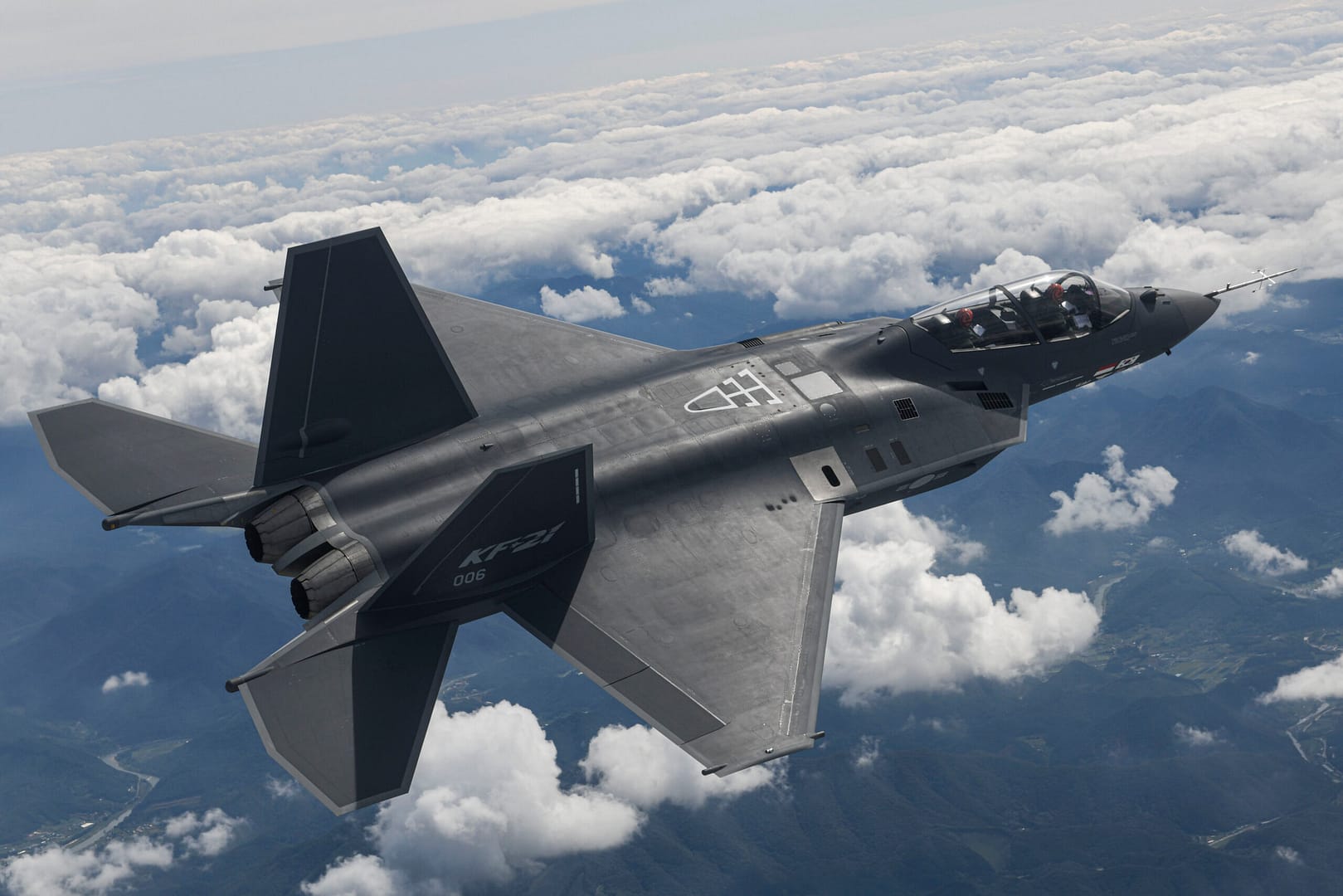
On 13 January 2026, South Korea’s Defense Acquisition Program Administration quietly announced what amounts to a seismic shift in the global fighter market: the KF-21 Boramae had completed its flight test programme. Two months ahead of schedule. 1,600 sorties without a single accident. And by 25 March, the first production aircraft had already rolled off the assembly line at Korea Aerospace Industries in Sacheon. This is the first entirely new fighter programme to reach series production in over a decade that is neither American nor Chinese — and it changes the calculus for every air force shopping for a modern combat aircraft.
Quick Facts: KF-21 Boramae
| Designation | KF-21 Boramae (“Young Hawk”) |
| Manufacturer | Korea Aerospace Industries (KAI), Sacheon |
| Generation | 4.5-generation multirole fighter |
| Powerplant | 2 × General Electric F414-GE-400K (~50,000 lbs combined thrust) |
| Max Speed | Mach 1.81 |
| Dimensions | Length: 16.9 m | Wingspan: 11.2 m |
| MTOW | 25,400 kg |
| Radar | Hanwha Systems APY-016K AESA (~1,000 GaN T/R modules) |
| Hardpoints | 10 (6 underwing, 4 under-fuselage) |
| Unit Cost | ~$83M (Block I) / ~$112M (Block II) |
| First Flight | 19 July 2022 |
| Flight Tests Complete | 13 January 2026 (1,600 sorties, 13,000 test conditions) |
| Initial Delivery | September 2026 (8 aircraft planned for 2026) |
The Flight Test Campaign: 1,600 Sorties Without a Scratch
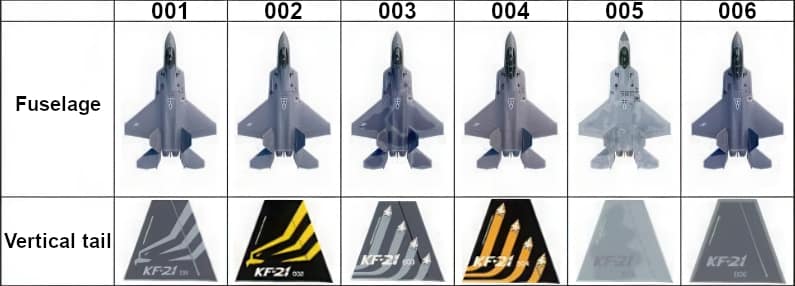
The numbers alone tell a remarkable story. Over 42 months, six KF-21 prototypes accumulated roughly 1,600 sorties and verified 13,000 individual test conditions — all without a single accident. The programme began with the maiden flight on 19 July 2022, and concluded on 12 January 2026 when the fourth prototype completed the final scheduled sortie from KAI’s facilities at Sacheon.
The test campaign covered the full spectrum of a modern fighter’s operational envelope: supersonic performance validation, high angle-of-attack manoeuvres, air-to-air weapon launches, precision ground attack profiles, and — notably — South Korea’s first-ever aerial refuelling trials with a fighter aircraft. That DAPA wrapped up the programme nearly two months ahead of the original schedule speaks volumes about the maturity of the design and the competence of the test team.
From Prototype to Production: The March 2026 Rollout
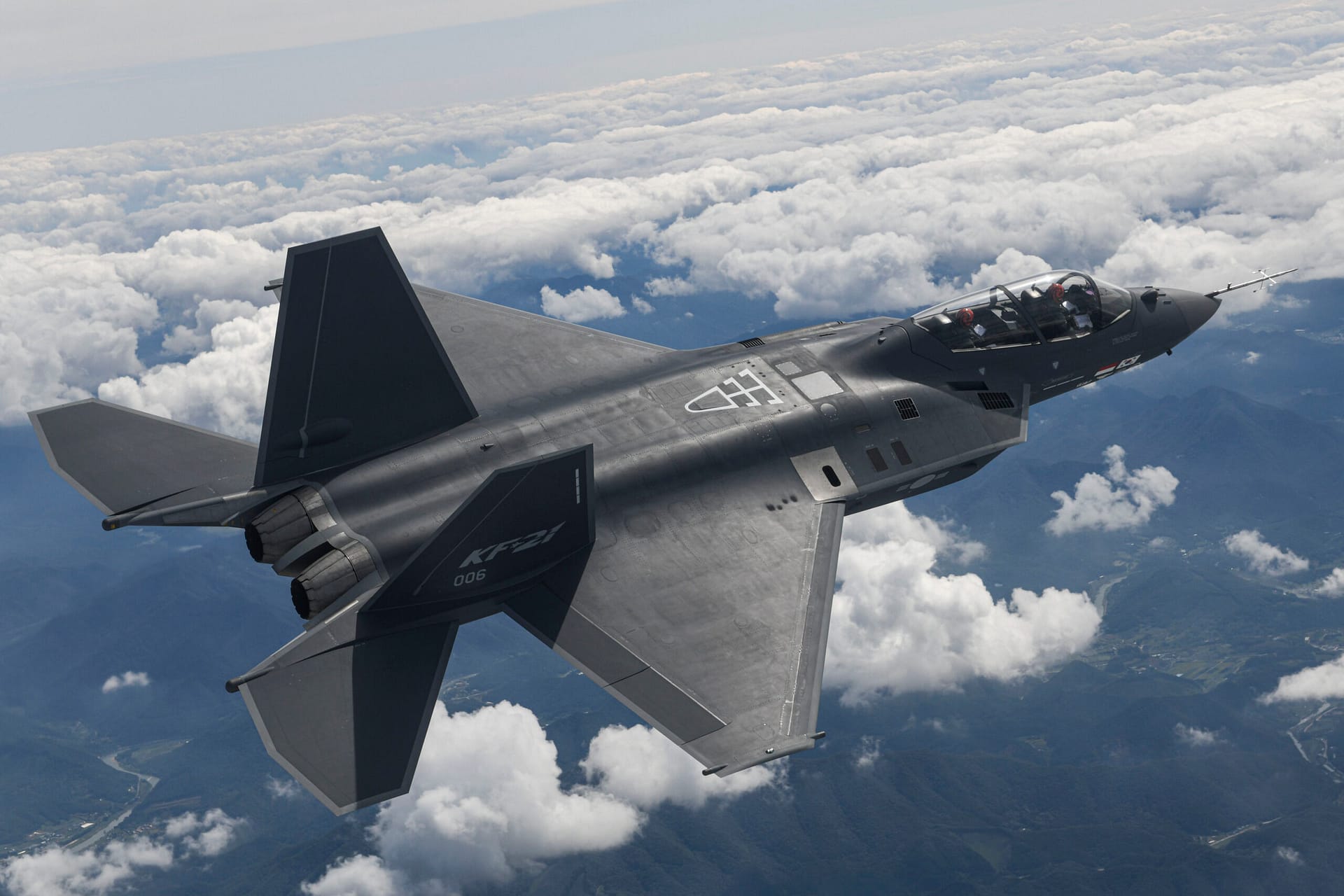
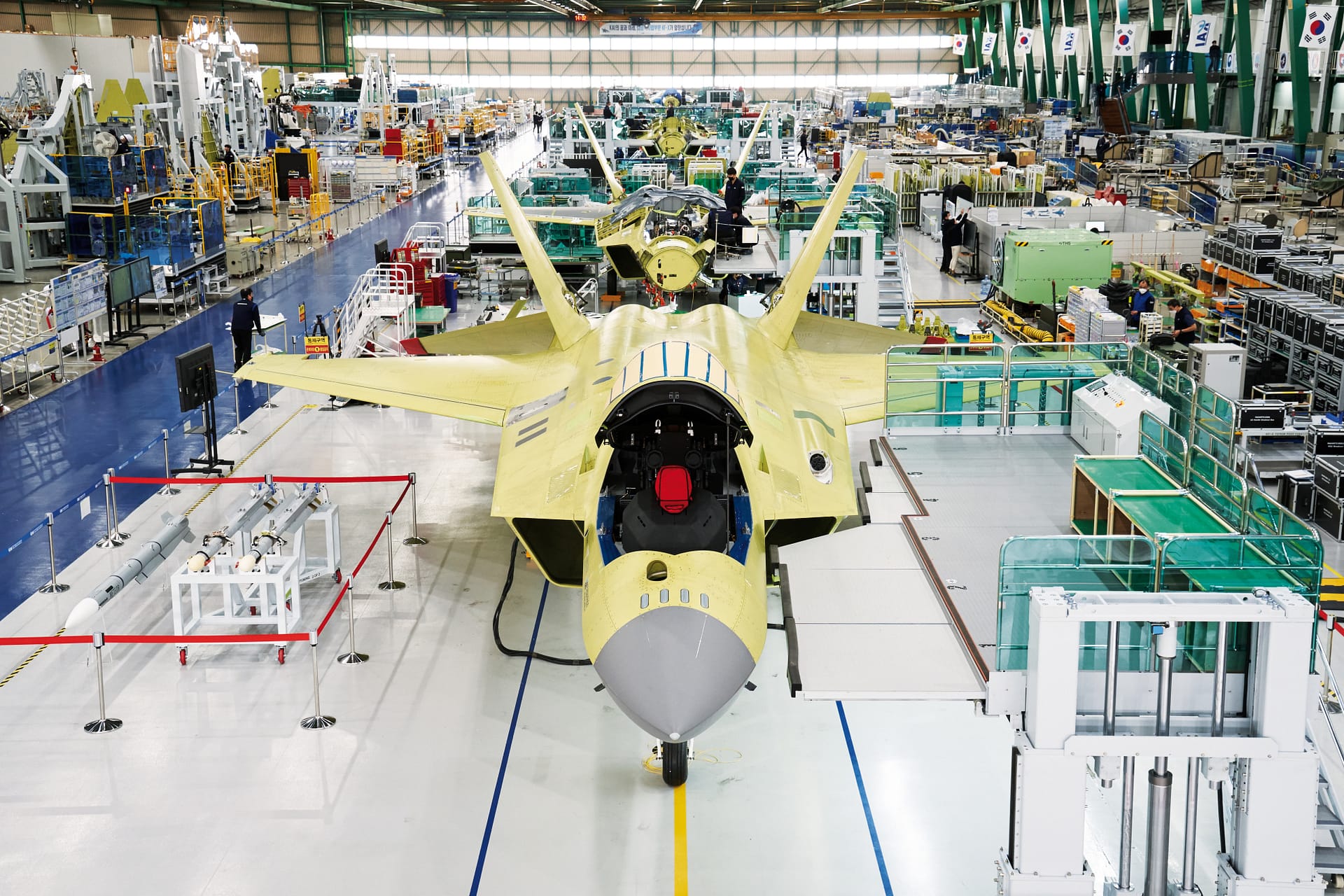
Barely two months after the final test flight, the first series-production KF-21 emerged from KAI’s factory in Sacheon on 25 March 2026. The two-seat aircraft, bearing the tail number 26-001, taxied under its own power to a ceremony stage before more than 500 guests, including air force pilots, defence executives, and ambassadors from 14 countries. President Lee Jae Myung addressed the crowd, framing the moment as a milestone in Korean defence sovereignty.
KAI’s production roadmap is ambitious but achievable: eight aircraft are scheduled for delivery to the Republic of Korea Air Force in 2026, followed by 31 in 2027 and completion of the initial 40 Block I airframes ahead of the previously stated 2028 deadline. The total Korean order stands at 120 aircraft, with 40 Block I air-superiority variants and 80 Block II multirole fighters scheduled for completion by 2032.
What Makes the Boramae Tick: Sensors, Systems, and Stealth
At the heart of the KF-21 sits the Hanwha Systems APY-016K AESA radar, a gallium nitride-based system with approximately 1,000 transmit/receive modules. Detection range exceeds 150 kilometres, with simultaneous tracking of 20 targets and support for air-to-air, air-to-ground, and air-to-sea modes. During testing, the radar successfully tracked a drone at 87 kilometres and guided an AIM-2000K missile to within one metre of its target.
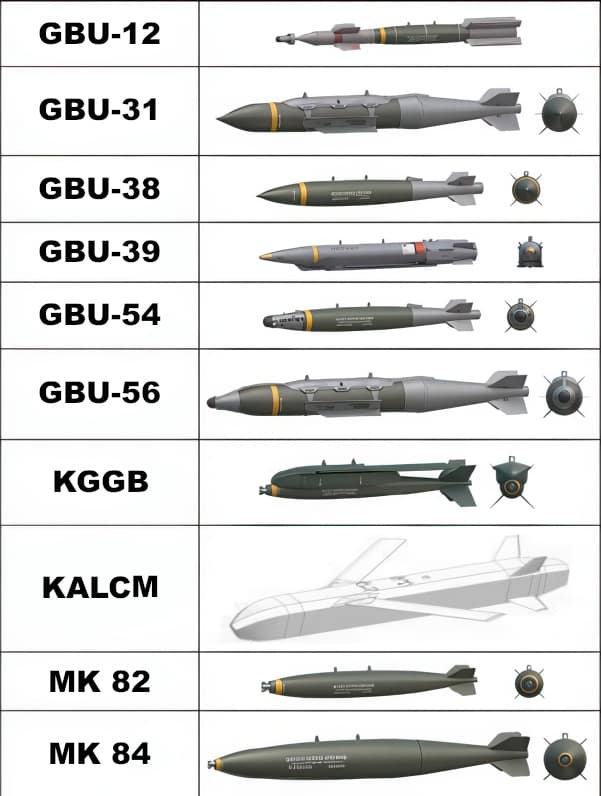
The weapons suite is impressively diverse for a programme of this vintage. Block I carries AIM-120 AMRAAM and Meteor beyond-visual-range missiles alongside the indigenous AIM-2000K, supplemented by JDAMs, GBU-12 Paveway II laser-guided bombs, and the Korean KGGB glide bomb. Ten hardpoints — six underwing, four under-fuselage — provide substantial carrying capacity.
Where the KF-21 occupies a particularly interesting niche is in its approach to stealth. Rather than pursuing full fifth-generation radar cross-section figures, KAI opted for a semi-stealth design using radar-absorbent materials and careful shaping to reduce the signature to approximately 1 m². The real step forward comes with Block II, which will introduce internal weapons bays for a significantly reduced signature when carrying air-to-air missiles — effectively bridging the gap between 4.5 and fifth generation.
KAI: The Manufacturer Behind the Programme
Korea Aerospace Industries, headquartered in Sacheon, South Gyeongsang Province, is the result of a 1999 government-mandated merger of the aerospace divisions of Samsung, Daewoo, and Hyundai. The company has steadily climbed the capability ladder — from the T-50 Golden Eagle supersonic trainer (developed with Lockheed Martin), through the FA-50 light combat aircraft now in service with multiple air forces, to the KF-21 as its first fully indigenous fighter design.
The KF-21 programme, known as KF-X during development, was formally launched in 2015 with a total development budget of approximately 8.8 trillion won ($6.5 billion). While Lockheed Martin provided early consulting, the intellectual property and design authority rest firmly with KAI — a crucial distinction for export purposes, as the aircraft does not carry the same ITAR (International Traffic in Arms Regulations) constraints as American-designed fighters.
The Indonesian Partnership: From Troubled Alliance to Export Customer
Indonesia’s involvement in the KF-X programme has been one of the longest-running sagas in Asian defence procurement. Originally committed as a 20% cost-sharing partner, Jakarta fell behind on payments for years, creating diplomatic friction that threatened the entire partnership. The resolution has been characteristically pragmatic.
In February 2026, the two countries agreed on a revised 600 billion won ($406 million) cost-sharing package centred on transferring the fifth KF-21 prototype — previously used for avionics validation and aerial refuelling trials — to Indonesia. Jakarta has already paid 536 billion won, leaving a final balance of roughly $42 million expected before June 2026.
More significantly, Indonesia is now negotiating the purchase of 16 KF-21 Block II fighters, positioning itself as the programme’s launch export customer. Although no binding contract was signed during President Prabowo Subianto’s visit to South Korea in late March 2026, officials from both sides continue to target the first half of 2026 for finalisation.
Export Prospects: Filling the Market Gap
The KF-21 enters the international market at a moment of remarkable opportunity. The gap between affordable but limited light combat aircraft and the exorbitantly priced F-35 has left dozens of air forces without a viable modernisation path. At roughly $83 million for Block I and $112 million for Block II, the Boramae offers genuine 4.5-generation capability — AESA radar, modern electronic warfare, network-centric operations, beyond-visual-range engagement — at a price point significantly below Western fifth-generation alternatives.
Beyond Indonesia, several countries have expressed interest. The Philippines and Malaysia are evaluating the type for their respective fighter requirements, with the Royal Malaysian Air Force reportedly considering the KF-21 alongside Russia’s Su-57 for its Multi-Role Combat Aircraft programme. KAI has also pitched a combined FA-50/KF-21 package for Peru’s fighter competition, where it faces the Rafale, F-16 Block 70, and Gripen E/F.
The Middle East and Africa represent additional potential markets, though KAI will need to navigate carefully around the political sensitivities of exporting to these regions. The KF-21’s relative freedom from American export controls — it uses GE engines under licence but is otherwise Korean-designed — gives it a significant advantage over competitors tethered to Washington’s approval process.
A New Chapter in Fighter Aviation
What South Korea has accomplished with the KF-21 Boramae deserves to be understood in its full context. This is a country that was assembling American-designed fighters under licence barely three decades ago. Today, it has designed, tested, and brought to production its own advanced combat aircraft — on schedule, on budget, and with a clean flight test record that most established aerospace powers would envy.
The Boramae will not replace the F-35. It was never designed to. What it does is offer something arguably more valuable to the international market: a modern, capable, and reasonably priced fighter that does not require a country to place its defence procurement at the mercy of Washington’s shifting political winds. For the dozens of air forces currently flying obsolescent F-5s, Mirages, and early-model F-16s, that proposition is extraordinarily compelling.
When the first operational KF-21s arrive at their squadrons in September 2026, they will mark not just a milestone for South Korea, but the opening of a genuinely new chapter in the global fighter market. The era of the affordable advanced fighter has arrived — and it speaks Korean.
 English
0 Comments