
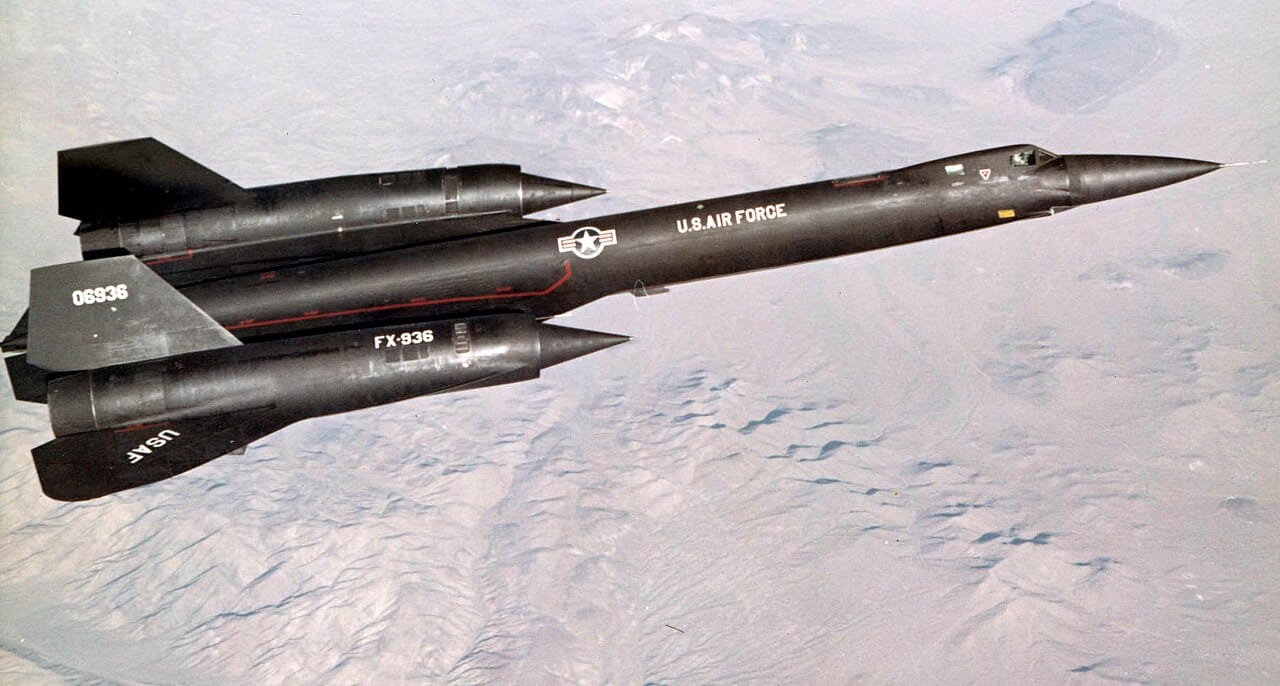
Three were built. Three flew. One crashed. Two went into storage. None ever entered service.
The Lockheed YF-12 is one of those aircraft that should have rewritten the book on continental air defence and instead became a footnote — overshadowed by the SR-71 Blackbird that was its direct sibling, killed by the McNamara Pentagon's preference for ground-based missile interceptors, and remembered today mostly because the few photographs of two YF-12s flying in formation at Mach 3 look like something out of a science-fiction film.
Two of the three YF-12s ever built — flying Mach 3 in formation. Via @aviationdiaryhd on Instagram
Quick Facts
Aircraft: Lockheed YF-12 (interceptor variant of A-12 Oxcart)
Designer: Kelly Johnson, Lockheed Skunk Works
Engines: 2× Pratt & Whitney J58, 32,500 lbf each with afterburner
Top speed: Mach 3.35 (~3,560 km/h)
Service ceiling: 90,000 ft (27,400 m)
Total built: 3 (serial 60-6934, 60-6935, 60-6936)
Armament: 3× AIM-47 Falcon air-to-air missiles in internal bays
Programme cancelled: February 1968

An Interceptor From the Skunk Works
By the early 1960s, the United States was facing a peculiar threat. Soviet Tupolev Tu-95 Bear bombers, lumbering turboprop strategic platforms, could carry nuclear weapons across the Arctic faster than any existing US interceptor could climb to meet them. Worse, by 1965 the Soviets were expected to deploy supersonic successors such as the Tu-22. The F-101 Voodoo and F-106 Delta Dart could not catch them. The Air Force needed something fundamentally new.
The CIA, meanwhile, had Kelly Johnson at Lockheed Skunk Works building the A-12 Oxcart — a single-seat reconnaissance aircraft that flew at Mach 3.2 and 90,000 feet. The Air Force asked: could you turn it into an interceptor? Johnson said yes. The result was the YF-12.
Two Pilots, Three Missiles, Mach 3
The YF-12 added a second cockpit for a fire-control officer, a Hughes ASG-18 long-range radar in the nose, and three internal bays each carrying a single Hughes AIM-47 Falcon missile — a 360-kilogram, two-stage weapon designed to intercept targets at ranges over 160 kilometres. The interceptor was supposed to launch the AIM-47s while still climbing through Mach 3, hit a Tu-95 from over 160 kilometres away, and turn for home before the Soviet bomber's escort fighters could even acquire radar contact.
It worked. In flight tests over the Mojave Desert in 1965 and 1966, the YF-12 successfully engaged QB-47 target drones at ranges over 80 nautical miles while flying Mach 3.2. One AIM-47 launched at extreme range scored a direct hit at a closing speed of over Mach 5 — a feat no operational interceptor matched until the F-14 Tomcat with the Phoenix in the 1970s.

Killed by Politics, Not Performance
By 1968, the threat had shifted. Soviet bomber numbers had stalled, but Soviet ICBM numbers had exploded. Defence Secretary Robert McNamara argued — correctly — that the United States needed to focus its limited budget on missile defence and bomber penetration, not on a Mach 3 interceptor for a bomber threat that no longer existed. The Air Force order for 93 production F-12B interceptors was cancelled.
Two of the three YF-12s were transferred to NASA for high-speed research — the first airframe had already been written off in a 1966 landing accident. One was destroyed in 1971 when an in-flight fire forced its crew to eject; the other, joined by an SR-71 flown under the designation YF-12C, became a flying laboratory for sustained Mach 3 research that informed every subsequent supersonic transport programme — including, indirectly, the Concorde and Tu-144.
The Family Survives
The YF-12 itself disappeared, but its DNA lived on. Lockheed reused the airframe, the J58 engines, the titanium construction, and the Mach 3+ flight envelope for the SR-71 Blackbird, which entered service in 1966 and operated until 1998. Every Blackbird that ever flew owed its existence to the YF-12 development work.
The sole surviving airframe is now in a museum — the National Museum of the US Air Force in Dayton, Ohio. It still looks, even today, like it should not be possible. Three jets. Mach 3.35. AIM-47 Falcons. An interceptor that arrived at the wrong moment and was buried by the same Pentagon that should have built a hundred of it.
Sources: Lockheed Skunk Works archives, NASA Dryden flight test records, "Lockheed Blackbird Family" (Donald), USAF declassified test reports.
Related Questions
What was the Lockheed YF-12?
The Lockheed YF-12 was a Mach 3 interceptor prototype derived from the CIA’s A-12 Oxcart reconnaissance aircraft. Designed by Kelly Johnson’s Skunk Works, it was armed with AIM-47 Falcon missiles in internal bays. Only three were built, and despite record-breaking performance, it never entered operational service.
How fast was the YF-12?
The YF-12 could reach about Mach 3.35 (around 3,560 km/h) and cruise at 90,000 feet, powered by two Pratt & Whitney J58 engines. That blistering performance came straight from its parent, Lockheed’s A-12 - the close relationship explored in this A-12 versus SR-71 comparison.
Why was the YF-12 cancelled?
The YF-12 programme was cancelled in February 1968. Despite its speed, the Pentagon under Robert McNamara preferred ground-based missile interceptors over a hugely expensive Mach 3 fighter. The Soviet bomber threat it was built to counter also shifted, leaving the interceptor without a clear mission to justify it.
What was the YF-12 designed to do?
The YF-12 was designed to intercept Soviet strategic bombers approaching North America over the Arctic. Existing fighters like the F-101 Voodoo and F-106 Delta Dart could not catch fast Soviet bombers, so the Air Force adapted the Mach 3 A-12 into a missile-armed interceptor carrying AIM-47 Falcon missiles.
How is the YF-12 related to the SR-71?
The YF-12 and SR-71 are both descendants of Lockheed’s A-12 Oxcart, all designed by the Skunk Works. The A-12 spawned the SR-71 reconnaissance aircraft, the YF-12 interceptor, and even a Mach 3 drone, the Lockheed D-21, launched from the family’s back.
How many YF-12s were built?
Only three YF-12s were built (serials 60-6934, 60-6935, and 60-6936). One was lost in a crash, while the surviving two went into storage; none entered service. Their Mach 3 flights put them in rare company with rocket research aircraft like the Bell X-2.
0 Comments