
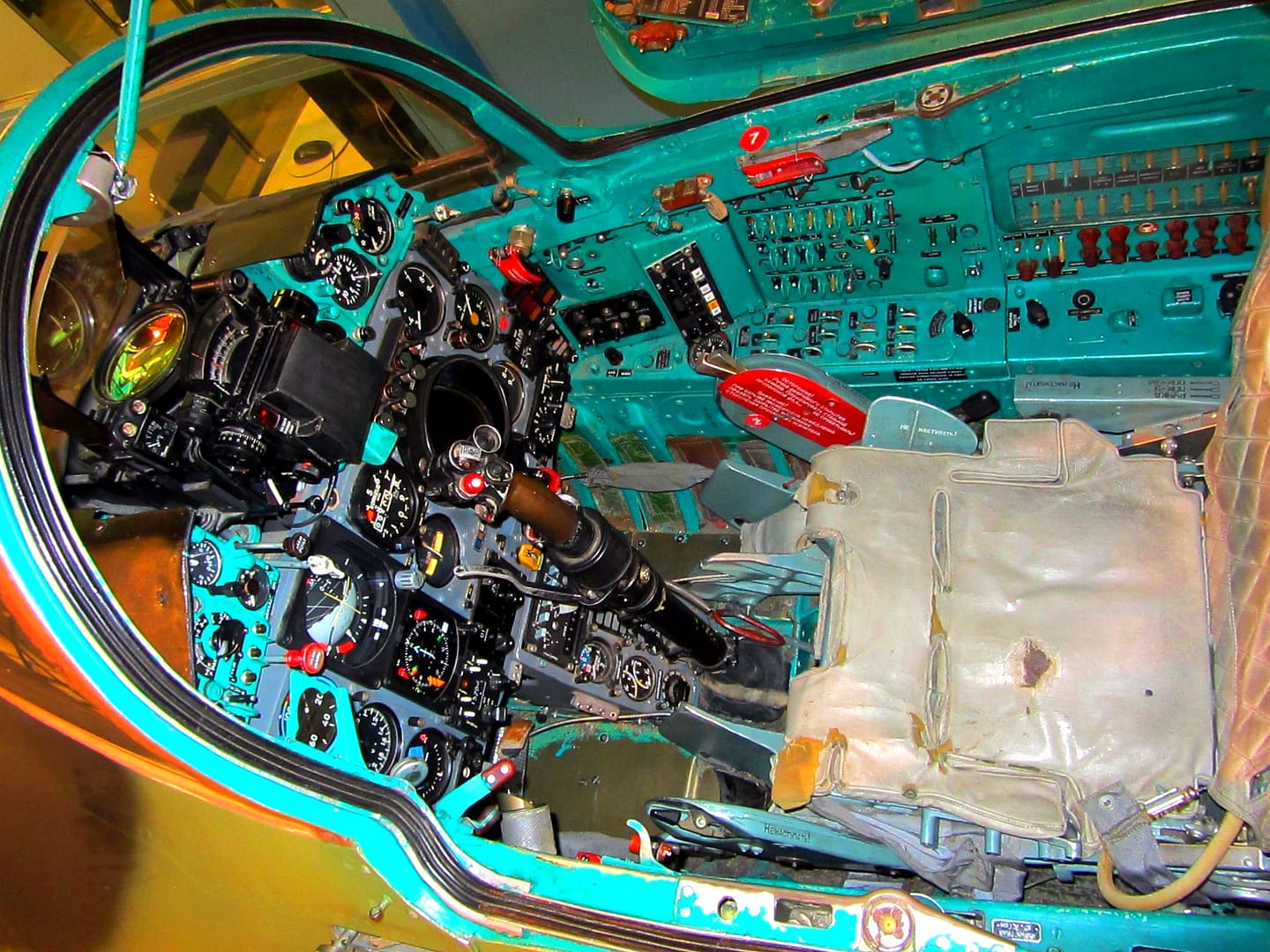
Step inside a MiG-21 cockpit and the first thing that hits you isn’t the claustrophobic canopy or the wall of analog dials. It’s the color. Every surface — the instrument panel frame, the side consoles, the canopy rails — is painted in a striking shade of turquoise green. Not military grey. Not matte black. Turquoise. It looks almost alien next to the jet’s bare-metal exterior, and it has baffled Western observers since the Cold War.
But that eerie shade wasn’t chosen on a whim. Soviet engineers selected it for the same reason surgeons wear green gowns — to protect the human eye under extreme conditions. The story behind this peculiar paint job stretches from wartime reverse engineering to cutting-edge vision science, and it reveals how seriously the Soviet Union took the invisible battle happening inside a pilot’s skull.
From B-29 Clone to Cockpit Standard
The origins of Soviet cockpit turquoise trace back, surprisingly, to an American bomber. In 1944, three battle-damaged B-29 Superfortresses made emergency landings in Soviet territory after bombing runs over Japan. Stalin ordered Andrei Tupolev to reverse-engineer the aircraft down to the last rivet. The result was the Tu-4 — a near-perfect copy that even replicated the interior paint tones of the original.
That initial color palette evolved through the late 1940s and 1950s. Early Soviet tactical fighters like the MiG-15 featured a light blue-grey interior designated PF-36m. Strategic bombers used various greens inherited from the B-29 lineage. But it was the MiG-21 — entering service in 1959 — that became the first Soviet tactical fighter to standardize the now-iconic cockpit turquoise as a factory finish.
From there, it spread to nearly every non-Sukhoi Soviet aircraft and helicopter. The Tu-22M adopted it for strategic bombers. Even Soviet-era train stations were painted in similar shades. It became, as aviation historians put it, a trademark of Eastern Bloc aircraft design.
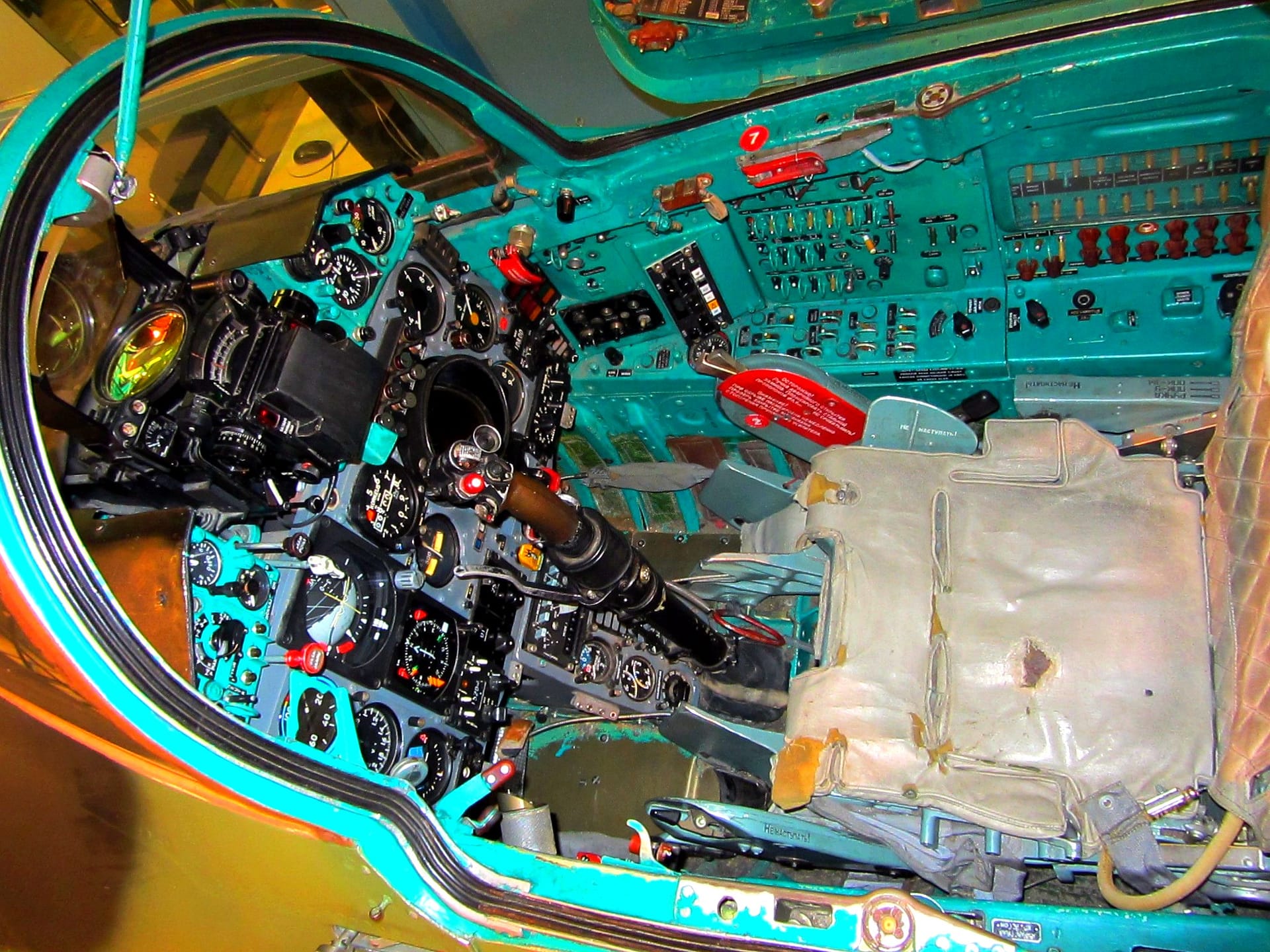
The unmistakable turquoise green of a MiG-21bis cockpit — Soviet engineers chose this shade for the same reason surgeons wear green. Photo: Falk2 / Wikimedia Commons (CC BY-SA 4.0)
The Science of Not Seeing Things
The core reason is optical. When the human eye focuses on a single color for an extended period, it generates a complementary-color afterimage upon looking away. Stare at red for thirty seconds, then glance at a white wall — you’ll see green. Surgeons discovered this the hard way: after hours of looking at red blood and tissue, shifting their gaze to white coats and sheets produced disorienting green flashes. The solution was to make everything around them green, neutralizing the afterimage effect.
Soviet aviation scientists applied the same principle. A fighter pilot’s world is dominated by black instrument housings, red warning lights, and the intense blue-white of sky and cloud. The turquoise-green cockpit surfaces serve as a visual anchor — a neutral resting point that doesn’t generate competing afterimages when the pilot’s eyes shift between instruments and the world outside the canopy.
There’s another layer to it. The specific wavelength of turquoise makes black instrument bezels, red warning indicators, and yellow caution lights equally eye-catching against the background. Nothing disappears. Nothing blends in. Every critical signal pops with equal urgency — a life-or-death advantage when you’re pulling 7g at 2,000 km/h and have fractions of a second to read a gauge.
Calming the Mind at Twice the Speed of Sound
Vision science was only half the equation. Soviet researchers also studied the psychological effects of cockpit color on pilot performance during long missions. Early studies — conducted primarily for strategic bomber crews who spent hours in the cockpit — found that blue-green tones were uniquely effective at reducing stress and maintaining alertness simultaneously. The color calmed without sedating.
Viktor Belenko, the Soviet pilot who defected to Japan in 1976 by flying his MiG-25 Foxbat to Hakodate, later confirmed this reasoning to Western intelligence. He described the blue-green cockpit environment as deliberately designed to be “soothing and relaxing” for flight crews operating under extreme physiological and psychological stress. His testimony gave the West its first insider confirmation of what they had long suspected from examining captured aircraft.
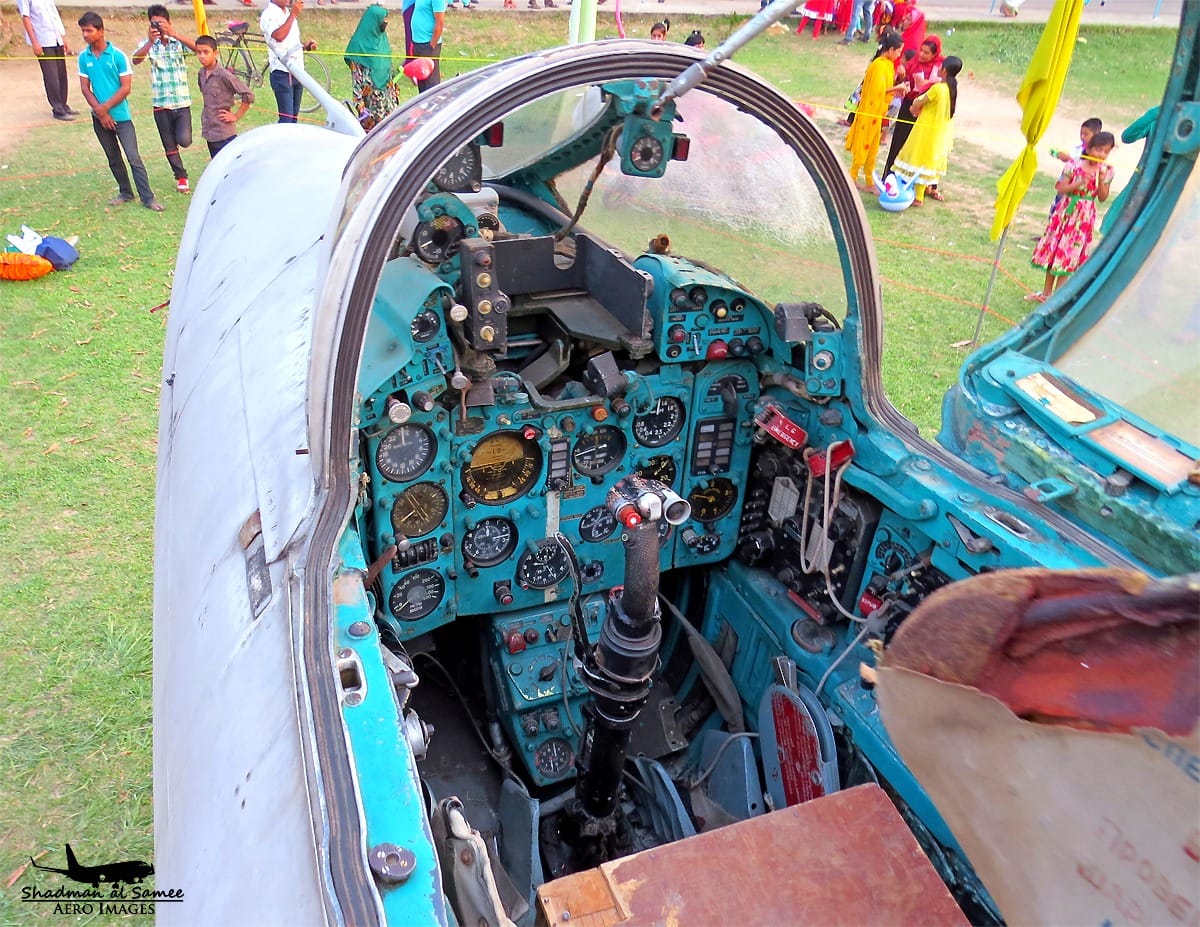
A Bangladesh Air Force MiG-21UM cockpit in natural daylight — the turquoise paint unmistakable even after decades. Photo: Shadman al Samee / Wikimedia Commons (CC BY-SA 2.0)
The practical benefits compounded. The bright turquoise also reduced the harsh contrast between the blinding brightness outside the canopy and the shadowed interior — easing the constant eye adjustment that fatigues pilots on clear-sky missions. And there’s evidence that the paint formulation itself had fire-retardant properties, making the color choice partly functional at the chemical level as well.
Sixty Nations, One Shade of Green
The MiG-21 became the most-produced supersonic fighter in aviation history — over 11,000 units built, exported to approximately 60 countries across four continents. From Vietnam to Egypt, India to Cuba, Finland to Mozambique, that turquoise cockpit traveled the world. Every pilot who strapped into a Fishbed — regardless of nationality, ideology, or conflict — looked out at the same distinctive color.
Among the more surprising operators was Finland. In 1962, Helsinki became the first nation outside the Warsaw Pact to purchase the MiG-21, acquiring 22 MiG-21F-13 fighters that entered service in 1963. The acquisition was partly driven by Soviet political pressure during a tense period of Cold War diplomacy, but the aircraft proved to be a capable and reliable interceptor. Finland later added the radar-equipped MiG-21bis variant in 1978, operating the type until 1998 — when F-18 Hornets finally replaced them. For a deeper look at Finland’s fascinating Cold War balancing act, check out our earlier post on The Finnish Air Force During the Cold War.
The MiG-21 saw combat in virtually every Cold War flashpoint: Vietnamese pilots used it to ambush American F-4 Phantoms over Hanoi, Egyptian pilots flew it against Israeli Mirages in the Six-Day War and Yom Kippur War, and Indian pilots took it into battle during three Indo-Pakistani conflicts. In every theater, the turquoise cockpit was part of the experience — a constant in a machine that shaped aerial warfare for half a century.
Why Not Grey? The Western Contrast
Western cockpit philosophy went in a completely different direction. American and European manufacturers settled on dark grey and matte black interiors — colors designed to minimize glare and reflections from cockpit glass. Boeing chose brown tones for its 747 through 777 flight decks. Airbus went with neutral grey. Each manufacturer had its own ergonomic reasoning, but none arrived at turquoise.
The divergence reflects fundamentally different design philosophies. Western engineers optimized for glare reduction in glass-heavy cockpits with advanced multi-function displays. Soviet engineers, working with cockpits dominated by analog instruments and minimal glass, optimized for eye recovery and instrument legibility. Neither approach was wrong — they solved different problems for different eras of cockpit technology.
Modern Russian aircraft have begun to break from the turquoise tradition. The Su-57 features a glass cockpit with large multi-function displays and darker interior tones. But step into any MiG-21, MiG-23, MiG-25, or Su-24 today — whether in a museum or on an active flight line — and the turquoise is still there, unchanged, doing exactly what it was designed to do decades ago.
Fly the Fishbed
The MiG-21 isn’t just a museum piece. MiGFlug now offers supersonic flights in this legendary aircraft — giving civilians the rare chance to experience Mach 2, 7g turns, and yes, that unforgettable turquoise cockpit, firsthand.
Sources: Cold War Air Museum, DCS World Forums, Massimo Tessitori Soviet Warplanes Archive, Gmodel Art, Key Aero
 English
0 Comments