
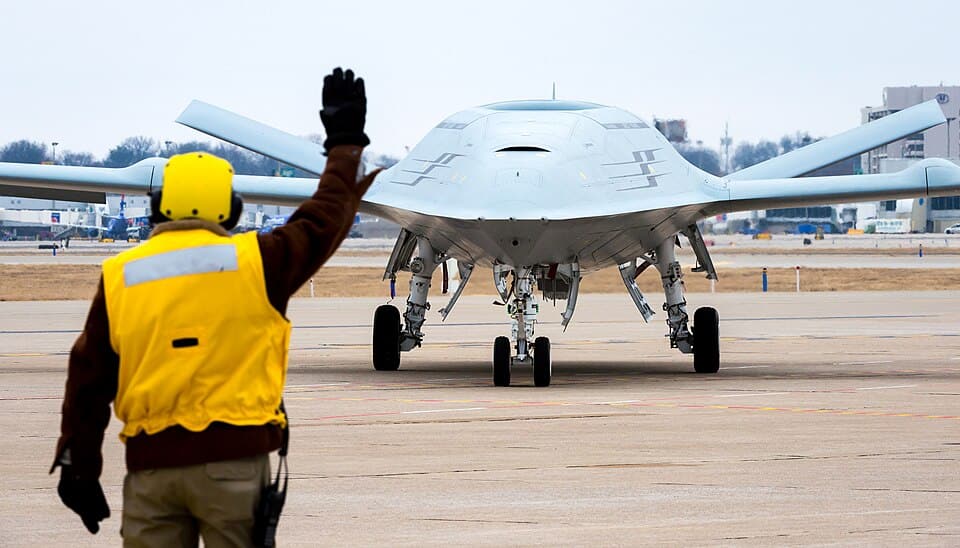
The Navy’s long wait for an autonomous flying gas station just ended. Acting Secretary of the Navy Hung Cao confirmed during a Senate Armed Services Committee hearing on May 19 that the MQ-25 Stingray — Boeing’s uncrewed, carrier-based aerial refuelling drone — has officially cleared Milestone C, the Pentagon’s green light for low-rate initial production. It is the first time in history that an autonomous refuelling aircraft has been approved for carrier operations, and it marks a turning point for how the U.S. Navy projects power across the Pacific.
The decision unlocks a Low-Rate Initial Production (LRIP) Lot 1 contract for three aircraft, expected to be awarded this summer. Two additional lots will follow: Lot 2 for three more airframes and Lot 3 for five, building toward an eventual fleet that will fundamentally reshape carrier air wing operations by freeing up F/A-18E/F Super Hornets currently burning flight hours hauling buddy stores instead of missiles.
✈ Milestone C cleared — first carrier-based autonomous refuelling drone approved for production
📦 LRIP Lot 1: 3 aircraft; Lot 2: 3 aircraft; Lot 3: 5 aircraft
📅 Announced: May 19, 2026, by Acting SecNav Hung Cao during SASC hearing
🏠 Manufacturer: Boeing, St. Louis, Missouri
⚓ Test ship: USS George H.W. Bush (CVN-77)
💰 Program value: $13+ billion over full production run
From Concept to Carrier Deck
The MQ-25 program has had a long and winding road to this moment. Born from the wreckage of the cancelled UCLASS (Unmanned Carrier-Launched Airborne Surveillance and Strike) program, the Stingray was deliberately descoped from a stealthy strike platform to a tanker — a decision that frustrated some advocates of carrier-based stealth attack drones but gave the Navy a realistic path to getting an unmanned aircraft operating routinely from a flight deck. Boeing won the contract in 2018 with a bid that beat out Lockheed Martin and General Atomics, and the T1 test article has been steadily racking up milestones ever since.
The bigger question, hovering just behind the tanker mission, is what comes next. The MQ-25 airframe was always designed with growth potential. Once the Navy proves it can routinely operate uncrewed aircraft from carrier decks, the door opens to ISR, electronic warfare, and eventually — if the political and technical stars align — strike variants. The tanker is the foot in the door. What walks through after it could reshape naval aviation for decades.
Sources: Senate Armed Services Committee hearing transcript (May 19, 2026); U.S. Navy PEO Unmanned Aviation and Strike Weapons; Boeing Defense; Naval Air Systems Command.


 English
0 Comments