
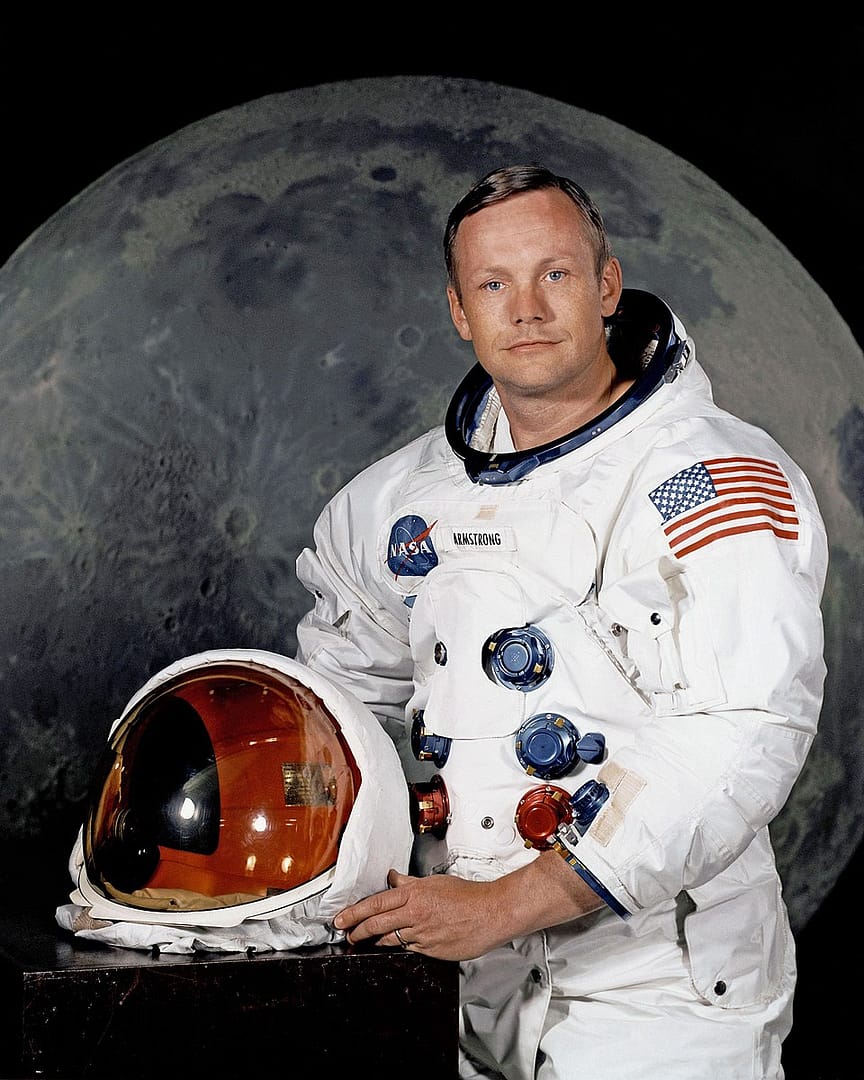
The biography of Neil Armstrong is usually told backwards — from the Moon down. But the Moon was the end of the story. The beginning was a Navy pilot flying combat missions over Korea in 1951, getting his jet shot up by anti-aircraft fire, having six feet of wing sheared off by a cable strung between two Korean mountains, and nursing the aircraft back to a friendly airfield where he ejected safely. He was 21 years old. He had been flying since he was 15.
Quick Facts
| Nationality | American 🇺🇸 |
| Achievement | First human to walk on the Moon (21 Jul 1969); NACA/NASA test pilot, 200+ aircraft types; X-15 pilot |
| Test Flights | 900+ test flights in 200+ aircraft types; X-15 reached 207,500 ft (63.2 km) |
| Apollo 11 | 16–24 Jul 1969 — first Moon landing; Armstrong walked on lunar surface 21 Jul |
| Born / Died | 5 Aug 1930 – 25 Aug 2012 (age 82) |

Armstrong joined NACA — the predecessor to NASA — in 1955 as a research test pilot at Edwards Air Force Base. He flew over 900 flights in more than 200 different aircraft types. He flew the Bell X-1B, the North American X-15 (reaching 207,500 feet — the boundary of space, by some definitions), the F-100, F-101, F-102, F-104, F5D Skylancer, B-29, B-47, and the revolutionary Paraglider Research Vehicle, among dozens of others. He could fly virtually anything, in virtually any condition, and analyse its behaviour with the precision of the engineer he also was.
His astronaut career nearly ended in 1966. During the Gemini 8 mission, the spacecraft began spinning uncontrollably after docking with an Agena target vehicle. The spin increased to one revolution per second — fast enough to cause a loss of consciousness. Armstrong shut down the spacecraft’s main thrusters, isolated the problem to a stuck attitude-control thruster, and stabilised the spacecraft using the re-entry control system. The mission was terminated early, but both astronauts survived. NASA’s review board concluded his response had been “textbook.”
The Longest Twelve Minutes
When Armstrong and Buzz Aldrin descended toward the Moon’s surface in the Eagle lunar module on 20 July 1969, the guidance computer triggered a series of alarm codes that neither man had ever seen in training. Mission Control, in Houston, cleared them to continue. At 2,000 feet, Armstrong looked at the designated landing site and saw it was a boulder field. He took manual control and flew past it, searching for flat ground, with the fuel gauge counting down. He landed with 25 seconds of fuel remaining.
“That’s one small step for a man, one giant leap for mankind.”
— Neil Armstrong — Mare Tranquillitatis, the Moon, 21 July 1969, 02:56 UTCArmstrong returned from the Moon and became, immediately, the most famous person on Earth — a role he found deeply uncomfortable. He gave almost no interviews and avoided public attention for the rest of his life. He taught engineering at the University of Cincinnati. He turned down nearly all requests for autographs after discovering signatures were being sold on the collectors’ market. He was private, precise, and completely uninterested in fame. What he was interested in — what had always driven him — was the work. The flying. The problem. The solution. Everything else was noise.


 English
0 Comments