
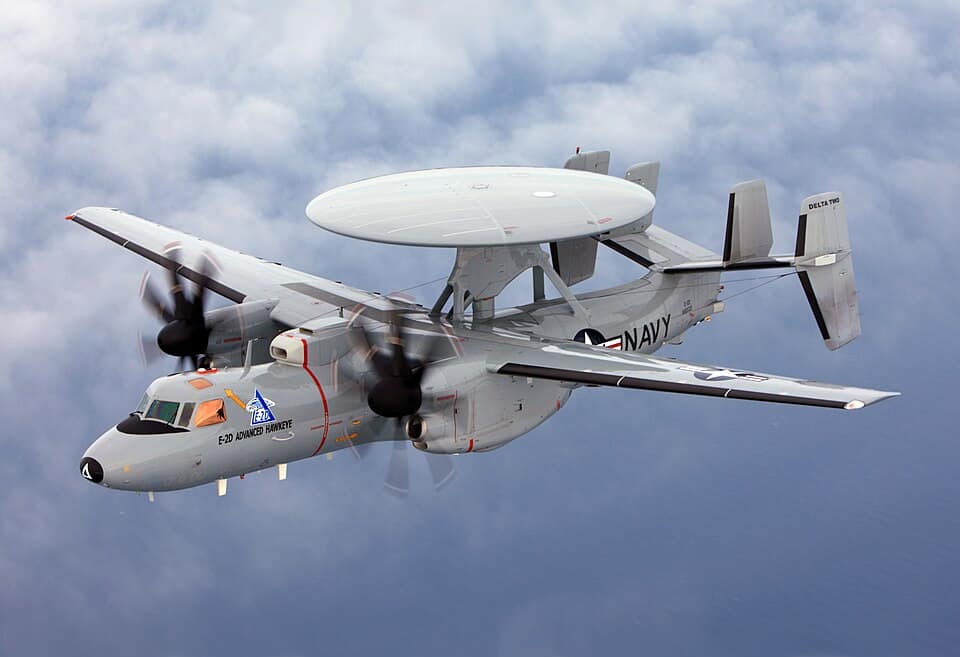
Northrop Grumman has just delivered the seventieth E-2D Advanced Hawkeye to the U.S. Navy. The aircraft itself looks essentially identical to the seventieth Hawkeye built — the same twin-turboprop, the same enormous radar dome on the back, the same boxy fuselage that has been launching off carrier decks since 1964. Look closer, however, and the seventieth E-2D is a fundamentally different machine.
The Hawkeye is the most under-discussed essential aircraft in the U.S. Navy. Almost no one outside the carrier community can pick a Hawkeye out of a line-up, and yet without a Hawkeye over the carrier strike group, the entire air wing is, in tactical terms, blind to anything beyond the horizon. It is the airborne radar that tells the F/A-18s and F-35s where the threat is. With the seventieth E-2D delivery, the U.S. Navy is now most of the way through replacing every legacy E-2C with the Advanced Hawkeye — and the air wings of the future are taking shape on top of that quiet, important workhorse.
Quick Facts
Aircraft: Northrop Grumman E-2D Advanced Hawkeye
Crew: Five (two pilots, three mission systems)
Radar: APY-9 with electronically scanned array
Powerplant: Two Rolls-Royce T56-A-427A turboprops, 5,100 shp each
Endurance: 6+ hours on station
Total ordered (USN): approx. 86 airframes
Latest delivery: 70th E-2D
Why the Hawkeye matters more than people realise
An aircraft carrier is not a magic device. It is a steel hull with a runway on top. What turns it into a fighting unit is the air wing — and what turns the air wing into something with reach is the radar over the strike group. That radar has, since the late 1960s, been the Hawkeye.
The U.S. Navy uses the Hawkeye for three overlapping jobs. First, it is the air-defence picket: a radar 25,000 feet up that can detect a low-flying cruise missile thirty minutes before any ship-based radar would. Second, it is the air-traffic controller for the air wing: every F/A-18, every F-35C, every E-2 itself takes departure clearance and strike-mission cuing from the same Hawkeye crew. Third, in modern operations, it is the central data-link node that stitches together the Naval Integrated Fire Control – Counter Air picture used by Aegis cruisers, F-35Cs, and Tomahawk-toting destroyers.
What the D variant brings
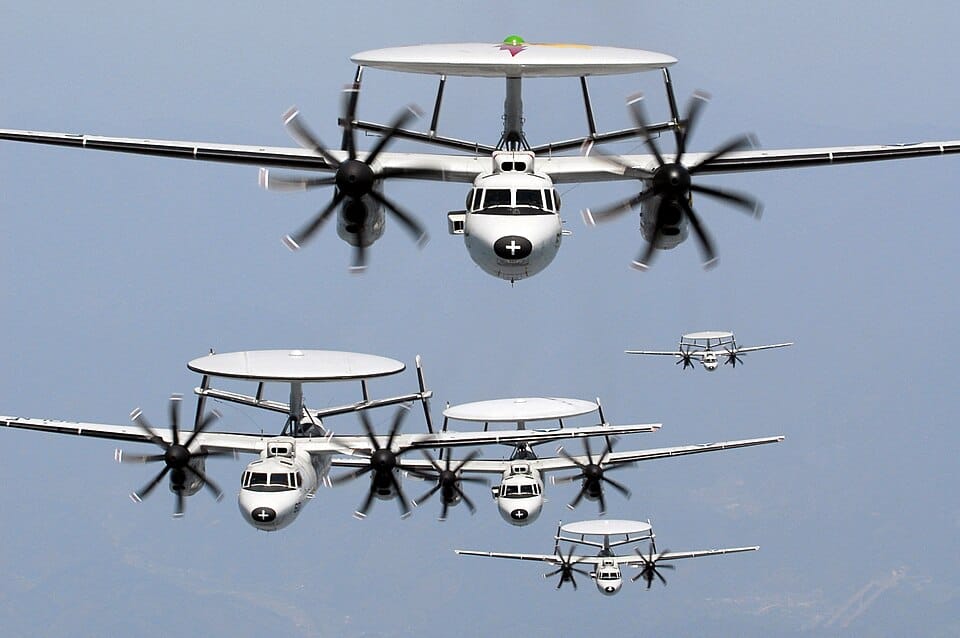
The E-2D upgrade is essentially a new aircraft inside an old shell. The headline change is the radar: the AN/APY-9, an active electronically scanned array, replaces the older mechanically-rotated APY-1/2 of the C model. The new radar can stare at one direction continuously, electronically steer its beam to follow a difficult target, and detect smaller, lower, slower aircraft than the old radar could. It is also significantly more resistant to electronic countermeasures.
The cockpit is glass and digital. The mission system has been completely redesigned to handle the firehose of data from the new radar. Most importantly for the long-term Pacific story, the E-2D can refuel in the air — making it, for the first time, a Hawkeye that can stay on station for nine, ten, twelve hours instead of the four or five the C model could manage. In a Pacific contingency where distances are enormous, that is the difference between a workable air-defence picture and gaps measured in hours.
Why the seventieth is a milestone
Each Hawkeye is built more or less by hand at Northrop Grumman’s St. Augustine, Florida facility. The line is small. There are no shortcuts. Reaching seventy delivered airframes means the Navy has, for the first time, more E-2Ds in service than legacy E-2Cs. From now on, the carrier-deployed Hawkeye is overwhelmingly the new variant. Every carrier strike group puts to sea with the better radar and the longer endurance.
For the Pacific, where the U.S. Navy expects to fight the next war if it has to fight one, that matters. For NATO and allied operators — France, Japan, and increasingly others — it matters because the U.S. Navy’s experience with the airframe is what makes export support credible.
An unglamorous excellence
The Hawkeye will never be on a movie poster. It does not break the sound barrier. It does not carry missiles. The pilots who fly it spend their careers droning around the perimeter of a strike group at 25,000 feet, talking quietly into the radio.
And every time those pilots take off, every other aircraft on the carrier deck flies a little more confidently, because someone overhead is watching everything that matters.
Seventy down. Sixteen to go.
Sources: Northrop Grumman press release, U.S. Navy public affairs, Aviation Geek Club.
 English
0 Comments