The B-1B Lancer does not get the headlines that the B-2 Spirit or the new B-21 Raider command. It was born in controversy, nearly cancelled, resurrected under Reagan, and spent decades as the workhorse nobody talked about. Yet today, the “Bone” — as its crews call it, from B-One — may be the most versatile heavy bomber in the United States Air Force inventory. It carries the largest conventional payload of any American aircraft, flies at near-supersonic speed, and has been continuously upgraded to fire the latest precision-guided munitions.
With 45 airframes still in service and a retirement date that keeps getting pushed further into the future, the B-1B Lancer refuses to fade away.
Quick Facts
Type: Strategic bomber / long-range strike
Manufacturer: Rockwell International (now Boeing)
First flight: December 23, 1974 (B-1A prototype)
Max speed: Mach 1.25 (1,529 km/h) at altitude
Payload: Up to 34,000 kg (75,000 lb) — three internal weapons bays
Range: 11,998 km without refuelling
Crew: 4 (aircraft commander, copilot, offensive systems officer, defensive systems officer)
The B-1 Lancer — variable-sweep wings, Mach 1.2, and a payload no other aircraft can match. Via @atomic_timeline2.0 on Instagram
Variable Geometry: The B-1’s Secret Weapon
The B-1B’s defining feature is its variable-sweep wing. At full forward sweep (15 degrees), the wings extend to their maximum span, giving the aircraft efficient lift for takeoff, landing, and long-range cruise. As the wings sweep back to 67.5 degrees, the Lancer transforms into a dart — slicing through dense, low-altitude air at speeds that would tear fixed-wing bombers apart.
This geometry gives the B-1B a tactical flexibility that neither the subsonic B-52 nor the stealth-optimised B-2 can match. It can dash at Mach 1.2 at high altitude, or thunder along at treetop level using terrain-following radar to slip beneath enemy air defences. During the opening nights of operations over Afghanistan and Iraq, B-1Bs loitered at altitude for hours before dropping precision-guided munitions on targets called in by ground forces — a mission profile nobody envisioned when the aircraft was designed as a nuclear penetrator.
The AGM-158 JASSM — the stealthy cruise missile that has given the B-1B a devastating new stand-off strike capability. Wikimedia Commons
From Nuclear Bomber to Conventional Powerhouse
The B-1 was originally designed in the 1970s as a supersonic nuclear penetrator to replace the B-52. President Carter cancelled the B-1A in 1977, but Ronald Reagan revived it in 1981 as the B-1B — a lower-cost, more survivable variant optimised for low-altitude penetration. One hundred aircraft were delivered between 1986 and 1988.
When the Cold War ended, the B-1B lost its nuclear mission entirely. Under the START I treaty, its nuclear capability was removed, and the aircraft was re-roled exclusively for conventional operations. What could have been a career-ending identity crisis became a liberation. Free from the constraints of nuclear alert duty, the B-1B became the most-deployed heavy bomber in the USAF fleet. It flew combat missions over Iraq, Afghanistan, Libya, and Syria, delivering more munitions than any other platform in several of those campaigns.
Modern Upgrades: JASSM and Beyond
The most significant recent upgrade has been the integration of the AGM-158 JASSM (Joint Air-to-Surface Standoff Missile) family. The JASSM-ER variant gives the B-1B a stealthy, 1,000-kilometre-range cruise missile that can be launched from well outside the reach of enemy air defences. With three internal weapons bays each capable of carrying rotary launchers, a single B-1B can deliver twenty-four JASSM-ERs in a single sortie — a devastating conventional strike package.
The Lancer has also received upgraded radar, new cockpit displays, and improved electronic warfare systems. The Integrated Battle Station programme replaced Cold War-era avionics with modern hardware capable of receiving and sharing targeting data in real time.
The Bone Soldiers On
The B-1B was supposed to retire as the B-21 Raider entered service. Instead, the USAF has repeatedly delayed the Lancer’s retirement, recognising that its sheer payload capacity and mission flexibility cannot be easily replaced. The B-21 is a stealth bomber optimised for penetrating contested airspace — it does not carry the same volume of weapons as the B-1B, and it cannot match its speed.
For now, the Bone soldiers on: a Cold War relic that reinvented itself, survived cancellation, lost its nuclear mission, and emerged as one of the most combat-tested bombers in history.
How the B-1B Lancer is redefining its role in modern warfare
The B-1B Lancer’s capabilities for modern warSources: U.S. Air Force, Boeing, Atomic Timeline (Instagram)
On November 1, 1952, the world's first hydrogen bomb vaporized the island of Elugelab in the Marshall Islands. The explosion — designated Ivy Mike — produced a fireball three miles wide and a mushroom cloud that punched into the stratosphere. And while most sane...
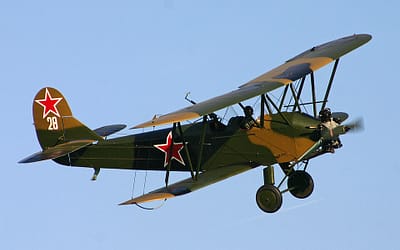
It sounds like the setup for a joke: what happens when a biplane from the 1920s fights jet fighters from the 1950s? The answer, it turns out, is that the biplane wins more often than anyone would like to admit. During the Korean War, North Korean pilots flying...
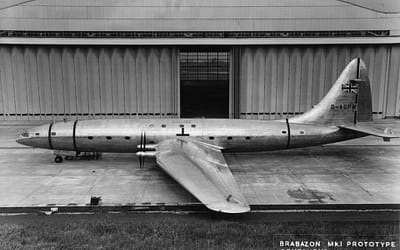
In September 1949, the largest land-based aircraft in the world took to the skies over southwest England. The Bristol Brabazon was a colossus — its 230-foot wingspan exceeded that of a modern Boeing 747. It was powered by eight radial engines coupled in pairs to drive...




 English
0 Comments