
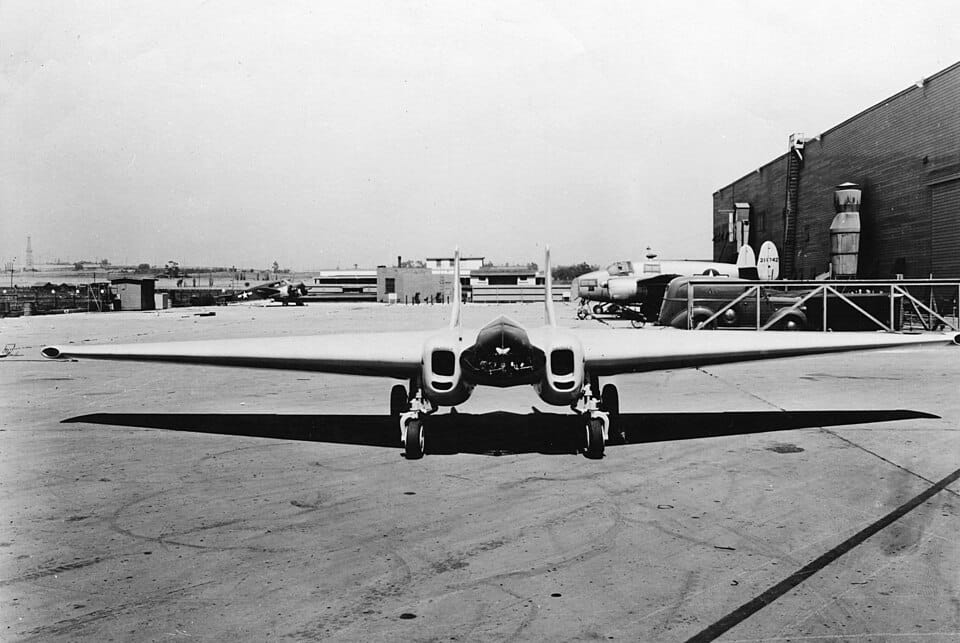
Of all the strange aircraft the United States built during the Second World War — and there were many — none was stranger, on paper or in person, than the Northrop XP-79.
The XP-79 has gone down in history as a manned missile. Its mission, so the famous story goes, was not to shoot down enemy bombers with guns or rockets, but to physically ram them. The aircraft was said to be designed around a magnesium-alloy leading edge strong enough to slice through an enemy fuselage in mid-air, while the XP-79 itself, sturdier than the bomber it had just gutted, would, theoretically, fly home for another go. Aviation historians now widely regard the ramming doctrine as a myth — the aircraft was always intended to carry four .50-calibre machine guns, and its welded magnesium structure was above all a construction choice — but the legend has clung to the aircraft ever since.
It was the kind of idea that could only have been entertained in a war so total that the U.S. Army Air Forces was widely believed to be buying a fighter whose entire combat doctrine was a mid-air collision. Northrop signed the contract. The aircraft was built. It flew once.
Quick Facts
Aircraft: Northrop XP-79B Flying Ram
Configuration: Tailless flying wing, prone-pilot cockpit, twin Westinghouse 19B turbojets
Wingspan: 38 ft (11.6 m)
Empty weight: 5,840 lb (2,648 kg)
Designed armament: Four .50 cal machine guns (the reinforced magnesium leading edge fuelled the ‘ramming’ legend)
First flight: 12 September 1945
Outcome: Crash, pilot killed, programme cancelled
Why anyone thought this was a good idea
To understand the XP-79 you have to understand 1942. The German Luftwaffe was bombing England with Heinkel He 111s and Junkers Ju 88s. The U.S. Army Air Forces, having watched the Royal Air Force lose dozens of fighters in single missions over the previous two years, was looking for radically new ways to defeat heavy bombers. According to the popular telling, one school of thought said the answer was a fighter that did not need ammunition. A fighter that did its work with structural strength, not bullets, would be cheaper to operate and would never run out.
The Northrop Corporation, founded by the visionary engineer Jack Northrop, had been working on flying-wing designs since the 1930s. Northrop's company already had a pure flying-wing demonstrator — the N-1M — and a clear theoretical understanding of how to build a tailless aircraft that could survive aerodynamic loads other fighters could not. When the USAAF ordered the radical interceptor that would become known as the Flying Ram, Northrop was, almost uniquely, in a position to design it.
A fighter you flew lying down
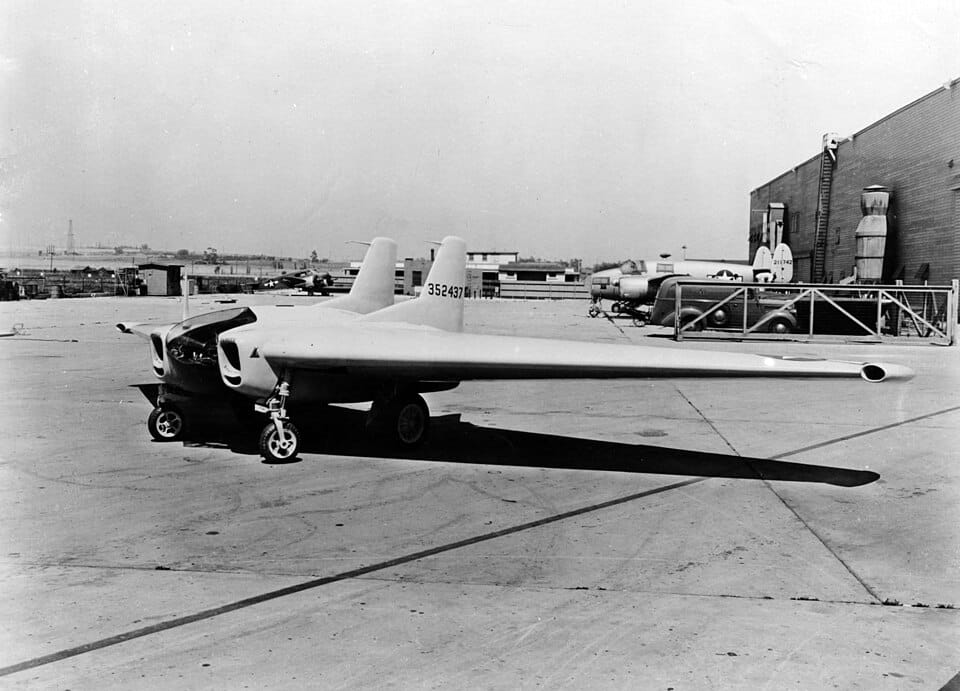
The XP-79 was, by any measure, a peculiar aircraft. The pilot did not sit in a normal seat. He lay flat on his stomach, head forward, in a prone-pilot cockpit cut into the centre of the wing. The reasoning was high-G tolerance: a pilot lying down can withstand significantly more positive G-load before greying out than a pilot sitting up. For a fighter that was supposed to ram bombers, the design team expected sudden manoeuvres on the order of nine or ten G. The prone position was the only way to keep a human conscious through the actual impact.
The aircraft itself was a low-aspect-ratio flying wing built almost entirely of welded magnesium alloy. The leading edge was unusually thick-skinned — welded magnesium roughly two centimetres thick, thinning towards the trailing edge — and it is this reinforced structure that gave rise to the story that it was meant to bite through aluminium bomber fuselages. The two Westinghouse 19B turbojets gave the aircraft a planned top speed of around 870 km/h, faster than any contemporary German bomber. Four .50-calibre machine guns were the aircraft’s intended armament — a fact that sits awkwardly with the ramming legend, and one of the main reasons many historians dismiss the ram doctrine as myth.
The single flight
The XP-79B — the only example built — sat in the desert at Muroc Army Air Field (later Edwards Air Force Base) for most of 1945, undergoing taxi tests, ground runs, and structural inspections. By September the war had been over for nearly a month. The Japanese had surrendered. The XP-79's stated mission — intercepting German bombers over Europe — had been moot for the better part of the year.
Northrop and the USAAF flew it anyway, partly out of contractual obligation and partly because the data on prone-pilot cockpits and flying-wing aerodynamics was considered valuable.
The first flight, on 12 September 1945, was given to test pilot Harry Crosby. He took off normally. He climbed to several thousand feet and began a low-rate roll to assess control authority around the longitudinal axis. About fifteen minutes into the flight, the aircraft entered an uncommanded descent. Crosby fought it for some seconds, then attempted to bail out. He was struck by the aircraft as he left the cockpit and fell to his death. The XP-79B crashed and burned in the desert.
The programme was cancelled within weeks.
Why this aircraft still matters
Most readers will, reasonably, file the XP-79 under "Second World War oddities" and move on. That would be a mistake. Three things from the XP-79 programme survived its violent end.
The first is the prone-pilot cockpit. Northrop's data from the XP-79 directly informed later high-G aircraft research, including the prone-pilot Reid and Sigrist Bobsleigh in Britain and post-war centrifuge testing of pilot G-tolerance. The reclining seat in the F-16, the F-22, and every modern fighter is a distant descendant of the lessons learned in 1945.
The second is the flying-wing aerodynamic data. Jack Northrop's company carried that knowledge through the YB-35 and YB-49 of the late 1940s, the unsuccessful but influential N-9M demonstrator series, and eventually — many decades later — into the B-2 Spirit and the B-21 Raider. The XP-79 was a stepping stone in a programme of flying-wing research that ultimately produced the most successful stealth bomber in history.
The third is the magnesium-alloy structural research. Magnesium-aluminium alloys are now used routinely in aerospace structures, particularly in helicopter gearboxes and certain fighter components. The XP-79's all-magnesium airframe was an early proof that the metal could be welded, formed, and stressed in load-bearing applications.
An aircraft from a more desperate decade
It is impossible to look at photographs of the XP-79 — squat, heavy-leading-edged, with its peculiar slot windows for the prone pilot — without thinking about the world that built it. A world in which the United States was at the same time developing the atomic bomb, building 300,000 aircraft, and entertaining a serious proposal for a flying ram. The XP-79 was, in a sense, the spirit of the era distilled into a single airframe.
It also reminds us that not every aviation idea is a good one. Sometimes the most valuable lesson is what does not work — and Harry Crosby paid the price for that lesson on a clear September morning in 1945.
Sources: U.S. Air Force Test Center History, National Air and Space Museum, Northrop Grumman corporate archive.
Related Questions
What was the Northrop XP-79?
The Northrop XP-79 was an experimental American interceptor of World War II — a tailless flying wing with a prone pilot lying face-down and twin Westinghouse turbojets. Nicknamed the "Flying Ram," it is remembered for the legend that it was meant to destroy enemy bombers by colliding with them. It flew only once.
Was the XP-79 really designed to ram bombers?
Historians now widely regard the ramming story as a myth. The XP-79 was always intended to carry four .50-calibre machine guns, and its welded magnesium structure was primarily a construction choice rather than a battering weapon. The reinforced magnesium leading edge simply fuelled the enduring "Flying Ram" legend.
When did the XP-79 first fly?
The Northrop XP-79B made its first and only flight on 12 September 1945. The aircraft crashed during that flight, killing the pilot, and the programme was cancelled. Only a single example was ever built and flown.
Why did the XP-79 pilot lie down?
The XP-79B pilot lay prone, face-down, in the centre section, with his head almost at the leading edge. This prone position was intended to help him withstand high g-forces and let the aircraft sit very low. Slot windows in the nose provided his only forward visibility.
Who was Jack Northrop?
Jack Northrop was the visionary American engineer who founded the Northrop Corporation and pioneered flying-wing aircraft from the 1930s. His company built the N-1M demonstrator and understood tailless aerodynamics better than almost anyone, which is why it was chosen to build the radical XP-79. His flying-wing ideas later led to the YB-49 and the B-2 bomber.
What engines did the XP-79B use?
The XP-79B was powered by two Westinghouse 19B turbojet engines. It had a wingspan of 38 feet (11.6 m) and an empty weight of about 5,840 lb (2,648 kg). Earlier proposals had considered rocket power before the design settled on the twin turbojets.
What other aircraft flew only once?
Several famous aircraft made just a single flight. The Hughes H-4 Hercules "Spruce Goose", the largest flying boat ever built, lifted off only once, in 1947. The Northrop XP-79B also flew once, in 1945, before crashing. Such one-flight aircraft are usually prototypes overtaken by accidents or the end of their programmes.
Related Posts
The Flying Pancake: The Flat Disc That Actually Flew
0 Comments