

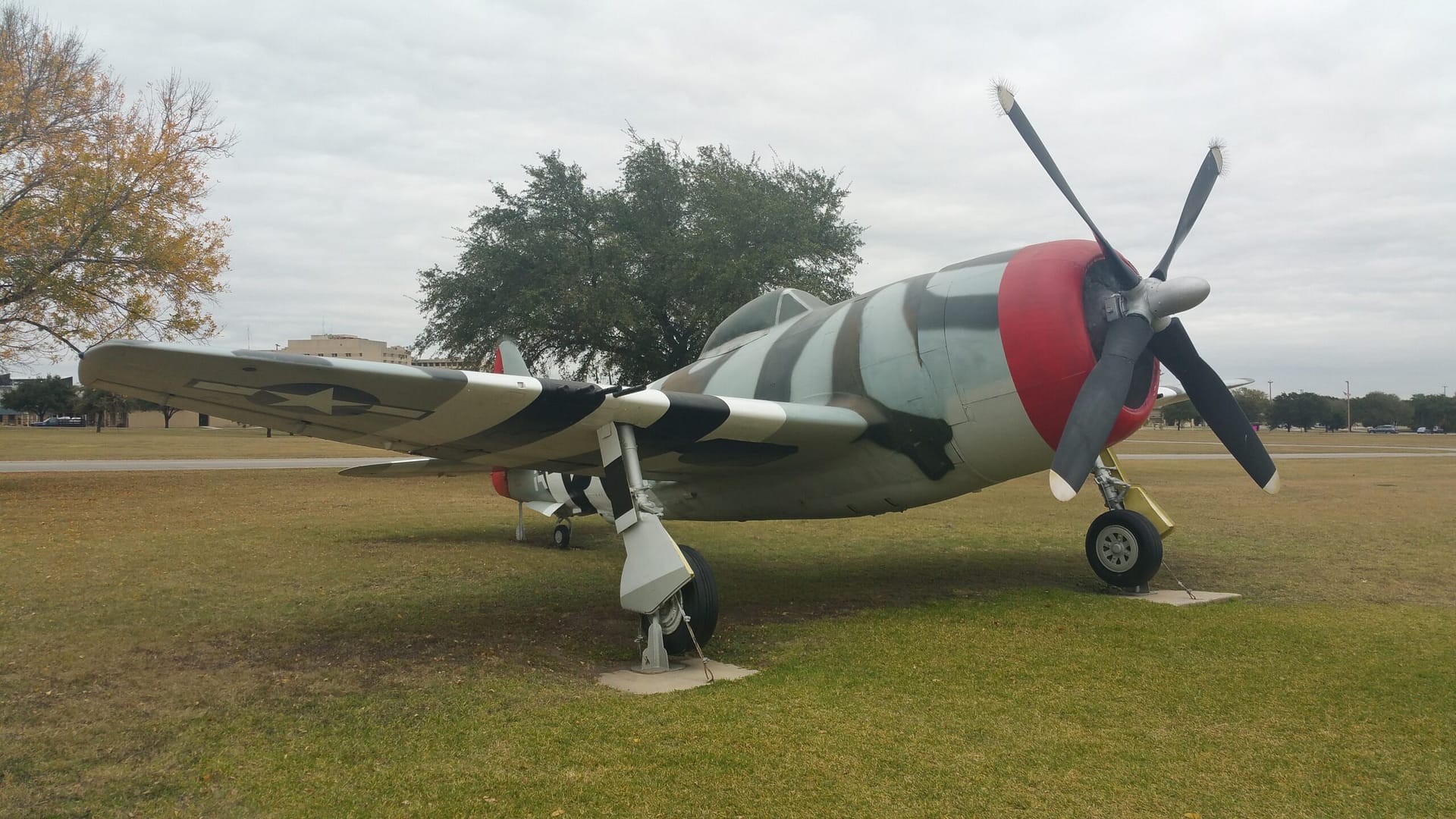
The air over the Yellow Sea, that morning, smelled of brine and avgas. It was August 13, 1945. Forty-eight hours from the surrender. Above the muggy haze, in the cockpit of a Republic P-47N called Lil Meaties Meat Chopper, a 26-year-old lieutenant from El Paso watched five Japanese silhouettes drop out of the cloud and decided not to live the rest of his life wondering what he might have done.
His name was Oscar Francis Perdomo. He was the son of Mexican immigrants. He had a baby boy back home. By the time he landed back at Ie Shima, hours later, with the wet wing of his Thunderbolt sticky from oil blow-by and his canopy fogged with sweat, he had shot down five enemy aircraft in a single mission — and become the last American “ace in a day” of the Second World War, and, as it would turn out, the last one in U.S. history.
Nobody else has done it since. Nobody is likely to.

Born: 14 June 1919, El Paso, Texas
Parents: Mexican immigrants
Service: USAAF, 464th Fighter Squadron, 507th Fighter Group, Twentieth Air Force
Aircraft: Republic P-47N Thunderbolt “Lil Meaties Meat Chopper”
Date of action: 13 August 1945 — Keijo (Seoul), Korea
Confirmed kills that day: 5 (four Nakajima Ki-84 fighters & one Yokosuka K5Y “Willow”)
Award: Distinguished Service Cross
Died: 1976
A boy from the border, a war in the Pacific
Perdomo grew up in El Paso in the Twenties, the kind of childhood where Spanish was spoken at the kitchen table and English was learned in the schoolyard. By the time he enlisted in 1942, he was already older than most of the cadets — twenty-three, married, working two jobs. The Army Air Forces sent him through flight school in Arizona, then California, then Louisiana, and finally to Ie Shima, a tiny coral island just off Okinawa that had been pried from the Japanese in three weeks of brutal fighting only a few months earlier.
The 464th Fighter Squadron was waiting for the invasion of Japan that everyone in the cockpit assumed was coming. The mission of August 13 was a 1,500-mile round trip up to Korea — a fighter sweep ahead of a planned bomber raid, the kind of mission only the P-47N, with its long-range wet wing, could actually fly.
Thirty-eight Thunderbolts crossed the Yellow Sea at altitude. Just inside the Korean coast, near a small airstrip outside what is now Seoul, they ran into roughly fifty Japanese aircraft staggered in two formations — Ki-84 Hayates above, and a stubby little K5Y “Willow” biplane trainer, of all things, somewhere in the mix.
Four hours, five kills
What happened next has been pieced together from gun-camera film, after-action reports, and the citation that would later land on Perdomo’s chest. He was an element leader, four ships out from the squadron lead, when the Japanese formation rolled into them. The first Ki-84 went down in a spiral he never pulled out of, set alight by a burst that converged on the nose and cockpit. The second died seconds later, the third in a tight turning fight that Perdomo somehow won despite the Thunderbolt’s reputation for sluggish stick at altitude.
The Willow — a trainer that had been pulled into the air in a final, panicked defense — he caught fourth, at just 800 feet, and sent spiralling into the ground. The fifth, another Ki-84, came after he climbed back toward the clouds, ran into a last knot of enemy fighters, swung in behind them and fired until one burst into flames and exploded. He had been in combat for less than fifteen minutes. He would never again fire a shot in anger.
Two days later, Emperor Hirohito’s voice cracked over a national radio broadcast that nobody outside the imperial household had ever heard before. The war was over. Perdomo flew home and almost nobody knew his name.

The man who walked back into a quiet life
What is striking about Perdomo isn’t only what he did in the air. It’s what he did on the ground after. He came home to Los Angeles. He worked. He raised his kids. He let the rest of his life be the rest of his life. He gave one major interview in his entire postwar career. When local reporters tried to track him down on anniversaries of V-J Day, he politely declined to perform.
He flew with the Air Force Reserve through Korea and into the Sixties, retired as a major, and died in 1976 at the age of 56. The El Paso boy who came home with the Distinguished Service Cross became, again, simply a man who lived on a quiet street and took his coffee black. Modern fighters average maybe one kill per pilot per career. The era of the ace in a day died with him, and he barely noticed.
There is a particular American kind of greatness that hides itself the moment the war ends. Oscar Perdomo embodied it. Twenty-six years old, four hours over Korea, five confirmed silhouettes painted under his canopy — and then, mercifully, half a century of being nobody special. We should know his name. He almost certainly wouldn’t have wanted us to.
Sources: National WWII Museum, Texas State Historical Association, Hall of Valor (Military Times), San Diego Air & Space Museum (Perdomo Personal Papers), Wikipedia.


 English
0 Comments