
On the morning of 17 January 1966, the people of Palomares were tending tomato fields under a clear Andalusian sky when the war they had never joined fell out of the heavens. Two American aircraft, tangled together seven miles up, came apart in a ball of fire — and four hydrogen bombs tumbled toward their village.
None of the bombs went off as designed. But two split open on impact, and in the dust that drifted across the fields was plutonium. What followed was one of the strangest episodes of the Cold War: a superpower on its hands and knees in a Spanish fishing village, searching the seabed for a missing weapon and the soil for an invisible poison.
Quick Facts
- Date: 17 January 1966, over Palomares, Almería, Spain
- Aircraft: a B-52G bomber and a KC-135 tanker collided during aerial refueling at 31,000 ft
- Mission: Operation Chrome Dome — a continuous airborne nuclear alert
- Casualties: all 4 aboard the tanker and 3 of the 7 on the bomber were killed
- The weapons: four B28 thermonuclear bombs, each with a yield of about 1.1 megatons
- Aftermath: two bombs scattered plutonium on land; a fourth fell into the sea and took 80 days to find
All Hell Breaks Loose
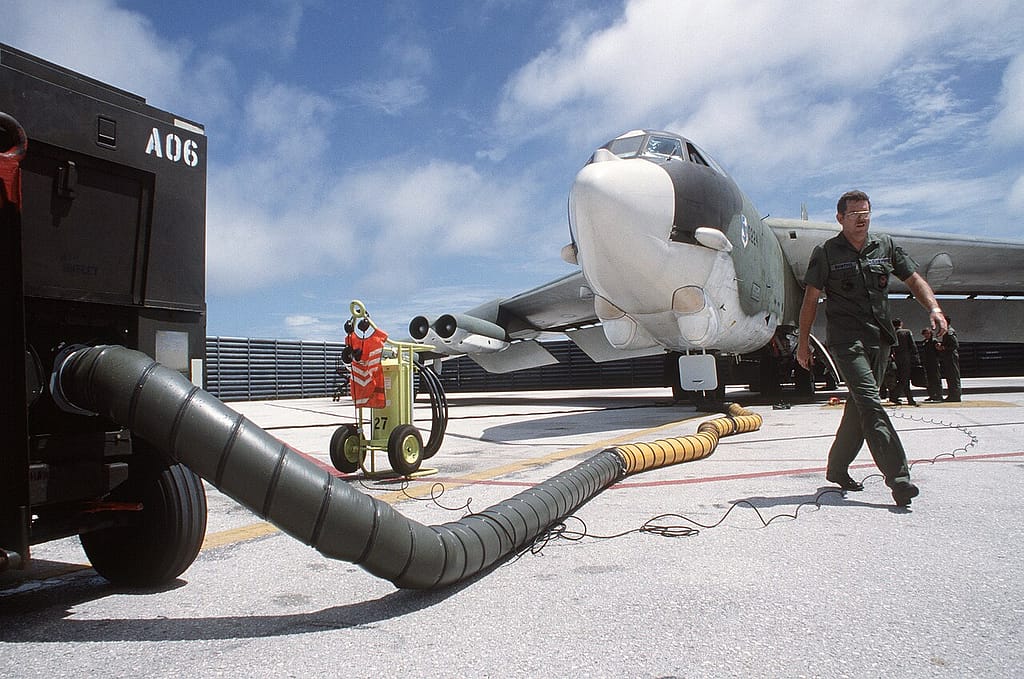
The B-52G Stratofortress had flown from Seymour Johnson Air Force Base in North Carolina, tracing the long loop of Operation Chrome Dome toward the edge of Soviet airspace and back. The mission demanded two refuelings over Spain. On the second, at around 10:30 a.m., the bomber slid in behind a KC-135 tanker out of Morón Air Base — a routine every crew had flown a hundred times.
The refueling boom struck the top of the bomber, broke a longeron and tore off its left wing. The tanker, its full fuel load igniting, was gone in an instant, killing all four men aboard. The B-52 broke apart. Four of its seven crew managed to bail out; three did not. And four hydrogen bombs, each roughly a hundred times more powerful than the weapon that destroyed Hiroshima, fell toward the coast.
Plutonium in the Tomato Fields
Three bombs came down on land. One was found nearly intact in a dry riverbed within a day. But the conventional explosives packed around the cores of the other two detonated on impact — not a nuclear blast, but enough to blow open the casings and scatter plutonium dust across roughly two and a half square kilometres of farmland on a brisk winter wind.
To calm a terrified public — and a furious Spanish government — the U.S. ambassador Angier Biddle Duke and Spain’s information minister Manuel Fraga staged a photo op that has never been forgotten: in March, the two men waded into the sea at Palomares and went for a swim in front of the world’s press, insisting the water was perfectly safe.
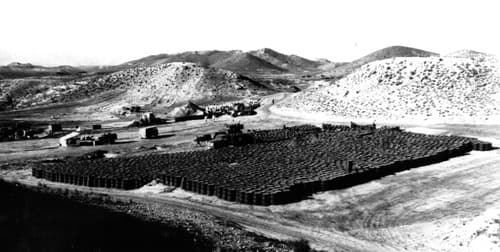
The cleanup was enormous. Around 1,750 tons of contaminated soil were sealed into barrels and shipped to a burial site in South Carolina. Even so, traces of contamination lingered for decades; as late as 2015, Spain and the United States were still signing agreements to finish the job.
The Bomb at the Bottom of the Sea
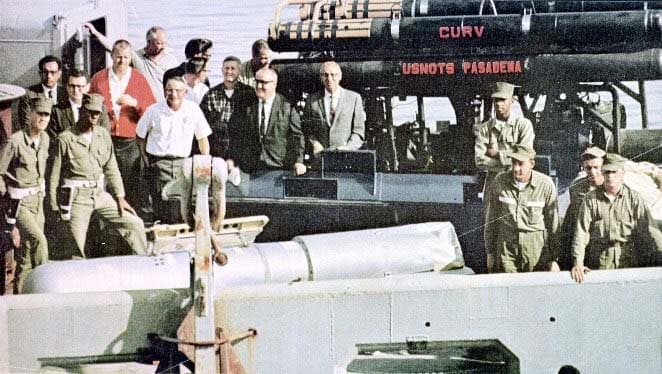
The fourth bomb was the nightmare. It had fallen into the Mediterranean and simply vanished. The only clue was a local fisherman, Francisco Simó Orts — forever after known as “Paco el de la bomba,” Bomb Paco — who had watched it splash down under a parachute. The U.S. Navy assembled a fleet and, using a then-radical technique called Bayesian search theory, calculated the most probable resting places on the seabed.
It took 80 days. The deep-diving submersible Alvin finally located the bomb on a steep undersea slope nearly 900 metres down. An early attempt to raise it failed and the weapon slipped back into the dark. At last, an unmanned recovery vehicle called CURV snagged its parachute, and on 7 April 1966 the bomb was lifted, dripping, onto the deck of USS Petrel — the first time in history a lost nuclear weapon had been recovered from the deep ocean.
Bomb Paco, reasoning that maritime law grants a salvage award to whoever finds a lost vessel, hired a lawyer — a former U.S. Attorney General, no less — and claimed a share of the bomb’s value. The Air Force quietly settled out of court. Among the Navy divers on the recovery was Carl Brashear, who lost part of his leg in a deck accident during the operation and went on to become the Navy’s first African-American master diver, later immortalised in the film Men of Honor.
The Bombs That Changed the Rules
Palomares, and a near-identical crash over Greenland two years later, made the airborne-alert programme politically impossible. Spain banned American aircraft carrying nuclear weapons from its skies, and Operation Chrome Dome was wound down for good. The idea of keeping armed hydrogen bombs permanently aloft had finally met a village that paid the price for it.
Six decades on, Palomares still has no monument — only a street named “17 January 1966.” The tomatoes still grow. And somewhere in the paperwork of two governments, the accounting for that clear winter morning is, remarkably, still not quite closed.
Sources: Wikipedia; John P. Craven, The Silent War; Barbara Moran, The Day We Lost the H-Bomb; The New York Times; TIME; WIRED.
0 Comments