
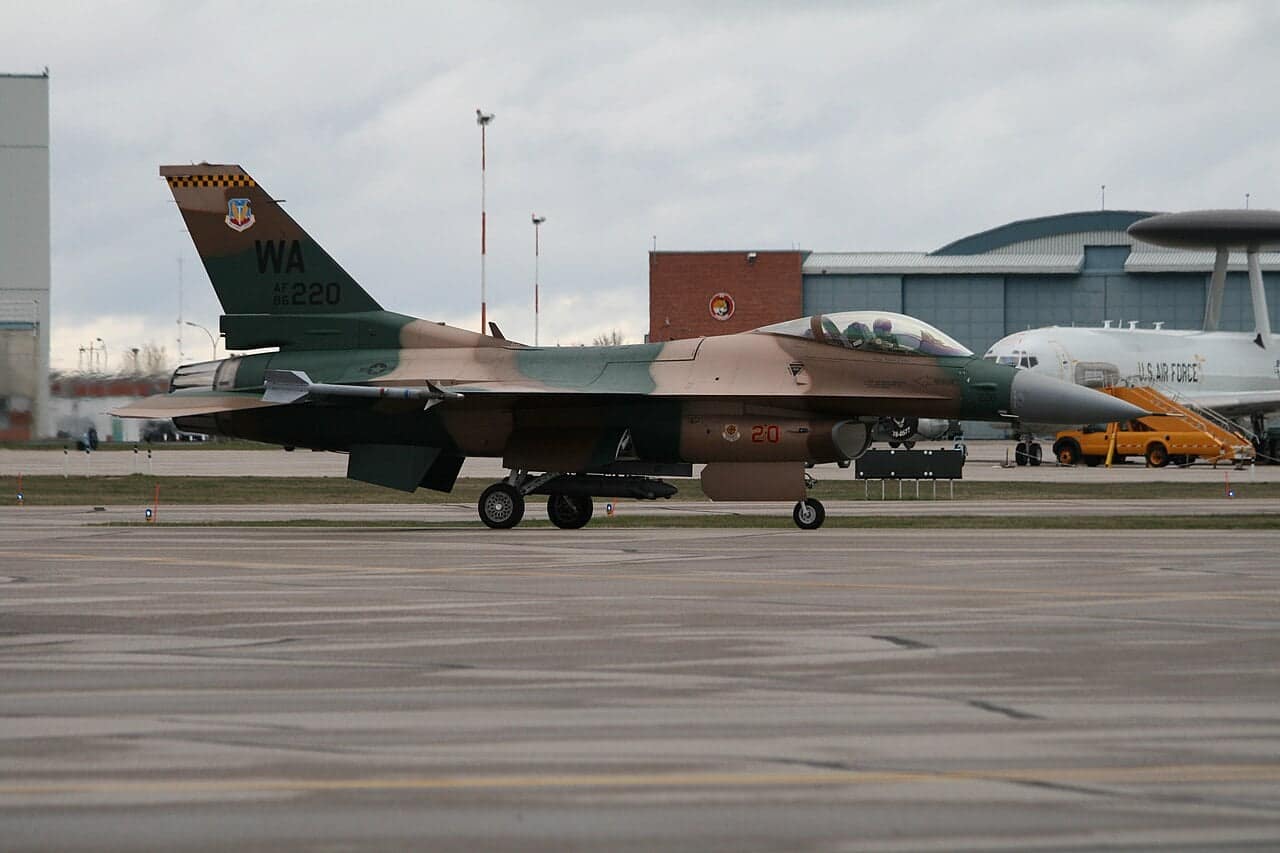
The pilots wear Russian-style flight patches. Their jets carry paint schemes ripped from Chinese and Russian air forces — digital splinter camouflage, red stars, Flanker-grey colour schemes that would make a Cold War spy blink. When they brief a mission, they think like the enemy. They study adversary doctrine, fly adversary tactics, and exploit every weakness in American fighter formations. And they are Americans — United States Air Force pilots whose entire job is to beat their own side.
Welcome to the aggressor squadrons, the most feared training adversaries in military aviation. Based at Nellis Air Force Base in the Nevada desert, these units exist for a single purpose: to make every USAF combat pilot face the most realistic possible simulation of a peer-level enemy before they ever meet one for real.
In 2026, the aggressors are more important than ever. China fields the J-20 stealth fighter. Russia has the Su-57. Both nations are developing tactics specifically designed to defeat American fifth-generation aircraft. The old days of red-painted F-5s pretending to be MiGs are long gone. Today’s aggressors fly F-35s.
Quick Facts
Primary units: 64th Aggressor Squadron (F-16C/D) and 65th Aggressor Squadron (F-35A), both at Nellis AFB, Nevada
Parent unit: 57th Adversary Tactics Group, 57th Wing
Mission: Provide realistic adversary air (“red air”) for Red Flag exercises, USAF Weapons School, and joint training
Threat simulation: Replicate tactics, capabilities, and low-observable signatures of Chinese J-20, Russian Su-57, and other advanced threats
History: USAF aggressor programme began in 1972 after Vietnam-era kill ratios revealed inadequate air combat training
2026 development: F-16 swarm tactics recently defeated F-35s in wargames by saturating stealth fighters’ limited internal missile carriage
Born From Failure
The aggressor programme exists because America was losing. In Vietnam, the USAF’s air-to-air kill ratio — the number of enemy aircraft shot down per friendly loss — had collapsed from 10:1 in Korea to barely 2:1 over North Vietnam. American pilots were being shot down by Vietnamese pilots flying inferior Soviet MiGs because the Americans had stopped practising dogfighting. The missile was supposed to have made close combat obsolete. It had not.
The Navy responded first, creating the famous TOPGUN school at Miramar in 1969. The Air Force followed in 1972 with the activation of the 64th Fighter Weapons Squadron at Nellis, later redesignated the 64th Aggressor Squadron. The concept was simple: recruit the best fighter pilots in the service, teach them to think and fly like Soviet aviators, and then turn them loose against operational squadrons in realistic combat exercises.
The early aggressors flew F-5E Tiger IIs — small, agile, and with a visual and radar signature that roughly approximated a MiG-21. The jets were painted in Soviet-style camouflage. The pilots studied Soviet tactical manuals, flew Soviet formations, and used Soviet radio procedures. When a visiting squadron showed up at Nellis for a Red Flag exercise, the aggressors’ job was to embarrass them — expose their weaknesses in a training environment so those weaknesses would not get them killed in combat.

The Fifth-Generation Problem
For decades, the aggressor formula worked brilliantly. F-5s pretended to be MiG-21s. Then F-16s inherited the role, using their agility and upgraded avionics to simulate more advanced threats — Su-27 Flankers, MiG-29 Fulcrums, and later Chinese J-10s and J-11s. The 64th Aggressor Squadron’s F-16C/Ds, painted in a variety of adversary schemes, became the backbone of Red Flag’s opposing force.
But by the mid-2010s, a problem emerged that no amount of creative paint schemes could solve. The threat had gone stealth. China’s J-20 entered service in 2017. Russia’s Su-57, while fielded in small numbers, demonstrated fifth-generation capabilities. Both aircraft combined low-observable airframes with advanced sensors, data fusion, and long-range missiles. An F-16 wearing Russian camouflage could not simulate a stealth fighter’s radar signature, sensor suite, or beyond-visual-range engagement tactics.
The Air Force’s answer was the 65th Aggressor Squadron, activated at Nellis in 2022 as the first-ever F-35 aggressor unit. These jets fly as “red air” in Red Flag and Weapons School exercises, simulating the tactics, low-observable characteristics, and sensor capabilities of advanced adversary stealth platforms. For the first time, USAF pilots training at Nellis face opponents who can actually replicate what a J-20 engagement might feel like.

Swarm Beats Stealth
The aggressors’ most fascinating recent revelation came in early 2026 wargames, where F-16 aggressors used swarm tactics to defeat F-35s. The method was brutally elegant: overwhelm the stealth fighter’s limited internal weapons capacity.
The F-35A carries just four AIM-120 AMRAAMs internally in its stealth configuration. Four missiles. The aggressor F-16s, flying in large coordinated formations, attacked from multiple axes simultaneously. The F-35 pilots faced an impossible math problem: four missiles against six, eight, or more inbound threats closing from different directions. Even if every AMRAAM hit — and they do not — the F-35 would run dry with enemies still inbound. Forced to merge into visual-range combat, the F-35s lost the signature advantage that defines their entire combat philosophy.
This is exactly why aggressors exist. A real adversary will not politely line up in pairs and fly straight at American fighters. They will swarm. They will saturate. They will exploit known limitations. The aggressor squadrons’ job is to figure out how — before the enemy does — and then train American pilots to survive it.
The Private Sector Steps In
The USAF aggressors cannot be everywhere at once, and operational squadrons need regular red air training beyond the annual Red Flag rotations. This has created a booming market for private adversary air companies. Firms like Draken International, ATAC (Airborne Tactical Advantage Company), and Tactical Air Support operate fleets of retired military jets — A-4 Skyhawks, F-5 Tiger IIs, L-159 Honeys, Mirage F1s — providing contract red air services to the military.
These companies fly thousands of adversary sorties per year at a fraction of the cost of using operational USAF fighters. An hour of F-16 red air costs the government roughly $25,000–30,000 when fully burdened. A contract adversary sortie in an A-4 or F-5 can cost half that. With the Air Force perpetually short of flying hours and fighter pilots, contract red air has become indispensable.
But private aggressors have limitations. They cannot replicate fifth-generation threats. Their aircraft lack the sensors, data links, and radar characteristics of modern adversaries. For high-end training — the kind that prepares pilots for a peer conflict with China — only the USAF’s own aggressor F-35s will do.
Why It Matters
The aggressor squadrons represent one of the most important lessons the American military has ever learned: you cannot train for war by fighting yourself. You have to train against someone who thinks differently, flies differently, and is actively trying to exploit your weaknesses. The aggressors do not play fair. They are not supposed to.
Every USAF combat pilot who has faced the aggressors at Red Flag comes away with the same assessment: it is the hardest flying they have ever done. Harder than combat, some say, because the aggressors know American tactics better than the Americans do. They know where the blind spots are. They know which formations are vulnerable. They know exactly when a pilot will make the wrong decision, because they have seen a thousand pilots make it before.
That is the point. Better to learn the lesson over the Nevada desert than over the Taiwan Strait.
Sources: Air & Space Forces Magazine, The War Zone, 57th Wing Public Affairs
 English
0 Comments