

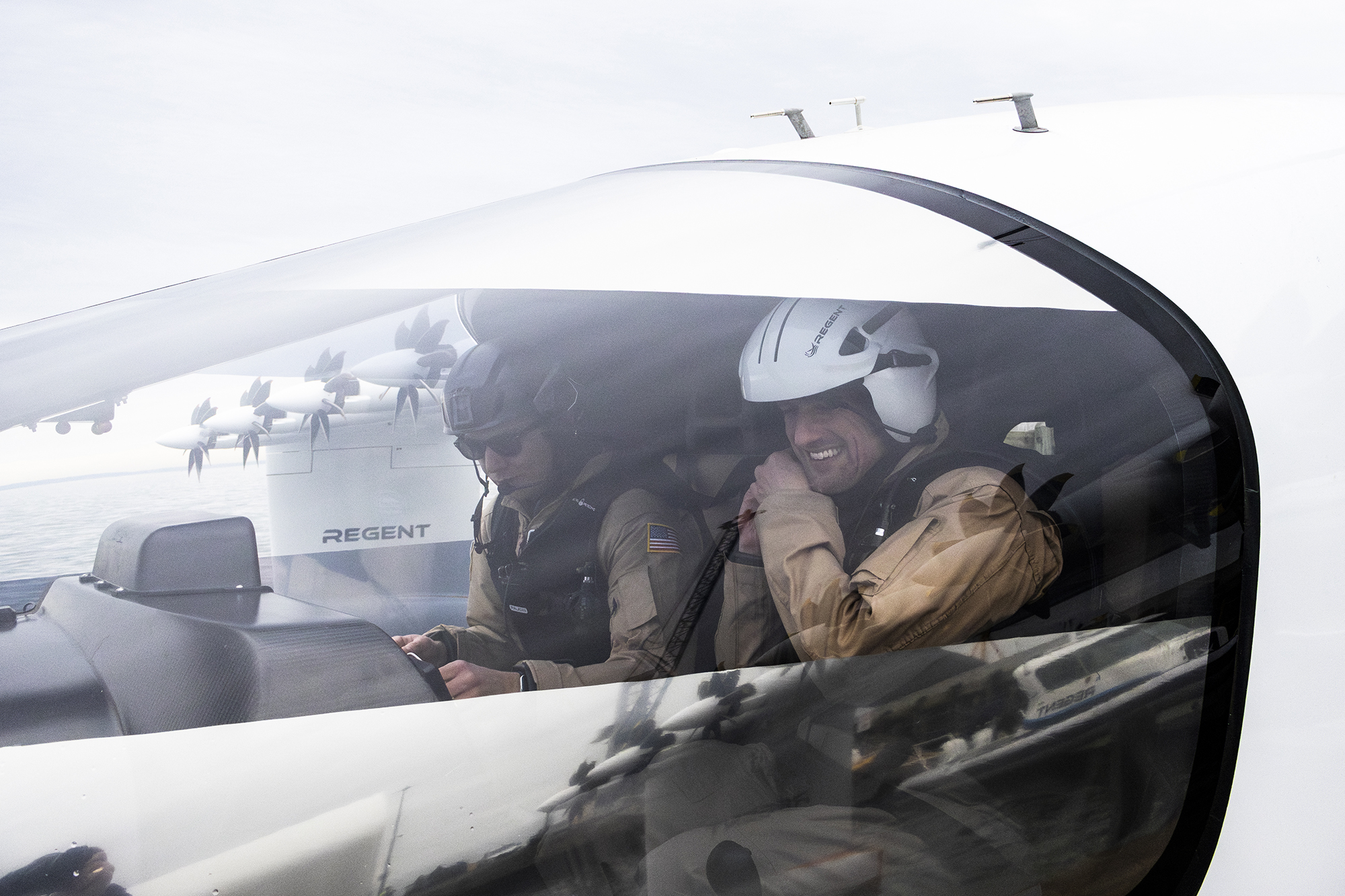
The Navy’s been studying seagliders for littoral ops. The Air Force frets over contested zones. But on April 13, 2026, the Marines—historically the force that thinks different—just flew something that looks like a distant cousin of the Soviet Caspian Sea Monster: REGENT’s Squire, a wing-in-ground-effect (WIG) drone demonstrator that skipped across Narragansett Bay in Rhode Island and proved a radical new category of unmanned platform actually works. And yes, it’s *exactly* as weird and tactical as it sounds.
Squire isn’t your grandpa’s seaplane. It’s not even your seaplane. It’s a 50-pound autonomous platform that exploits a physics trick the Soviets stumbled onto in the 1960s: fly close enough to water, and the compressed air between your wings and the surface literally lifts you higher and faster on less energy. That aerodynamic love letter is called ground effect, and it’s about to revolutionize how the Corps thinks about strike, reconnaissance, and resupply in contested seas.
During the demonstration, the scaled Squire lifted off the water, climbed to operational altitude, and transitioned into true flight—all the hallmarks needed to prove the concept. Top speed hit 40 knots, with hydrofoils tucked under the fuselage as altitude increased. To any observer watching from shore, it was a thumbnail version of something out of a 1980s Soviet weapons manual. To the Marines watching from a command center, it was the opening salvo in a new arms race.
What the Heck is a Wing-in-Ground-Effect Aircraft?
If you’ve ever noticed a helicopter seems to hover easier and faster right over water than in free air, you’ve observed ground effect. When a wing operates within about half its wingspan of a surface—ground or water—the downwash gets compressed. Air pressure builds underneath the wing; drag drops by roughly 25 percent. The aerodynamic efficiency skyrockets. You get more lift for less power. It’s Bernoulli’s principle meets wall-bouncing physics.
A WIG aircraft (or ekranoplan, the Russian term) takes that freak of nature and says: “Let’s *live* in that zone.” Instead of occasionally dipping into ground effect, a WIG spends its entire mission profile within about one-tenth of its wingspan above the surface. That means inches above the water. It’s not quite flying. It’s not quite surfing. It’s both, and neither, and it will wreck your intuition about how aircraft work.
The trade-off? A WIG can’t climb high. Can’t fly over rough seas (the chop destroys the effect). Can’t take off without a specific technique. But within those constraints, it moves *fast* and *far* on minimal fuel. Which, for a naval force operating in contested waters where speed and range mean everything, is exactly what you want.

The Soviet Playbook: Caspian Sea Monster
The concept isn’t new. In the 1960s, Soviet designer Rostislav Alexeyev’s team sketched out something they called the KM—the Korabl Maket, or “Ship-maquette.” It was a 544-ton monster with a 302-foot wingspan and a top speed of 340 mph. The West called it the Caspian Sea Monster. And it was revolutionary. It could carry payloads of ordnance or troops at speeds no conventional seaplane could match, flying so low the radar had to track it *above* the sea clutter.
Moscow deployed a follow-on design, the Lun-class ekranoplan, in the Caspian Flotilla from the 1980s onward. Armed with anti-ship missiles, it was a weapon that broke every rule of aviation. You couldn’t climb above storms. You couldn’t land on rough water. You *had* to operate in a specific corridor, over water, at speed. But if the adversary didn’t know what they were looking at, and if you owned the airspace, the Lun was nearly unstoppable: stealthy, fast, and carrying a payload with standoff range.
The Soviets abandoned the ekranoplan program after the Cold War. Western navies shrugged. “Cool idea, too weird, too limited,” the consensus went. But 60 years later, the Marines are watching the West drift toward peer conflict in the Pacific—where the seas *are* controlled, where speed and stealth matter enormously, where radar clutter is a tactical asset rather than a problem. And they’re thinking: maybe the Soviets weren’t crazy after all.
Why the Marines Care (Hint: It’s About Speed and Silence)
The U.S. Marine Corps operates in a shrinking bubble of time. In a peer-conflict scenario—a fight with China over Taiwan, or a brawl in the contested zone between the Strait of Malacca and the South China Sea—every sortie is timed in minutes, not hours. Resupply helicopters are slow and loud and visible. Fast Attack Craft (FACs) get spotted on radar. But a WIG drone? It stays below the radar horizon, rides the sea clutter, moves at 70+ knots, and carries enough payload to deliver ammunition, medical supplies, or a loitering munition to a forward patrol base.
Squire’s 50-pound payload might not sound like much. But consider the mission: ISR, or Intelligence Surveillance and Reconnaissance. One small sensor package. One night. One route across disputed water. Or: logistics resupply to a forward position. Or: combat search and rescue—a WIG moves fast enough to reach a downed pilot before the adversary does.
Matthew Koch, the Marine Corps Warfighting Lab project manager, was careful not to oversell the moment. But his conditional statement was telling: “If the technology proves out in Silent Swarm this July and full-size flight in early August, I will have a statement on how the Marines intend to use it in the Pacific.”

From Commercial to Military: The Viceroy to Squire Pipeline
REGENT wasn’t always building drones for the Marines. The company started with a commercial vision: seaglider passenger and cargo vessels for coastal routes. The Viceroy—the parent design—carries 12 passengers, cruises at 180 mph, and has a range of 180 nautical miles. It’s all-electric, which means it runs quiet. The same company that pitches coastal commuter routes to airlines also spins up a weaponized, autonomous variant for the defense market. That’s the defense industrial base working the way it’s supposed to.
Squire is the military variant: smaller, unmanned, autonomous, optimized for long endurance and sensor integration. The hydrofoil landing gear and fuselage shape? Borrowed straight from Viceroy testing. The ground-effect flight regime? Same physics, different scale. It’s a pattern we’re seeing across the industry: startups prove a commercial concept, *then* the military sees a use case and funds a derivative.
A New Aircraft Category for Littoral Warfare
Every branch of the U.S. military is asking: How do we fight in the Pacific without using traditional aircraft? Stealth fighters cost $80 million and need a 10,000-foot runway. Helicopters are slow, loud, and visible. Fast Attack Craft get spotted. Unmanned systems are trending toward either tiny loitering munitions or massive surveillance platforms.
A WIG drone sits in a gap. It’s unmanned, so no pilot, no life support, no ejection seat. It’s fast enough to matter tactically. It’s low enough to complicate enemy sensors. It’s autonomous enough to fly a pre-planned route without constant satellite handhold. And it can operate from any flat water—a lagoon, a strait, a coastline.
The Squire’s April 13 flight is the opening move. The full-size variant, scheduled to fly in early August, will carry a 50-pound sensor suite or ordnance package and prove the scaling. Silent Swarm 26, a two-week military innovation showcase in July, will demo the swarm capability—multiple Squires operating together. And if that works, the Marines will have a decision to make: Is this the future of littoral support in a contested Pacific?
Based on what we know about naval warfare in 2026, the answer is probably yes. The Soviet playbook, retired for 30 years, is about to get a 21st-century reboot. And this time, it’s all-electric, autonomous, and flying under the radar—literally.
Sources: The War Zone, REGENT Craft, U.S. Marine Corps Warfighting Lab


 English
0 Comments