
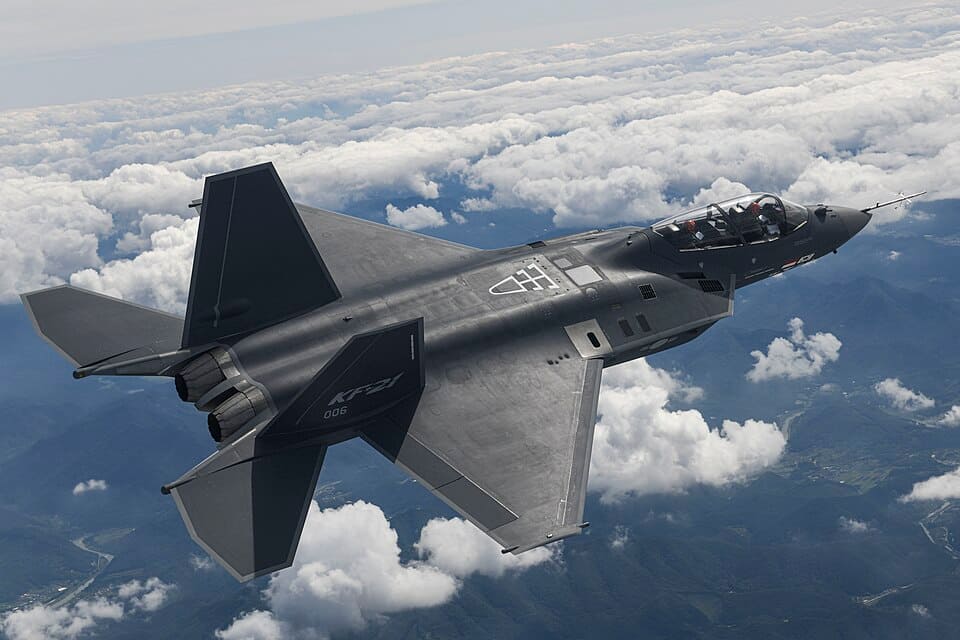
Quick Facts
- Aircraft: KAI KF-21 Boramae (“Young Hawk”) — 4.5-generation supersonic fighter
- First production rollout: March 25, 2026
- First production test flight: April 15, 2026
- 2026 deliveries: 8 aircraft
- IOC target: September 2026
- Total planned: 40 Block I + 80 Block II = 120 aircraft by 2032
- Unit cost: ~$65 million — significantly less than the F-35
- Engines: 2× General Electric F414-GE-400K afterburning turbofans
- Manufacturer: Korea Aerospace Industries (KAI), Sacheon
The Engineering
The KF-21 occupies a deliberate design niche. It is not a stealth fighter in the F-35 sense — Block I carries its weapons externally on ten hardpoints, sacrificing radar cross-section reduction for payload flexibility and lower development risk. It is not a legacy fourth-generation design either. The airframe incorporates reduced-observable shaping, an AESA radar, an indigenous infrared search-and-track system, and a sensor fusion architecture that puts it firmly in the 4.5-generation category. Two General Electric F414-GE-400K turbofans provide a combined 22,000 pounds of afterburning thrust — the same engine family that powers the F/A-18E/F Super Hornet, adapted and license-produced with Korean content. Maximum speed exceeds Mach 1.8. Combat radius with a representative weapons load is estimated at 800 kilometres. Block II, expected from 2028 onward, will introduce internal weapons bays — moving the KF-21 closer to true low-observable capability. The transition from external to internal carriage is the most technically demanding phase of the programme, requiring significant structural and software modifications to an airframe that was designed from the outset to accommodate them.Strategic Context
South Korea’s motivation for the KF-21 is both military and industrial. The ROKAF operates 60 F-35As and over 100 ageing F-16s and F-5s. The KF-21 is designed to replace the older types — not to duplicate the F-35, but to complement it. The F-35 handles the high-end stealth penetration mission. The KF-21 handles the volume work: air superiority patrols, ground attack, maritime strike, and the sheer numbers required to cover the Korean Peninsula. At approximately $65 million per unit, the KF-21 costs roughly half of an F-35A. For a nation facing a nuclear-armed adversary across a 250-kilometre border, the ability to field more airframes at lower cost is not a luxury. It is a strategic necessity. The industrial dimension is equally significant. South Korea is now the world’s fourth-largest arms exporter, and the KF-21 is designed from the outset for the export market. Indonesia was originally a 20% development partner — a relationship that has since been restructured — but interest from other Southeast Asian and Middle Eastern air forces is reported to be strong. A combat-capable, attractively priced fighter with no ITAR restrictions on most components is a compelling proposition for nations that cannot buy the F-35.What Comes Next
The eight aircraft delivered in 2026 will be assigned to the ROKAF’s test and evaluation squadron before transferring to an operational unit for IOC declaration in September. Weapons integration testing — including the Diehl IRIS-T short-range missile and the MBDA Meteor beyond-visual-range missile — is ongoing, with full weapons clearance expected by the end of the year. Production rate will ramp from 8 aircraft in 2026 to 12 per year by 2028, with KAI’s Sacheon facility expanding capacity to support both domestic and potential export orders simultaneously. The first foreign customer announcement, if it comes, is expected within the next 18 months. Fifty-six years after South Korea assembled its first F-5 Freedom Fighter under license, the country is delivering fighters it designed and built from a blank sheet of paper. The Boramae is airborne.Sources: Army Recognition, Aerotime, Air Data News, Aerospace Global News
 English
0 Comments